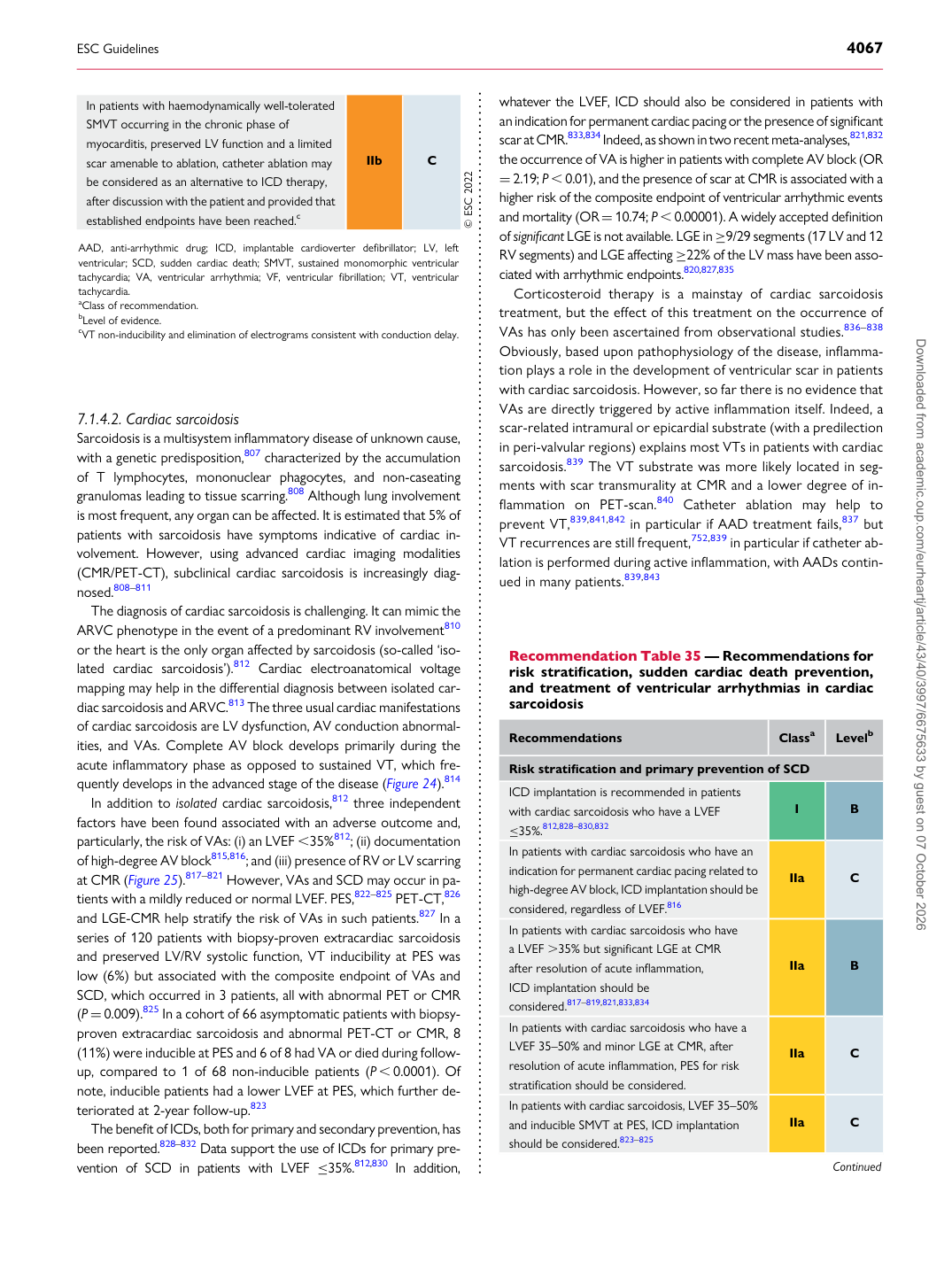
p.71 抽出テキスト
7.1.4.2 Cardiac sarcoidosis

Sarcoidosis is a multisystem inflammatory disease of unknown cause, with a genetic predisposition,807 characterized by the accumulation of T lymphocytes, mononuclear phagocytes, and non-caseating granulomas leading to tissue scarring.808 Although lung involvement is most frequent, any organ can be affected. It is estimated that 5% of patients with sarcoidosis have symptoms indicative of cardiac involvement. However, using advanced cardiac imaging modalities (CMR/PET-CT), subclinical cardiac sarcoidosis is increasingly diagnosed.808–811 The diagnosis of cardiac sarcoidosis is challenging. It can mimic the ARVC phenotype in the event of a predominant RV involvement810 or the heart is the only organ affected by sarcoidosis (so-called ‘isolated cardiac sarcoidosis’).812 Cardiac electroanatomical voltage mapping may help in the differential diagnosis between isolated cardiac sarcoidosis and ARVC.813 The three usual cardiac manifestations of cardiac sarcoidosis are LV dysfunction, AV conduction abnormalities, and VAs. Complete AV block develops primarily during the acute inflammatory phase as opposed to sustained VT, which frequently develops in the advanced stage of the disease (Figure 24).814 In addition to isolated cardiac sarcoidosis,812 three independent factors have been found associated with an adverse outcome and, particularly, the risk of VAs: (i) an LVEF ,35%812; (ii) documentation of high-degree AV block815,816; and (iii) presence of RV or LV scarring at CMR (Figure 25).817–821 However, VAs and SCD may occur in patients with a mildly reduced or normal LVEF. PES,822–825 PET-CT,826 and LGE-CMR help stratify the risk of VAs in such patients.827 In a series of 120 patients with biopsy-proven extracardiac sarcoidosis and preserved LV/RV systolic function, VT inducibility at PES was low (6%) but associated with the composite endpoint of VAs and SCD, which occurred in 3 patients, all with abnormal PET or CMR (P = 0.009).825 In a cohort of 66 asymptomatic patients with biopsyproven extracardiac sarcoidosis and abnormal PET-CT or CMR, 8 (11%) were inducible at PES and 6 of 8 had VA or died during followup, compared to 1 of 68 non-inducible patients (P , 0.0001). Of note, inducible patients had a lower LVEF at PES, which further deteriorated at 2-year follow-up.823 The benefit of ICDs, both for primary and secondary prevention, has been reported.828–832 Data support the use of ICDs for primary prevention of SCD in patients with LVEF ≤35%.812,830 In addition, whatever the LVEF, ICD should also be considered in patients with anindication for permanent cardiacpacingor the presence of significant scaratCMR.833,834Indeed,asshownintwo recent meta-analyses,821,832

the occurrence of VA is higher in patients with complete AV block (OR = 2.19; P , 0.01), and the presence of scar at CMR is associated with a higher risk of the composite endpoint of ventricular arrhythmic events and mortality (OR= 10.74; P , 0.00001). A widely accepted definition of significant LGE is not available. LGE in ≥9/29 segments (17 LV and 12 RV segments) and LGE affecting ≥22% of the LV mass have been associated with arrhythmic endpoints.820,827,835 Corticosteroid therapy is a mainstay of cardiac sarcoidosis treatment, but the effect of this treatment on the occurrence of VAs has only been ascertained from observational studies.836–838 Obviously, based upon pathophysiology of the disease, inflammation plays a role in the development of ventricular scar in patients with cardiac sarcoidosis. However, so far there is no evidence that VAs are directly triggered by active inflammation itself. Indeed, a scar-related intramural or epicardial substrate (with a predilection in peri-valvular regions) explains most VTs in patients with cardiac sarcoidosis.839 The VT substrate was more likely located in segments with scar transmurality at CMR and a lower degree of inflammation on PET-scan.840 Catheter ablation may help to prevent VT,839,841,842 in particular if AAD treatment fails,837 but VT recurrences are still frequent,752,839 in particular if catheter ablation is performed during active inflammation, with AADs continued in many patients.839,843

In patients with haemodynamically well-tolerated SMVT occurring in the chronic phase of myocarditis, preserved LV function and a limited scar amenable to ablation, catheter ablation may be considered as an alternative to ICD therapy, after discussion with the patient and provided that established endpoints have been reached.c IIb C © ESC 2022

AAD, anti-arrhythmic drug; ICD, implantable cardioverter defibrillator; LV, left ventricular; SCD, sudden cardiac death; SMVT, sustained monomorphic ventricular tachycardia; VA, ventricular arrhythmia; VF, ventricular fibrillation; VT, ventricular tachycardia. aClass of recommendation. bLevel of evidence. cVT non-inducibility and elimination of electrograms consistent with conduction delay.

Recommendation Table 35 — Recommendations for risk stratification, sudden cardiac death prevention, and treatment of ventricular arrhythmias in cardiac sarcoidosis

Recommendations Classa Levelb

Risk stratification and primary prevention of SCD ICD implantation is recommended in patients with cardiac sarcoidosis who have a LVEF ≤35%.812,828–830,832 I B In patients with cardiac sarcoidosis who have an indication for permanent cardiac pacing related to high-degree AV block, ICD implantation should be considered, regardless of LVEF.816 IIa C In patients with cardiac sarcoidosis who have a LVEF .35% but significant LGE at CMR after resolution of acute inflammation, ICD implantation should be considered.817–819,821,833,834 IIa B In patients with cardiac sarcoidosis who have a LVEF 35–50% and minor LGE at CMR, after resolution of acute inflammation, PES for risk stratification should be considered. IIa C In patients with cardiac sarcoidosis, LVEF 35–50% and inducible SMVT at PES, ICD implantation should be considered.823–825 IIa C

Continued Downloaded from academic.oup.com/eurheartj/article/43/40/3997/6675633 by guest on 07 October 2026