p.7 抽出テキスト
RCM Restrictive cardiomyopathy RCT Randomized control trial RV Right ventricular RVOT Right ventricle outflow tract SADS Sudden arrhythmic death syndrome SaECG Signal-averaged ECG SCA Sudden cardiac arrest SCD Sudden cardiac death SD Sudden death SGLT2 Sodium–glucose co-transporter 2 SHD Structural heart disease S-ICD Subcutaneous implantable cardioverter defibrillator SMVT Sustained monomorphic ventricular tachycardia SPTV Sustained polymorphic ventricular tachycardia SQTS Short QT syndrome STEMI ST elevation myocardial infarction SVT Supraventricular tachycardia TAVI Transcatheter aortic valve implantation TdP Torsades de pointes TOF Tetralogy of Fallot VA Ventricular arrhythmia VF Ventricular fibrillation VT Ventricular tachycardia WCD Wearable cardioverter defibrillator WPW Wolff–Parkinson–White

1 Preamble

Guidelines summarize and evaluate available evidence with the aim of assisting health professionals in proposing the best management strategies for an individual patient with a given condition. Guidelines and their recommendations should facilitate decision making of health professionals in their daily practice. However, guidelines are not a substitute for the patient’s relationship with their practitioner. The final decisions concerning an individual patient must be made by the responsible health professional(s), based on what they consider to be the most appropriate in the circumstances. These decisions are made in consultation with the patient and caregiver as appropriate.

Guidelines are intended for use by health professionals. To ensure that all users have access to the most recent recommendations, the ESC makes its guidelines freely available. The ESC warns readers that the technical language may be misinterpreted and declines any responsibility in this respect. A great number of guidelines have been issued in recent years by the ESC. Because of their impact on clinical practice, quality criteria for the development of guidelines have been established to make all decisions transparent to the user. The recommendations for formulating and issuing ESC Guidelines can be found on the ESC website (https://www.escardio.org/Guidelines). The ESC Guidelines represent the official position of the ESC on a given topic and are regularly updated. In addition to the publication of Clinical Practice Guidelines, the ESC carries out the EURObservational Research Programme of international registries of cardiovascular diseases and interventions that are essential to assess diagnostic/therapeutic processes, use of resources, and adherence to guidelines. These registries aim at providing a better understanding of medical practice in Europe and around the world, based on high-quality data collected during routine clinical practice. Furthermore, the ESC develops sets of quality indicators (QIs), which are tools to evaluate the level of implementation of the guidelines and may be used by the ESC, hospitals, healthcare providers, and professionals to measure clinical practice, and in educational

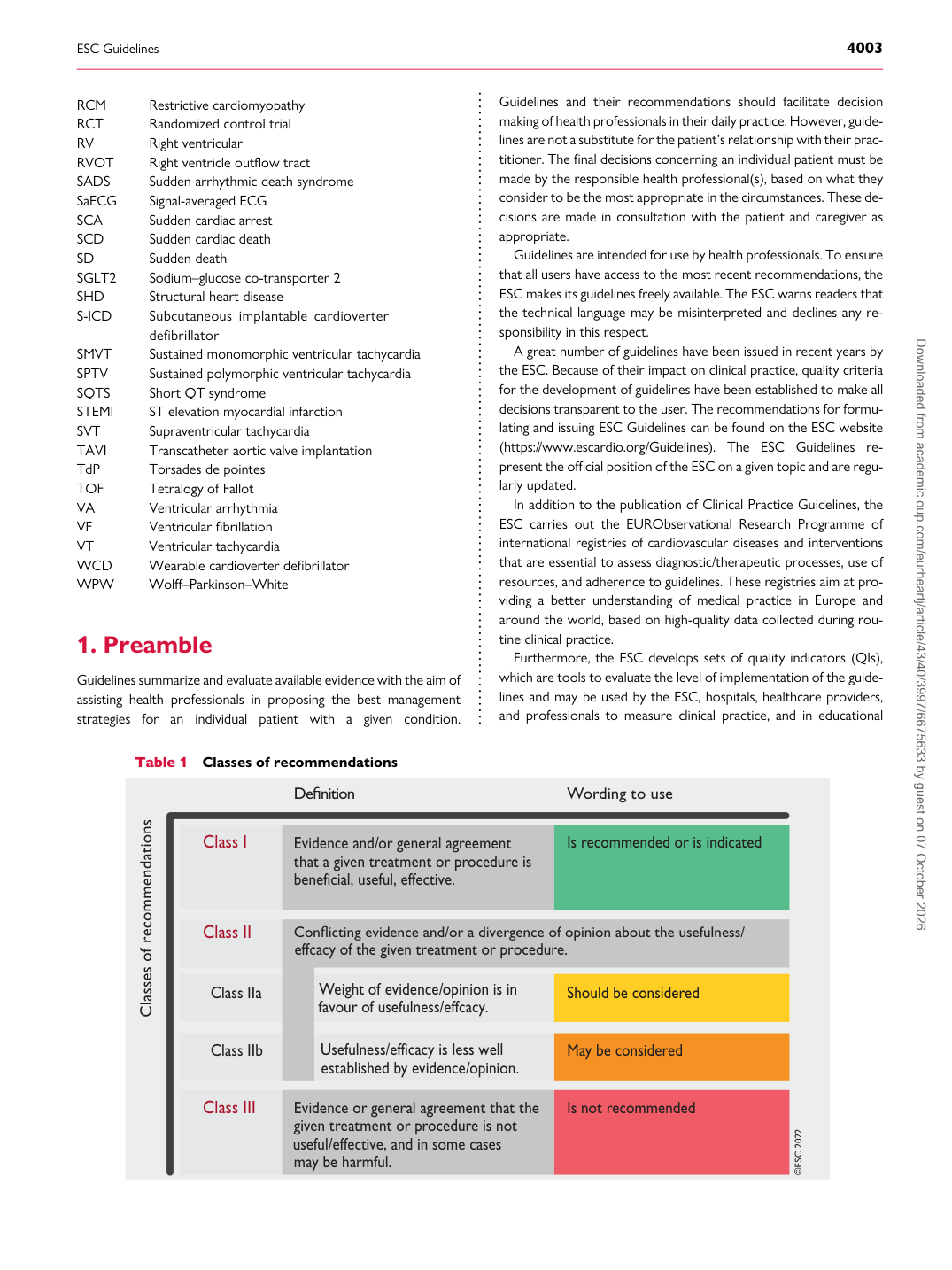
Table 1 Classes of recommendations

©ESC 2022

Classes of recommendations Class I Evide

beneficial, useful, effective.

effcacy of the given treatment or procedure.

nce and/or general agreement that a given treatment or procedure is

Conflicting evidence and/or a divergence of opinion about the usefulness/

Is recommended or is indicated

Wording to use Definition

Class III Evidence or general agreement that the given tr useful/effective, and in some cases

eatment or procedure is not

may be harmful. Is not recommended

Class IIb

established by evidence/opinion. May be considered

Class IIa W favour of usefulness/effcacy.

eight of

Usefulness/efficacy is less well

evidence/opinion is in Should be considered

Class II

© ESC 2022 Downloaded from academic.oup.com/eurheartj/article/43/40/3997/6675633 by guest on 07 October 2026