p.69 抽出テキスト
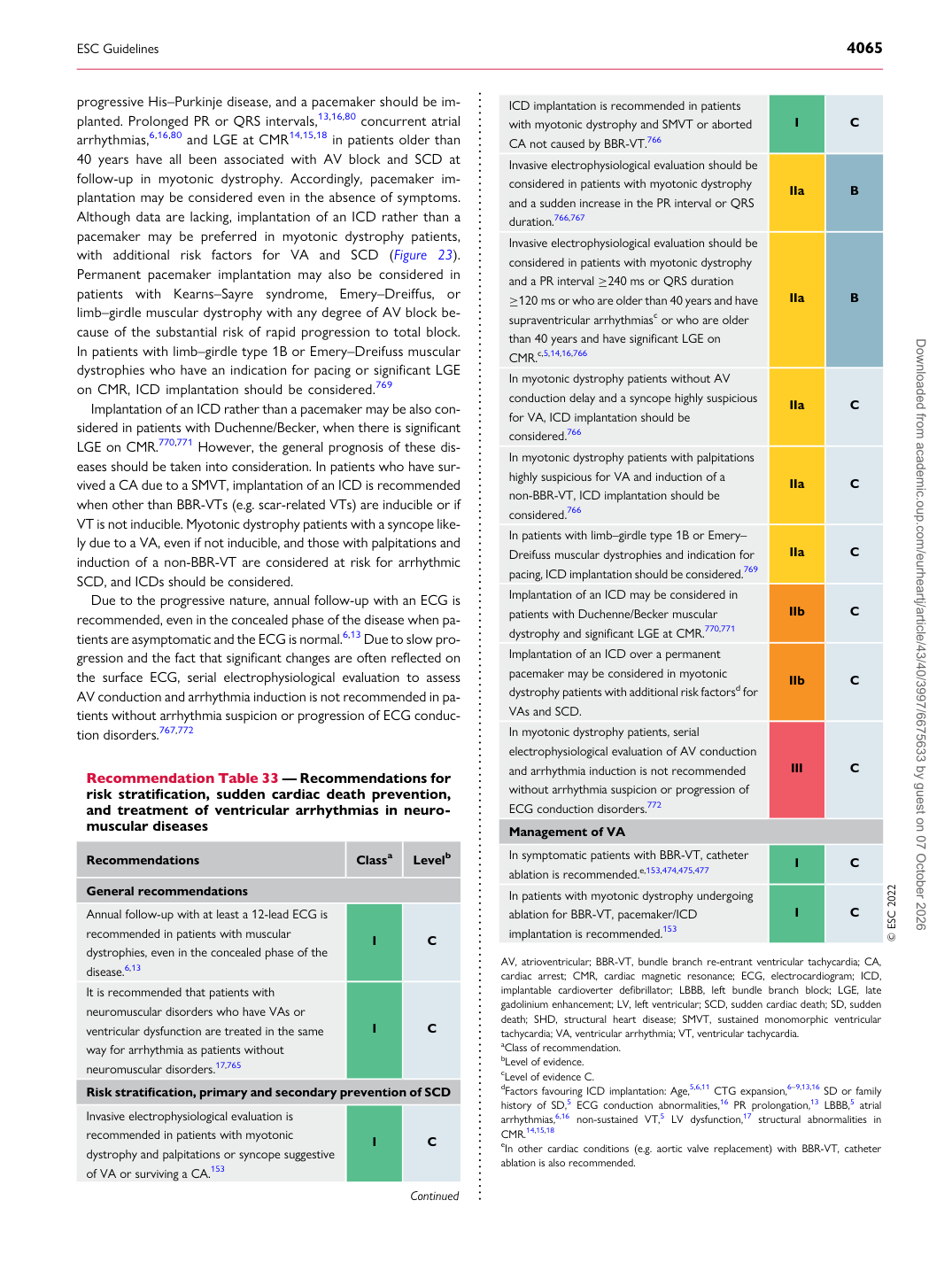
progressive His–Purkinje disease, and a pacemaker should be implanted. Prolonged PR or QRS intervals,13,16,80 concurrent atrial arrhythmias,6,16,80 and LGE at CMR14,15,18 in patients older than 40 years have all been associated with AV block and SCD at follow-up in myotonic dystrophy. Accordingly, pacemaker implantation may be considered even in the absence of symptoms. Although data are lacking, implantation of an ICD rather than a pacemaker may be preferred in myotonic dystrophy patients, with additional risk factors for VA and SCD (Figure 23). Permanent pacemaker implantation may also be considered in patients with Kearns–Sayre syndrome, Emery–Dreiffus, or limb–girdle muscular dystrophy with any degree of AV block because of the substantial risk of rapid progression to total block. In patients with limb–girdle type 1B or Emery–Dreifuss muscular dystrophies who have an indication for pacing or significant LGE on CMR, ICD implantation should be considered.769 Implantation of an ICD rather than a pacemaker may be also considered in patients with Duchenne/Becker, when there is significant LGE on CMR.770,771 However, the general prognosis of these diseases should be taken into consideration. In patients who have survived a CA due to a SMVT, implantation of an ICD is recommended when other than BBR-VTs (e.g. scar-related VTs) are inducible or if VT is not inducible. Myotonic dystrophy patients with a syncope likely due to a VA, even if not inducible, and those with palpitations and induction of a non-BBR-VT are considered at risk for arrhythmic SCD, and ICDs should be considered. Due to the progressive nature, annual follow-up with an ECG is recommended, even in the concealed phase of the disease when patients are asymptomatic and the ECG is normal.6,13 Due to slow progression and the fact that significant changes are often reflected on the surface ECG, serial electrophysiological evaluation to assess AV conduction and arrhythmia induction is not recommended in patients without arrhythmia suspicion or progression of ECG conduction disorders.767,772

Recommendation Table 33 — Recommendations for risk stratification, sudden cardiac death prevention, and treatment of ventricular arrhythmias in neuromuscular diseases

Recommendations Classa Levelb

General recommendations Annual follow-up with at least a 12-lead ECG is recommended in patients with muscular dystrophies, even in the concealed phase of the disease.6,13 I C It is recommended that patients with neuromuscular disorders who have VAs or ventricular dysfunction are treated in the same way for arrhythmia as patients without neuromuscular disorders.17,765 I C Risk stratification, primary and secondary prevention of SCD Invasive electrophysiological evaluation is recommended in patients with myotonic dystrophy and palpitations or syncope suggestive of VA or surviving a CA.153 I C

Continued ICD implantation is recommended in patients

with myotonic dystrophy and SMVT or aborted CA not caused by BBR-VT.766 I C Invasive electrophysiological evaluation should be considered in patients with myotonic dystrophy and a sudden increase in the PR interval or QRS duration.766,767 IIa B Invasive electrophysiological evaluation should be considered in patients with myotonic dystrophy and a PR interval ≥240 ms or QRS duration ≥120 ms or who are older than 40 years and have supraventricular arrhythmiasc or who are older than 40 years and have significant LGE on CMR.c,5,14,16,766 IIa B In myotonic dystrophy patients without AV conduction delay and a syncope highly suspicious for VA, ICD implantation should be considered.766 IIa C In myotonic dystrophy patients with palpitations highly suspicious for VA and induction of a non-BBR-VT, ICD implantation should be considered.766 IIa C In patients with limb–girdle type 1B or Emery– Dreifuss muscular dystrophies and indication for pacing, ICD implantation should be considered.769 IIa C Implantation of an ICD may be considered in patients with Duchenne/Becker muscular dystrophy and significant LGE at CMR.770,771 IIb C Implantation of an ICD over a permanent pacemaker may be considered in myotonic dystrophy patients with additional risk factorsd for VAs and SCD. IIb C In myotonic dystrophy patients, serial electrophysiological evaluation of AV conduction and arrhythmia induction is not recommended without arrhythmia suspicion or progression of ECG conduction disorders.772 III C Management of VA In symptomatic patients with BBR-VT, catheter ablation is recommended.e,153,474,475,477 I C In patients with myotonic dystrophy undergoing ablation for BBR-VT, pacemaker/ICD implantation is recommended.153 I C © ESC 2022

AV, atrioventricular; BBR-VT, bundle branch re-entrant ventricular tachycardia; CA, cardiac arrest; CMR, cardiac magnetic resonance; ECG, electrocardiogram; ICD, implantable cardioverter defibrillator; LBBB, left bundle branch block; LGE, late gadolinium enhancement; LV, left ventricular; SCD, sudden cardiac death; SD, sudden death; SHD, structural heart disease; SMVT, sustained monomorphic ventricular tachycardia; VA, ventricular arrhythmia; VT, ventricular tachycardia. aClass of recommendation. bLevel of evidence. cLevel of evidence C. dFactors favouring ICD implantation: Age,5,6,11 CTG expansion,6–9,13,16 SD or family history of SD,5 ECG conduction abnormalities,16 PR prolongation,13 LBBB,5 atrial arrhythmias,6,16 non-sustained VT,5 LV dysfunction,17 structural abnormalities in CMR.14,15,18 eIn other cardiac conditions (e.g. aortic valve replacement) with BBR-VT, catheter ablation is also recommended. Downloaded from academic.oup.com/eurheartj/article/43/40/3997/6675633 by guest on 07 October 2026