p.66 抽出テキスト
Documented NSVT during exercise test is very rare, but was associated with a higher risk of SCD.732 Additional risk factors have been identified and a 5-year SCD risk stratification score based on seven factors (age, LV wall thickness, LA size, LVOT gradient, NSVT, unexplained syncope, and family history of SCD) has been developed85 (HCM Risk-SCD: https://doc2do.com/hcm/webHCM.html) and externally validated.85,728,729 The calculator is not intended for use in elite athletes, or in individuals with metabolic or infiltrative diseases, or after myectomy or alcohol septal ablation.85 Additional factors not captured by the Risk-SCD model should also be considered in patients with intermediate or low calculated risk, including LV systolic dysfunction, apical aneurysm, extensive LGE on CMR, and presence of single or multiple sarcomeric mutations (Figure 22).716,717,722,736–739 Extensive LGE on CMR defined as ≥15% of LV mass has been suggested as good predictor of SCD in adults. However, thresholds may be difficult to use because LGE quantification is dependent on CMR acquisition, type, and amount of contrast. Periodic reassessment is mandatory as part of the longitudinal evaluation of patients. VA induced by PES is considered non-specific, although conflicting results have been reported.740,741 In children few data on primary prevention were available until the recent development of scores and related risk calculators.83,84 The HCM Risk-Kids score84 has been developed and externally validated742 specifically in children with HCM (1–16 years of age) and includes unexplained syncope, maximal LV wall thickness, large left atrial diameter, low LVOT gradient, and NSVT (https://hcmriskkids. org). In contrast to adults, including age and family history of SCD did not improve the performance of the paediatric model. Patients with prior VF or sustained VT, known inborn errors of metabolism, and syndromic causes of HCM were excluded. The predictive value of LGE in children is less defined, although preliminary data were reported.743

7.1.3.3.2 Treatment to prevent ventricular arrhythmia recur-

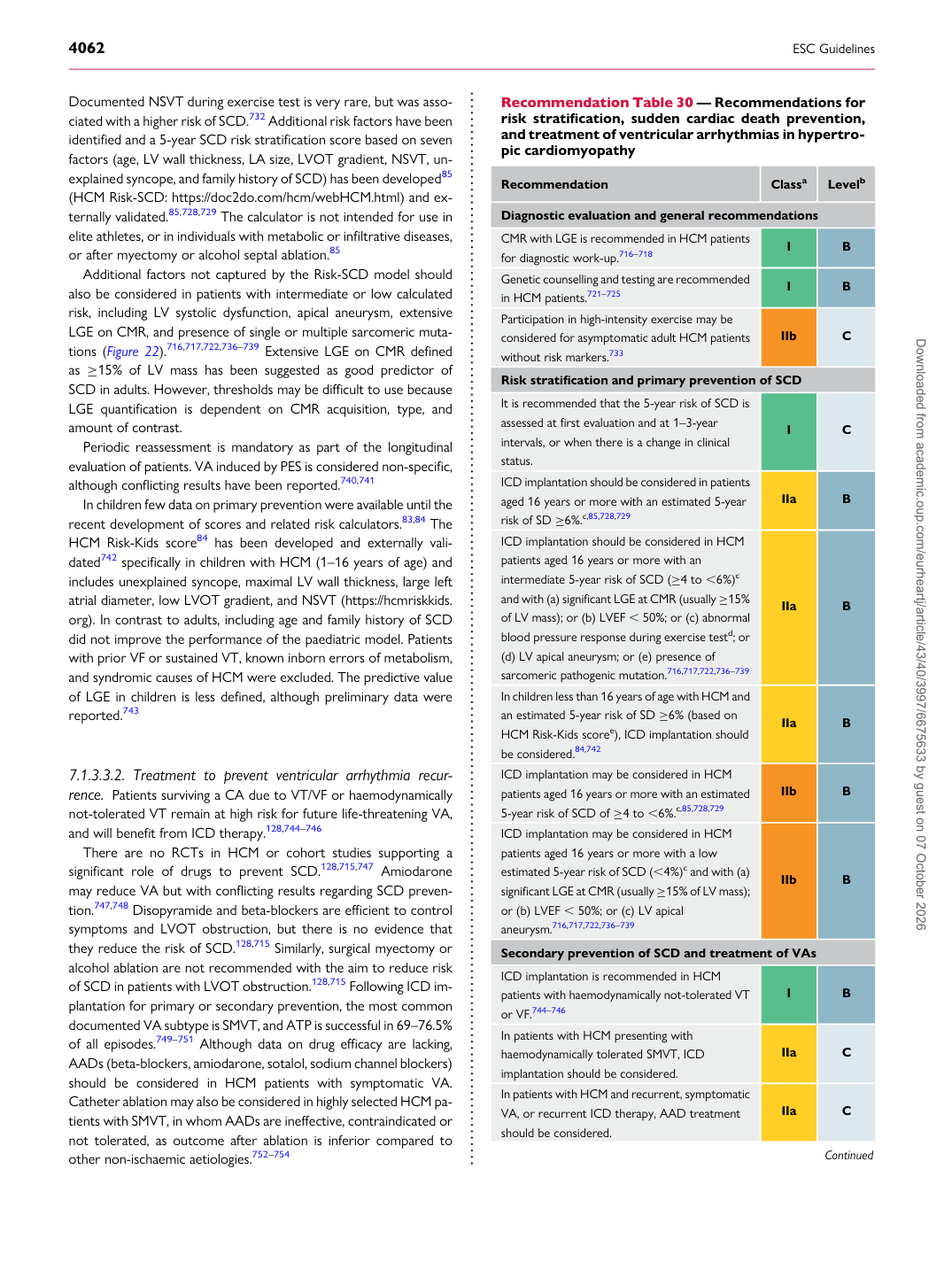
rence. Patients surviving a CA due to VT/VF or haemodynamically not-tolerated VT remain at high risk for future life-threatening VA, and will benefit from ICD therapy.128,744–746 There are no RCTs in HCM or cohort studies supporting a significant role of drugs to prevent SCD.128,715,747 Amiodarone may reduce VA but with conflicting results regarding SCD prevention.747,748 Disopyramide and beta-blockers are efficient to control symptoms and LVOT obstruction, but there is no evidence that they reduce the risk of SCD.128,715 Similarly, surgical myectomy or alcohol ablation are not recommended with the aim to reduce risk of SCD in patients with LVOT obstruction.128,715 Following ICD implantation for primary or secondary prevention, the most common documented VA subtype is SMVT, and ATP is successful in 69–76.5% of all episodes.749–751 Although data on drug efficacy are lacking, AADs (beta-blockers, amiodarone, sotalol, sodium channel blockers) should be considered in HCM patients with symptomatic VA. Catheter ablation may also be considered in highly selected HCM patients with SMVT, in whom AADs are ineffective, contraindicated or not tolerated, as outcome after ablation is inferior compared to other non-ischaemic aetiologies.752–754 Recommendation Table 30 — Recommendations for risk stratification, sudden cardiac death prevention, and treatment of ventricular arrhythmias in hypertropic cardiomyopathy

Recommendation Classa Levelb

Diagnostic evaluation and general recommendations CMR with LGE is recommended in HCM patients for diagnostic work-up.716–718 I B Genetic counselling and testing are recommended in HCM patients.721–725 I B Participation in high-intensity exercise may be considered for asymptomatic adult HCM patients without risk markers.733 IIb C Risk stratification and primary prevention of SCD It is recommended that the 5-year risk of SCD is assessed at first evaluation and at 1–3-year intervals, or when there is a change in clinical status. I C ICD implantation should be considered in patients aged 16 years or more with an estimated 5-year risk of SD ≥6%.c,85,728,729 IIa B ICD implantation should be considered in HCM patients aged 16 years or more with an intermediate 5-year risk of SCD (≥4 to ,6%)c and with (a) significant LGE at CMR (usually ≥15% of LV mass); or (b) LVEF , 50%; or (c) abnormal blood pressure response during exercise testd; or (d) LV apical aneurysm; or (e) presence of sarcomeric pathogenic mutation.716,717,722,736–739 IIa B In children less than 16 years of age with HCM and an estimated 5-year risk of SD ≥6% (based on HCM Risk-Kids scoree), ICD implantation should be considered.84,742 IIa B ICD implantation may be considered in HCM patients aged 16 years or more with an estimated 5-year risk of SCD of ≥4 to ,6%.c,85,728,729 IIb B ICD implantation may be considered in HCM patients aged 16 years or more with a low estimated 5-year risk of SCD (,4%)c and with (a) significant LGE at CMR (usually ≥15% of LV mass); or (b) LVEF , 50%; or (c) LV apical aneurysm.716,717,722,736–739 IIb B Secondary prevention of SCD and treatment of VAs ICD implantation is recommended in HCM patients with haemodynamically not-tolerated VT or VF.744–746 I B In patients with HCM presenting with haemodynamically tolerated SMVT, ICD implantation should be considered. IIa C In patients with HCM and recurrent, symptomatic VA, or recurrent ICD therapy, AAD treatment should be considered. IIa C

Continued Downloaded from academic.oup.com/eurheartj/article/43/40/3997/6675633 by guest on 07 October 2026