p.64 抽出テキスト
7.1.3.2.2 Treatment. Up to 97.4% of all VA episodes in ARVC ICD

recipients are SMVT. The very high termination rate by ATP (92% of all episodes) independent from VT cycle length strongly supports devices with the capability for ATP.698 S-ICDs reduce lead-related complications and have been proven to effectively shock terminate VA in small cohorts of ARVC patients during short-term follow-up.707 Additional treatment to supress VA is often required. Although not confirmed by clinical data, beta-blockers are recommended as first-line therapy in symptomatic patients. Data on AADs to prevent VT recurrence are limited to small observational studies and registries. In general, AAD therapy has limited efficacy. Although sotalol was effective to prevent inducibility of VT,708 it did not supress clinically relevant arrhythmias.690,708 Treatment with amiodarone or class 1 drugs was associated with a trend to lower VT recurrence as compared with sotalol.709 The addition of flecainide to beta-blockers/sotalol was beneficial in a small cohort.710 Catheter ablation provides an alternative. Endocardial and adjuvant epicardial substrate ablation, if needed, has been associated with promising VT-free survival. Potential procedural risks, drug side effects, and the patient’s preference need to be taken into consideration.482

7.1.3.3 Hypertrophic cardiomyopathy

HCM is characterized by increased LV wall thickness not explained by abnormal loading conditions (such as hypertension or valvular disease).128,715 Because the natural history and management differs according to the underlying aetiology of LVH, diagnostic work-up is of paramount importance (see Section 7.1.3.5) and includes CMR and genetic testing.716–725 HCM is usually caused by a mutation with autosomal dominant inheritance, supporting cardiac screening in first-degree relatives, in parallel with genetic testing in the index patient. A sarcomeric gene mutation is identified in 30–60%, most frequently in patients who are younger at diagnosis or with a family history of HCM.646,722 The estimated prevalence of HCM in adults is 1 in 500.726 In children, the prevalence is much lower.

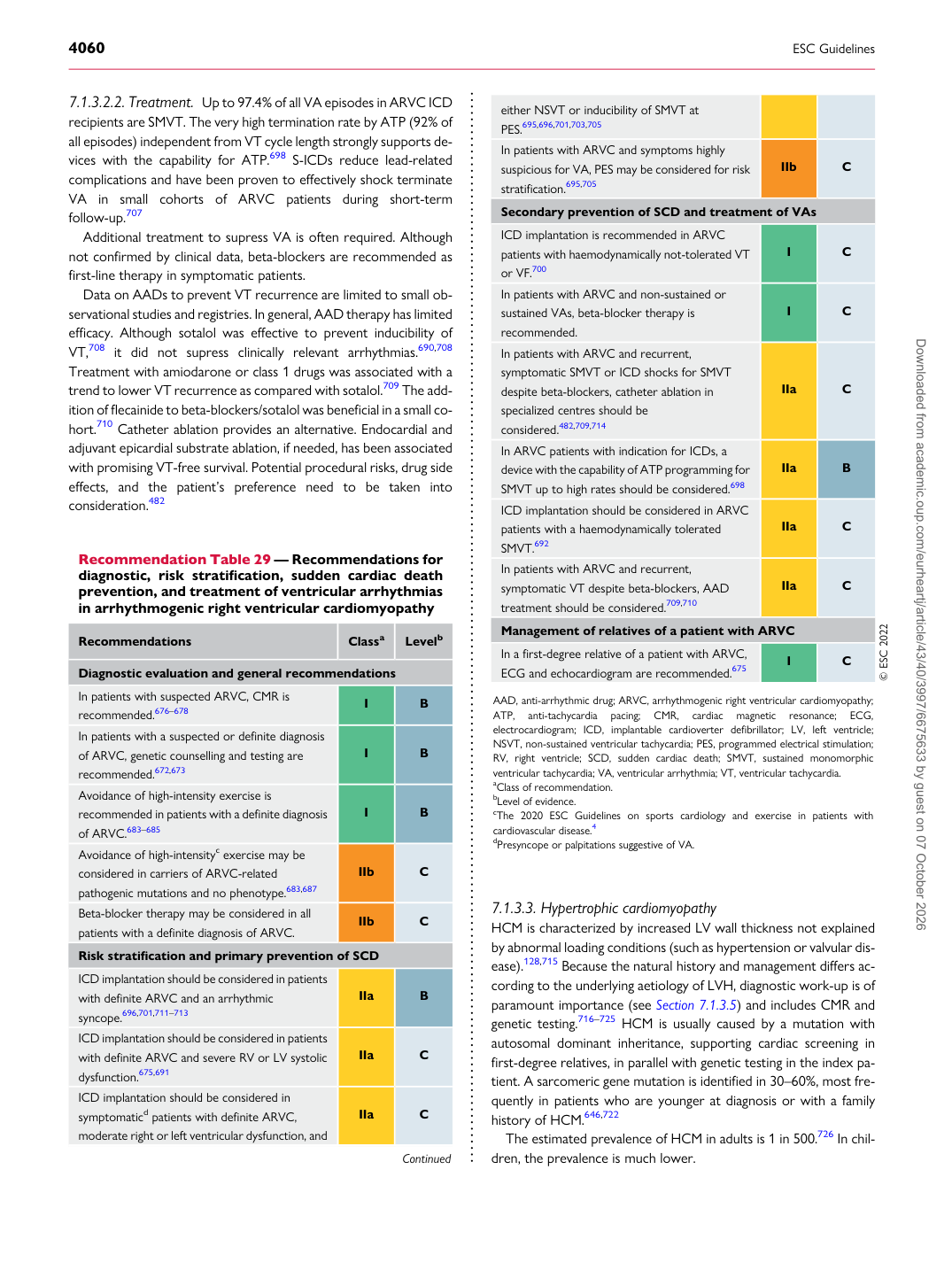
Recommendation Table 29 — Recommendations for diagnostic, risk stratification, sudden cardiac death prevention, and treatment of ventricular arrhythmias in arrhythmogenic right ventricular cardiomyopathy

Recommendations Classa Levelb

Diagnostic evaluation and general recommendations In patients with suspected ARVC, CMR is recommended.676–678 I B In patients with a suspected or definite diagnosis of ARVC, genetic counselling and testing are recommended.672,673 I B Avoidance of high-intensity exercise is recommended in patients with a definite diagnosis of ARVC.683–685 I B Avoidance of high-intensityc exercise may be considered in carriers of ARVC-related pathogenic mutations and no phenotype.683,687 IIb C Beta-blocker therapy may be considered in all patients with a definite diagnosis of ARVC. IIb C Risk stratification and primary prevention of SCD ICD implantation should be considered in patients with definite ARVC and an arrhythmic syncope.696,701,711–713 IIa B ICD implantation should be considered in patients with definite ARVC and severe RV or LV systolic dysfunction.675,691 IIa C ICD implantation should be considered in symptomaticd patients with definite ARVC, moderate right or left ventricular dysfunction, and IIa C

Continued either NSVT or inducibility of SMVT at

PES.695,696,701,703,705 In patients with ARVC and symptoms highly suspicious for VA, PES may be considered for risk stratification.695,705 IIb C Secondary prevention of SCD and treatment of VAs ICD implantation is recommended in ARVC patients with haemodynamically not-tolerated VT or VF.700 I C In patients with ARVC and non-sustained or sustained VAs, beta-blocker therapy is recommended. I C In patients with ARVC and recurrent, symptomatic SMVT or ICD shocks for SMVT despite beta-blockers, catheter ablation in specialized centres should be considered.482,709,714 IIa C In ARVC patients with indication for ICDs, a device with the capability of ATP programming for SMVT up to high rates should be considered.698 IIa B ICD implantation should be considered in ARVC patients with a haemodynamically tolerated SMVT.692 IIa C In patients with ARVC and recurrent, symptomatic VT despite beta-blockers, AAD treatment should be considered.709,710 IIa C Management of relatives of a patient with ARVC In a first-degree relative of a patient with ARVC, ECG and echocardiogram are recommended.675 I C © ESC 2022

AAD, anti-arrhythmic drug; ARVC, arrhythmogenic right ventricular cardiomyopathy; ATP, anti-tachycardia pacing; CMR, cardiac magnetic resonance; ECG, electrocardiogram; ICD, implantable cardioverter defibrillator; LV, left ventricle; NSVT, non-sustained ventricular tachycardia; PES, programmed electrical stimulation; RV, right ventricle; SCD, sudden cardiac death; SMVT, sustained monomorphic ventricular tachycardia; VA, ventricular arrhythmia; VT, ventricular tachycardia. aClass of recommendation. bLevel of evidence. cThe 2020 ESC Guidelines on sports cardiology and exercise in patients with cardiovascular disease.4 dPresyncope or palpitations suggestive of VA. Downloaded from academic.oup.com/eurheartj/article/43/40/3997/6675633 by guest on 07 October 2026