p.62 抽出テキスト
7.1.3.2 Arrhythmogenic right ventricular cardiomyopathy

ARVC is an inherited disease characterized by fibrofatty myocardial replacement.670 The prevalence ranges from 1:1000 to 1:5000 individuals, with male predominance among probands.671 Patients with SCD/VF at first presentation are typically younger (median age 23 [range 13–57]) compared to those who present with a SMVT (median age 36 years [range 14–78]).672 ARVC is caused by pathogenic mutations in desmosomal genes and less commonly in non-desmosomal genes. Genetic testing is indicated and identification of a mutation (in up to 73% of probands) is a major criterion for the diagnosis.116,671 In 4–16% compound/ digenic mutations are found, which have been associated with an increased risk of VA at younger age.672,673 The disease penetrance in first-degree relatives is 28–58%,674,675 supporting regular clinical evaluation of relatives. ARVC is characterized by a predominant RV involvement. The 2010 revised international diagnostic task force criteria are based on a multiparametric strategy116 (Figure 21). Tissue characterization by CMR was not included. However, RV fatty infiltration and LV LGE are frequently observed (in 29–53% and 35.5–45% of probands, respectively) and may be present before patients meet major task force imaging criteria.676–678 Both wall motion alterations and pre-/ post-contrast signal abnormalities have been suggested to enhance the diagnostic accuracy of CMR for ARVC.679 The identification of biventricular and left-dominant involvement in ARVC patients680,681 has recently led to the proposed term ‘arrhythmogenic cardiomyopathy’.682

Restriction from high-intensity exercise is regarded as a preventive tool in clinically affected ARVC patients to reduce the risk of VAs and disease progression.683–685 Whether sport restriction is beneficial in all mutation carriers without disease expression has not been evaluated in prospective cohorts, but avoidance of competitive, highintensity exercise seems to be reasonable.686,687 SCD and VA occur disproportionately during exercise in affected patients, and high-dose isoproterenol infusion may provoke PVT in .90% of ARVC patients, supporting the role of sympathetic stimulation for arrhythmogeneity.152,688,689 Whether beta-blockers can prevent spontaneous VA is, however, unclear. Limited data suggest a potential beneficial role of atenolol.690

7.1.3.2.1 Risk stratification. In ARVC patients not implanted with

ICDs, CA occurs in 4.6–6.1%, while 23% of patients experience a non-fatal SMVT during an average follow-up of 8–11 years.691–694 Whether a SMVT is acutely life-threatening depends on the VT cycle length, cardiac function, and the circumstances under which VT occurs. Among definite/probable ARVC patients considered at high risk for VA, 23–48% will experience appropriate ICD intervention during a mean follow-up of 4.7 years. In 16–19% of cases, ICD intervention is triggered by fast VT ≥250 b.p.m. or VF, which is considered as surrogate for a life-threatening event.695–698 In a large cohort of 864 ARVC patients (38.8% with a prior VA), 43% had VT/VF during a median follow-up of 5.75 years, but only 10.8% a potentially lifethreatening event. Thus, in 3 out of 4 ARVC patients, ICD therapy is appropriate but may not be considered acutely life-saving. This is relevant because risk prediction algorithms and models are based on combined arrhythmic endpoints, which are often equated with ICD indications to prevent SCD. This is particularly important for the young ARVC patients with a lifetime risk of ICD-related complications.695,699 Randomized studies of ICD therapy for secondary prevention are lacking, but the high rates of appropriate ICD therapy triggered by fast VT/VF episodes in patients implanted after CA or haemodynamically poorly tolerated VT strongly suggest a survival benefit from ICD.700 In patients who present with a haemodynamically tolerated VT, the survival benefit from ICD is less clear.691,700–702 Identification of ARVC patients at risk for SCD is difficult, and the evidence supporting risk factors for life-threatening VAs is limited. Arrhythmic syncope was a predictor for subsequent events in most series of patients with definitive ARVC (pooled HR 3.67; CI 2.75– 4.9)81,696,701,703 and, in these patients, an ICD should be considered. RV and LV dysfunction have been associated with a higher arrhythmic risk.675,704 Cut-off values are difficult to determine but, in

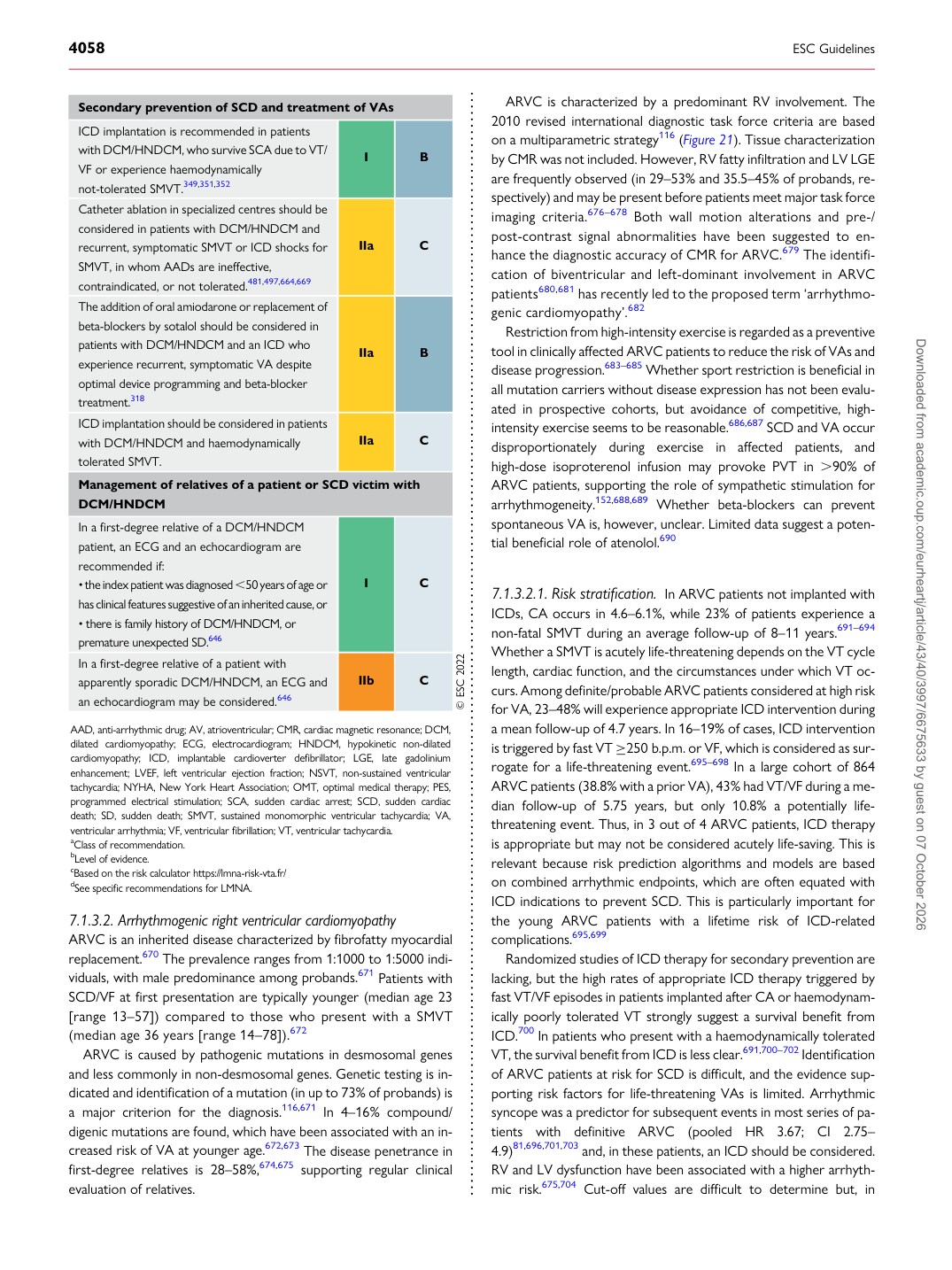
Secondary prevention of SCD and treatment of VAs ICD implantation is recommended in patients with DCM/HNDCM, who survive SCA due to VT/ VF or experience haemodynamically not-tolerated SMVT.349,351,352 I B Catheter ablation in specialized centres should be considered in patients with DCM/HNDCM and recurrent, symptomatic SMVT or ICD shocks for SMVT, in whom AADs are ineffective, contraindicated, or not tolerated.481,497,664,669 IIa C The addition of oral amiodarone or replacement of beta-blockers by sotalol should be considered in patients with DCM/HNDCM and an ICD who experience recurrent, symptomatic VA despite optimal device programming and beta-blocker treatment.318 IIa B ICD implantation should be considered in patients with DCM/HNDCM and haemodynamically tolerated SMVT. IIa C Management of relatives of a patient or SCD victim with DCM/HNDCM In a first-degree relative of a DCM/HNDCM patient, an ECG and an echocardiogram are recommended if: •theindexpatientwasdiagnosed,50yearsofageor hasclinicalfeaturessuggestiveofaninheritedcause,or • there is family history of DCM/HNDCM, or premature unexpected SD.646 I C In a first-degree relative of a patient with apparently sporadic DCM/HNDCM, an ECG and an echocardiogram may be considered.646 IIb C © ESC 2022

AAD, anti-arrhythmic drug; AV, atrioventricular; CMR, cardiac magnetic resonance; DCM, dilated cardiomyopathy; ECG, electrocardiogram; HNDCM, hypokinetic non-dilated cardiomyopathy; ICD, implantable cardioverter defibrillator; LGE, late gadolinium enhancement; LVEF, left ventricular ejection fraction; NSVT, non-sustained ventricular tachycardia; NYHA, New York Heart Association; OMT, optimal medical therapy; PES, programmed electrical stimulation; SCA, sudden cardiac arrest; SCD, sudden cardiac death; SD, sudden death; SMVT, sustained monomorphic ventricular tachycardia; VA, ventricular arrhythmia; VF, ventricular fibrillation; VT, ventricular tachycardia. aClass of recommendation. bLevel of evidence. cBased on the risk calculator https://lmna-risk-vta.fr/ dSee specific recommendations for LMNA. Downloaded from academic.oup.com/eurheartj/article/43/40/3997/6675633 by guest on 07 October 2026