p.61 抽出テキスト
The results of the DANISH trial emphasize the need for further refining the indication for primary prevention ICDs in contemporary DCM patients. Age and comorbidity need to be considered.635 In the DANISH trial, ICD implantation was associated with a significantly lower rate of death in younger patients.359 A further analysis of the DANISH data647 showed an association between reduced all-cause mortality and ICDs in patients ≤70 years of age (HR, 0.70; 95% CI 0.51–0.96; P = 0.03), but not in patients .70 years of age. Prospective studies evaluating the benefit of ICDs in DCM/ HNDCM patients with intermediate LV dysfunction, but with risk factors that have been associated with VA and SCD (including LGE on CMR, pathogenic mutations in PLN, FLNC, RBM20, unexplained syncope, and inducibility of SMVT), are lacking.129,641,643,644,659–662 Given the limitation of LVEF as the only risk marker in DCM/HNDCM, this panel of experts shares the opinion that in the presence of a combination of risk markers an ICD should be considered.

7.1.3.1.3 Secondary prevention of sudden cardiac death and

management of ventricular arrhythmias. Three randomized trials (AVID, CASH, and CIDS) have compared ICD therapy and medical treatment for secondary prevention in patients after aborted CA or not-tolerated VT.349,351,352 The three trials enrolled a total of 1963 patients, of whom only 292 (14.8%) had non-ischaemic aetiologies. A significant reduction in death from any cause in patients with ICDs was demonstrated, which was almost entirely due to a 50% reduction in arrhythmic death.352 In the subgroup of patients with cardiomyopathies there was a similar but non-significant trend in the reduction of death.352 RCTs have excluded patients with haemodynamically tolerated VT. In DCM patients the VT substrate is less well defined, and disease progression needs to be considered. Therefore, despite the lack of data, this panel of experts shares the opinion that an ICD should also be considered in DCM patients with haemodynamically tolerated VT. Optimization of ICD programming (see Section 6.2.3.1) can reduce ICD shocks delivered in response to VT, but additional therapy to reduce symptomatic VA episodes is often required. In the OPTIC trial, 412 patients with ICD implantation within 21 days of VT/VF were randomized to amiodarone plus beta-blockers, sotalol alone, or beta-blocker alone. ICD shock rates after one year were 10.3%, 24.3%, and 38.5%, respectively. The higher efficacy of amiodarone plus beta-blockers compared to sotalol needs to be weighed against the higher rate of medication-related adverse events on an individual basis.318 Although only limited data are available, sodium channel blockers may control VT in SHD and may be beneficial in ICD recipients without advanced heart failure. The majority of SMVT is due to scar-related re-entry, which can be targeted by catheter ablation. Acute ablation outcome has been reported to be similar for CAD and DCM.497,663 However, VT recurrence rates are usually higher in DCM patients (VT-free survival 40.5% in DCM vs. 57% in CAD at 1 year).497 After multiple procedures in 36% of the patients, longterm freedom of VT could be achieved in 69% of cases in a retrospective, single-centre cohort of 282 patients treated between 1999 and 2014.664

Epicardial ablation is needed in 27–30% of the procedures.497,664 Outcome is particularly poor, and bailout strategies (transcoronary ethanol ablation, bipolar ablation, surgical ablation) may be required in patients with pathogenic mutations (LMNA gene) and in those with deep intramural, anteroseptal substrate locations.499,665,666 Considering the complexity of the ablation procedure, DCM patients should therefore be treated only in specialized centres.

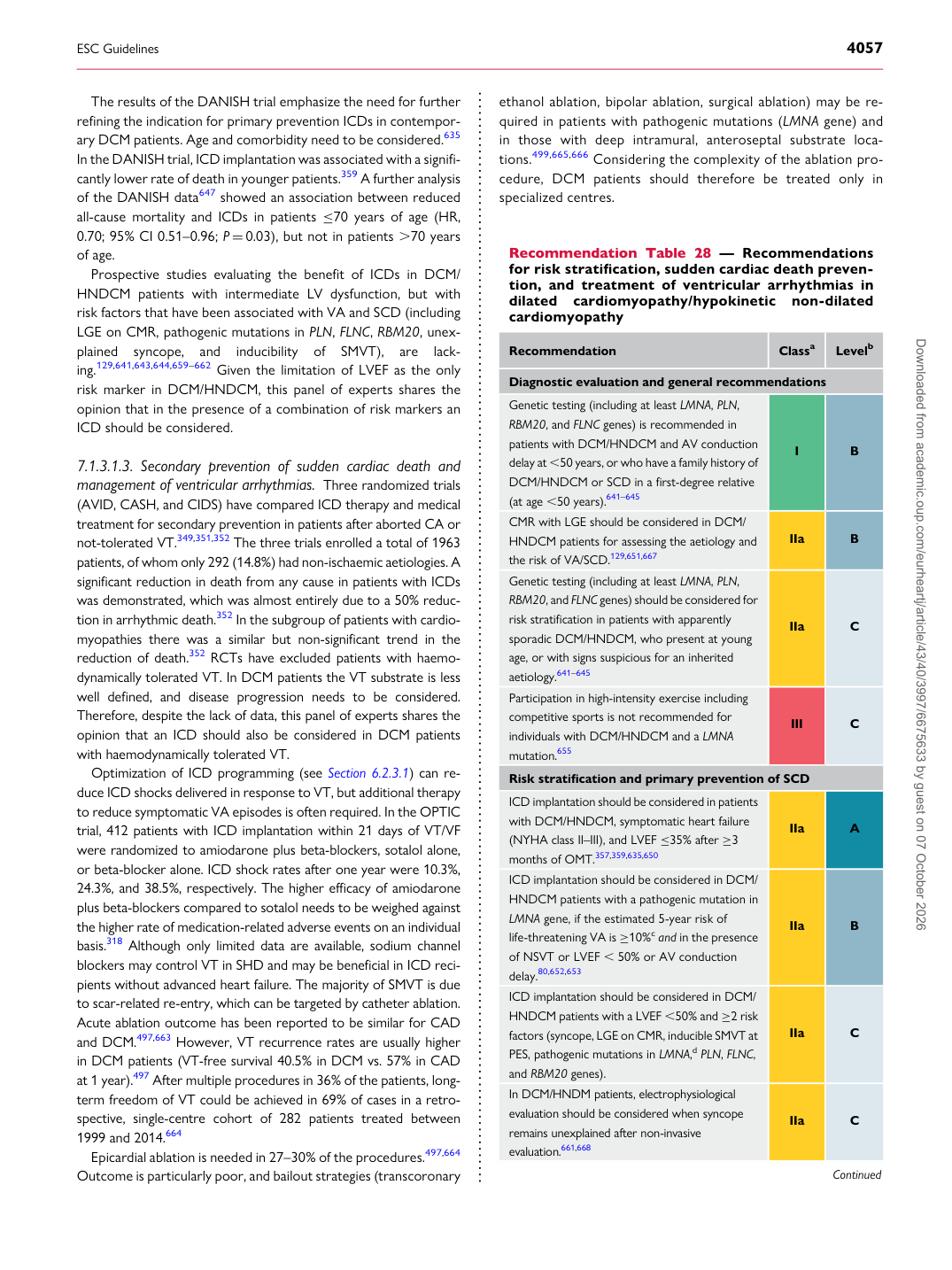
Recommendation Table 28 — Recommendations for risk stratification, sudden cardiac death prevention, and treatment of ventricular arrhythmias in dilated cardiomyopathy/hypokinetic non-dilated cardiomyopathy

Recommendation Classa Levelb

Diagnostic evaluation and general recommendations Genetic testing (including at least LMNA, PLN, RBM20, and FLNC genes) is recommended in patients with DCM/HNDCM and AV conduction delay at ,50 years, or who have a family history of DCM/HNDCM or SCD in a first-degree relative (at age ,50 years).641–645 I B CMR with LGE should be considered in DCM/ HNDCM patients for assessing the aetiology and the risk of VA/SCD.129,651,667 IIa B Genetic testing (including at least LMNA, PLN, RBM20, and FLNC genes) should be considered for risk stratification in patients with apparently sporadic DCM/HNDCM, who present at young age, or with signs suspicious for an inherited aetiology.641–645 IIa C Participation in high-intensity exercise including competitive sports is not recommended for individuals with DCM/HNDCM and a LMNA mutation.655 III C Risk stratification and primary prevention of SCD ICD implantation should be considered in patients with DCM/HNDCM, symptomatic heart failure (NYHA class II–III), and LVEF ≤35% after ≥3 months of OMT.357,359,635,650 IIa A ICD implantation should be considered in DCM/ HNDCM patients with a pathogenic mutation in LMNA gene, if the estimated 5-year risk of life-threatening VA is ≥10%c and in the presence of NSVT or LVEF , 50% or AV conduction delay.80,652,653 IIa B ICD implantation should be considered in DCM/ HNDCM patients with a LVEF ,50% and ≥2 risk factors (syncope, LGE on CMR, inducible SMVT at PES, pathogenic mutations in LMNA,d PLN, FLNC, and RBM20 genes). IIa C In DCM/HNDM patients, electrophysiological evaluation should be considered when syncope remains unexplained after non-invasive evaluation.661,668 IIa C

Continued Downloaded from academic.oup.com/eurheartj/article/43/40/3997/6675633 by guest on 07 October 2026