p.58 抽出テキスト
7.1.3 Cardiomyopathies

7.1.3.1. Dilated cardiomyopathy and hypokinetic non-dilated cardiomyopathy DCM is characterized by LV dilatation and systolic dysfunction unexplained by CAD or abnormal loading conditions.632 The true prevalence is difficult to estimate. Older studies reported a prevalence of 1 in 2700 individuals.633 Historic data in adults with DCM showed a 1-year mortality of 20–25% and a 50% survival at 5 years.634 Recent trials of DCM patients with systolic heart failure and OMT report 5-year mortality rates in the range of 21–28%.356,359 SCD occurs in up to 12% of patients with DCM and still accounts for 25–35% of all deaths.359,634,635 In children, the annual incidence of DCM is 0.57 cases per 100 000.636 The prognosis in children is poor, with a 5-year incidence of heart transplantation or heart failure-related death of 40%. However, in contrast to adults, the incidence of SCD in paediatric DCM patients is much lower, with a 5-year incidence of 2.4–3% as reported in two large paediatric cardiomyopathy registries from the United States and Australia.637,638 Causes of DCM can be genetic or acquired.639 Genetic predisposition may also interact with extrinsic factors such as in peri-partum, alcoholic, or chemotherapy-related cardiomyopathies.639 The phenotype, particularly of genetic aetiologies, can change over time and/or may not meet standard disease criteria at the time of disease manifestation. As a consequence, a new category of a hypokinetic non-dilated cardiomyopathy (HNDCM) has been proposed.639

7.1.3.1.1 Diagnostic evaluation and risk stratification. An algo-

rithm for risk stratification and primary prevention of SCD in patients with DCM/HNDCM is presented in Figure 19. Careful diagnostic work-up, including genetic testing and CMR, should be considered to identify the underlying cause for aetiology-oriented risk stratification and treatment.341,639 Pathogenic mutations are identified in 25–55% of DCM patients,634,639,640 most often with autosomal dominant inheritance. Truncated mutations in the titin gene (TTN) are most frequently found, followed by LMNA, sarcomeric, and desmosomal mutations. Mutations in genes such as LMNA, PLN, RBM20, and FLNC are associated with a higher risk of VA and SCD.641–645 Carriers of desmosomal and LMNA variants experienced the highest rate of VA/SCD, which was independent of the LVEF in one series.645

The yield of genetic testing is particularly high in DCM patients with familial forms of DCM or SCD in a first-degree relative at younger age. An inherited DCM is also more likely in patients who present at young age or with signs suspicious for a specific aetiology (e.g. prolonged AV conduction for LMNA) (Figure 20).634,639,640,646 First-degree relatives of DCM/HNDCM patients should undergo clinical diagnostic evaluation, especially if an inherited cause is suspected. Discrimination between high- and low-risk patients for SCD remains challenging. Beyond LVEF and NYHA class,357,359,635,647–650 recent data suggest that both genetic and CMR findings can contribute to risk stratification. A meta-analysis of 29 studies combining 2948 patients studied the role of CMR in patients with DCM.129 LGE was significantly associated with the arrhythmic endpoint, even when including only studies that performed multivariate analysis (HR 6.7; P , 0.001). Interestingly, the association between LGE and the arrhythmic endpoint remained significant among patients with mean LVEF .35%. Similarly, a recent study of 1020 consecutive patients with DCM and CMR observed that LGE and LVEF were both risk markers for all-cause mortality and cardiac death, but only LGE was significantly associated with SCD risk.651 SCD risk stratification has been refined in the subgroup of patients with LMNA mutations, which represent 5–10% of all DCM patients. LMNA mutations are associated with early atrial and ventricular arrhythmias, premature conduction disease, a high risk of SCD, and progression to end-stage heart failure.80,642,652,653 In a multicentre registry of 269 LMNA mutation carriers, NSVT, LVEF ,45% at first evaluation, male sex, and non-missense mutations were identified as independent risk factors for VA.652 VA occurred only in persons with at least two of these risk factors. The risk stratification was subsequently externally validated.653 Another study, which involved 589 LMNA mutation carriers, identified AV block as an additional predictor. Recently a risk calculator has been developed (https://lmna-riskvta.fr/) to predict the risk of life-threatening VA (C-index of 0.776 [95% CI: 0.711–0.842]).80 In patients with a 5-year estimated risk ≥10% and a manifest cardiac phenotype (NSVT, LVEF , 50%, or AV conduction delay), a primary prevention ICD implantation should be considered to avoid potential over-implantation in mutation carriers without a cardiac phenotype. In LMNA mutation carriers with a DCM phenotype, high-intensity exercise has been associated with a high risk of SCD and impaired LVEF and is therefore not recommended.654,655 A risk score for VA prediction has been recently proposed for patients with DCM or ARVC related to the p.Arg14del mutation in the PLN gene.656 Validation studies are needed before it can be recommended for clinical use. Beyond genetics and CMR, additional SCD predictors have been suggested, often derived from small cohorts with no or few replication studies. An unexplained syncope requires further evaluation and PES may determine the underlying cause. The risk for arrhythmic

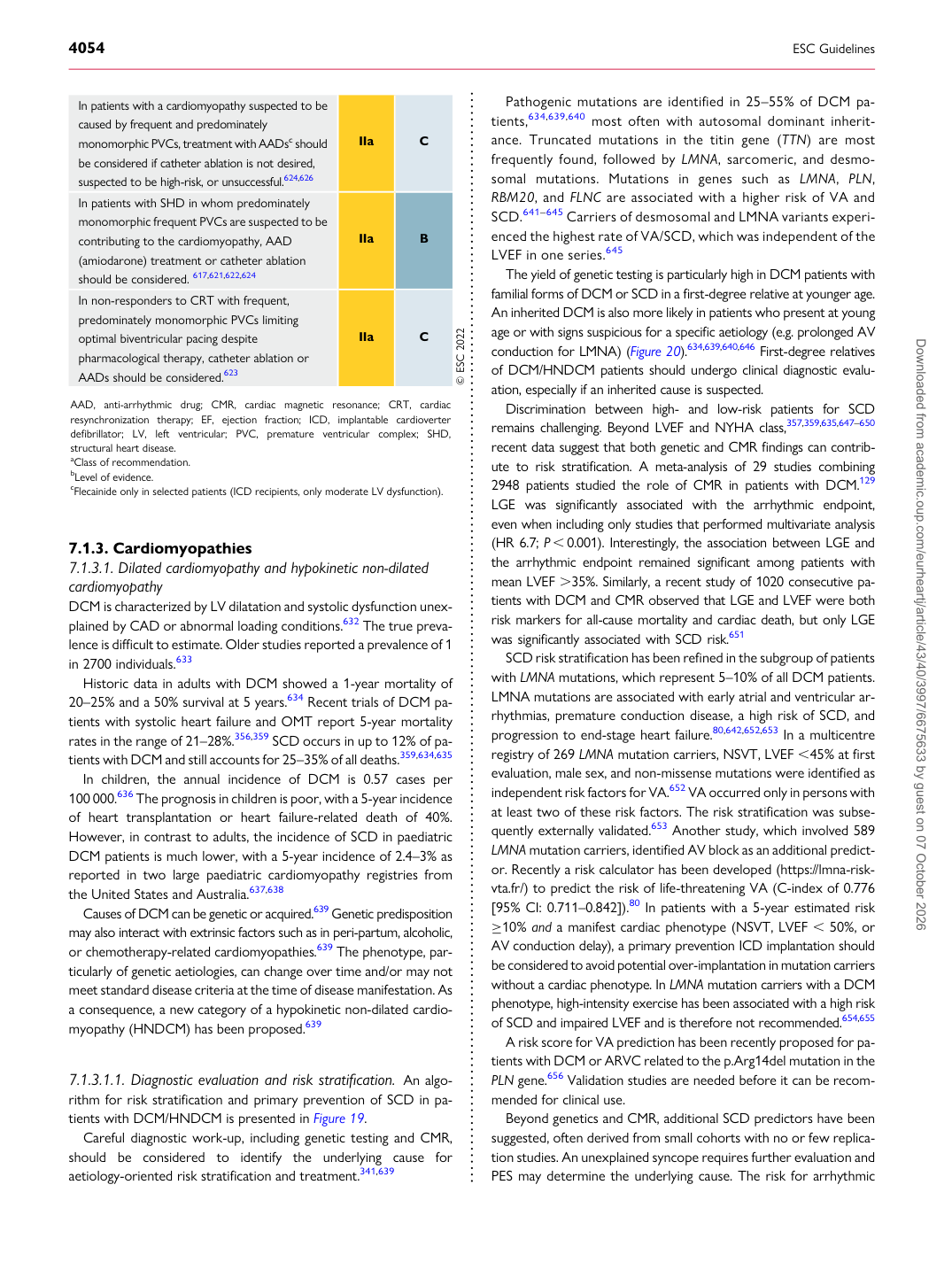
In patients with a cardiomyopathy suspected to be caused by frequent and predominately monomorphic PVCs, treatment with AADsc should be considered if catheter ablation is not desired, suspected to be high-risk, or unsuccessful.624,626 IIa C In patients with SHD in whom predominately monomorphic frequent PVCs are suspected to be contributing to the cardiomyopathy, AAD (amiodarone) treatment or catheter ablation should be considered. 617,621,622,624 IIa B In non-responders to CRT with frequent, predominately monomorphic PVCs limiting optimal biventricular pacing despite pharmacological therapy, catheter ablation or AADs should be considered.623 IIa C © ESC 2022

AAD, anti-arrhythmic drug; CMR, cardiac magnetic resonance; CRT, cardiac resynchronization therapy; EF, ejection fraction; ICD, implantable cardioverter defibrillator; LV, left ventricular; PVC, premature ventricular complex; SHD, structural heart disease. aClass of recommendation. bLevel of evidence. cFlecainide only in selected patients (ICD recipients, only moderate LV dysfunction). Downloaded from academic.oup.com/eurheartj/article/43/40/3997/6675633 by guest on 07 October 2026