p.54 抽出テキスト
7.1.2 Idiopathic premature ventricular complexes/

ventricular tachycardia and premature ventricular complex-induced cardiomyopathy 7.1.2.1. Idiopathic premature ventricular complexes/ventricular tachycardia PVCs/VT in patients without SHD are defined as idiopathic (Figure 17). In patients with presumed idiopathic PVCs/VT based on a negative history and normal physical examination, 12-lead ECG and transthoracic echocardiography are important first diagnostic steps to exclude underlying SHD. Twenty-four-hour ECG Holter monitoring is usually performed to determine the PVC burden. Multiform PVCs at prolonged ECG monitoring and subtle changes on ECG or echocardiography need to be recognized.589 CMR should be performed whenever ECG and echocardiography are inconclusive to rule out SHD, or the clinical presentation raises suspicion for SHD.590,591 Patients need to be treated when PVCs/VT are symptomatic or associated with deterioration of cardiac function. The clinical course and responses to different treatments have been mostly studied in those originating from the RVOT or the left fascicles. Several drugs have been used to treat idiopathic PVCs/VT. Recommendations are based on small or non-controlled series. Beta-blockers and CCBs are the most-studied drugs and both have been shown to be effective at arrhythmia suppression.304 The evidence for flecainide is scarce.592 In case of a higher burden of PVCs with higher heart rate or during exercise, beta-blockers should be preferred.593 If there is not such a correlation, the use of flecainide or CCB drugs have been associated with more effective PVC suppression. Beta-blockers should also be selected when a focal triggered activity mechanism is suspected. CCB should be the drug of choice for fascicular PVC/VT. Although data are lacking, betablockers or CCBs are considered first choice for PVCs with an origin outside the RVOT or the left fascicles because flecainide may have proarrhythmic side effects. Amiodarone is associated with severe systemic toxicity and should be used only if ablation or other drugs fail or cannot be used.594 A summary of the recommendations for the treatment of idiopathic PVCs/VT and PVC-induced or aggravated cardiomyopathy with AADs is provided in Table 9.

A high success rate of catheter ablation of idiopathic PVCs/VT has been reported with rare complications, particularly for the RVOT and fascicular types.535 In a randomized study including patients with RVOT PVCs, ablation was superior to AAD therapy for arrhythmia suppression with no differences in complications.595 Ablation is therefore recommended as the first-line therapy for RVOT and fascicular PVCs/VT. The available information for other forms of idiopathic PVCs/VT is limited and mostly restricted to the acute success of ablation, which, in general, is lower and associated with more recurrences than for RVOT and fascicular PVCs/VT.540 In addition, access to and ablation at specific locations (e.g. sinus of Valsalva, LV summit) may increase the risk for procedural complications. Therefore, when the 12-lead ECG is highly suspicious of a PVC/VT source outside the RVOT or left fascicles, the level of recommendation for ablation is lower. In general, treatment of children should be similar to that of adults. However, ablation should be deferred in young and small children due to the risk of complications and the relatively larger size of the ablation lesion as compared to the child’s heart.596,597 Verapamil is not recommended as the first-line therapy in children ,1 year old because it has been associated with hypotension in some case reports.542 Of note, all reported patients had either heart failure, overdosing of verapamil, or other concurrent AADs at the time verapamil was given.598 Patients may present with asymptomatic frequent PVCs/VTs. Only a minority of patients with .1000 PVCs per day will develop ventricular dysfunction after 5 years follow-up.599 A PVC burden of 10% seems to be the minimal threshold for development of LV dysfunction, with higher risk when the PVC burden is .20%.535,600,601 Regular assessment of LVEF in this setting is therefore indicated. To date, there are no data supporting the benefit of arrhythmia treatment for asymptomatic patients with preserved ventricular function. In addition, PVC burden often decreases spontaneously over time, particularly in children.599,602 In selected patients, e.g. patients who do not want to be followed, catheter ablation may be considered. In patients with PVC burden , 10%, reevaluation may be appropriate in case of development of new symptoms or change in patient condition.

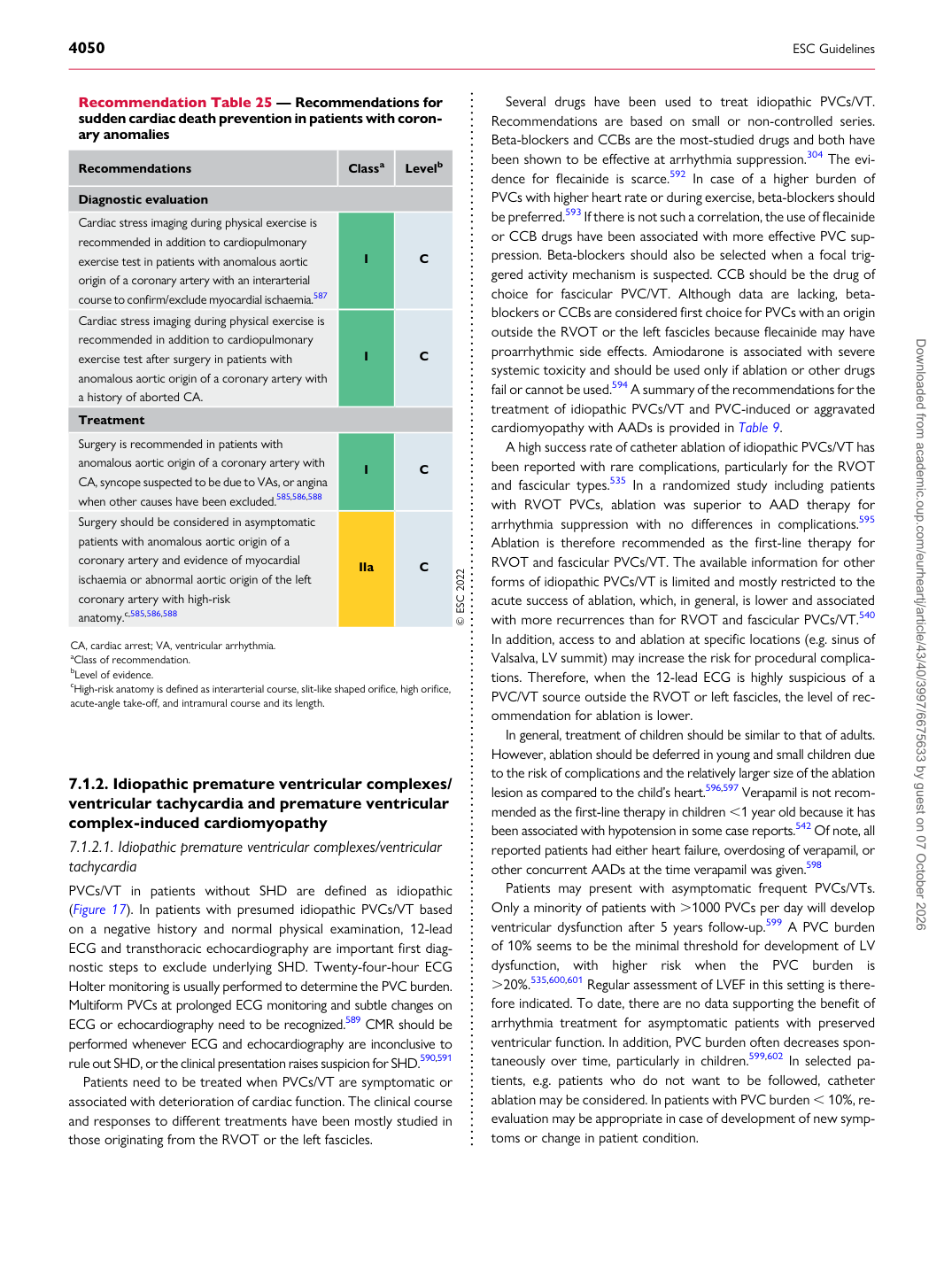
Recommendation Table 25 — Recommendations for sudden cardiac death prevention in patients with coronary anomalies

Recommendations Classa Levelb

Diagnostic evaluation Cardiac stress imaging during physical exercise is recommended in addition to cardiopulmonary exercise test in patients with anomalous aortic origin of a coronary artery with an interarterial course to confirm/exclude myocardial ischaemia.587 I C Cardiac stress imaging during physical exercise is recommended in addition to cardiopulmonary exercise test after surgery in patients with anomalous aortic origin of a coronary artery with a history of aborted CA. I C Treatment Surgery is recommended in patients with anomalous aortic origin of a coronary artery with CA, syncope suspected to be due to VAs, or angina when other causes have been excluded.585,586,588 I C Surgery should be considered in asymptomatic patients with anomalous aortic origin of a coronary artery and evidence of myocardial ischaemia or abnormal aortic origin of the left coronary artery with high-risk anatomy.c,585,586,588 IIa C © ESC 2022

CA, cardiac arrest; VA, ventricular arrhythmia. aClass of recommendation. bLevel of evidence. cHigh-risk anatomy is defined as interarterial course, slit-like shaped orifice, high orifice, acute-angle take-off, and intramural course and its length. Downloaded from academic.oup.com/eurheartj/article/43/40/3997/6675633 by guest on 07 October 2026