p.53 抽出テキスト
does not prevent VT recurrence, exclusion or treatment of significant CAD before catheter ablation is reasonable.

7.1.1.3.5 Management of recurrent ventricular tachycardia in im-

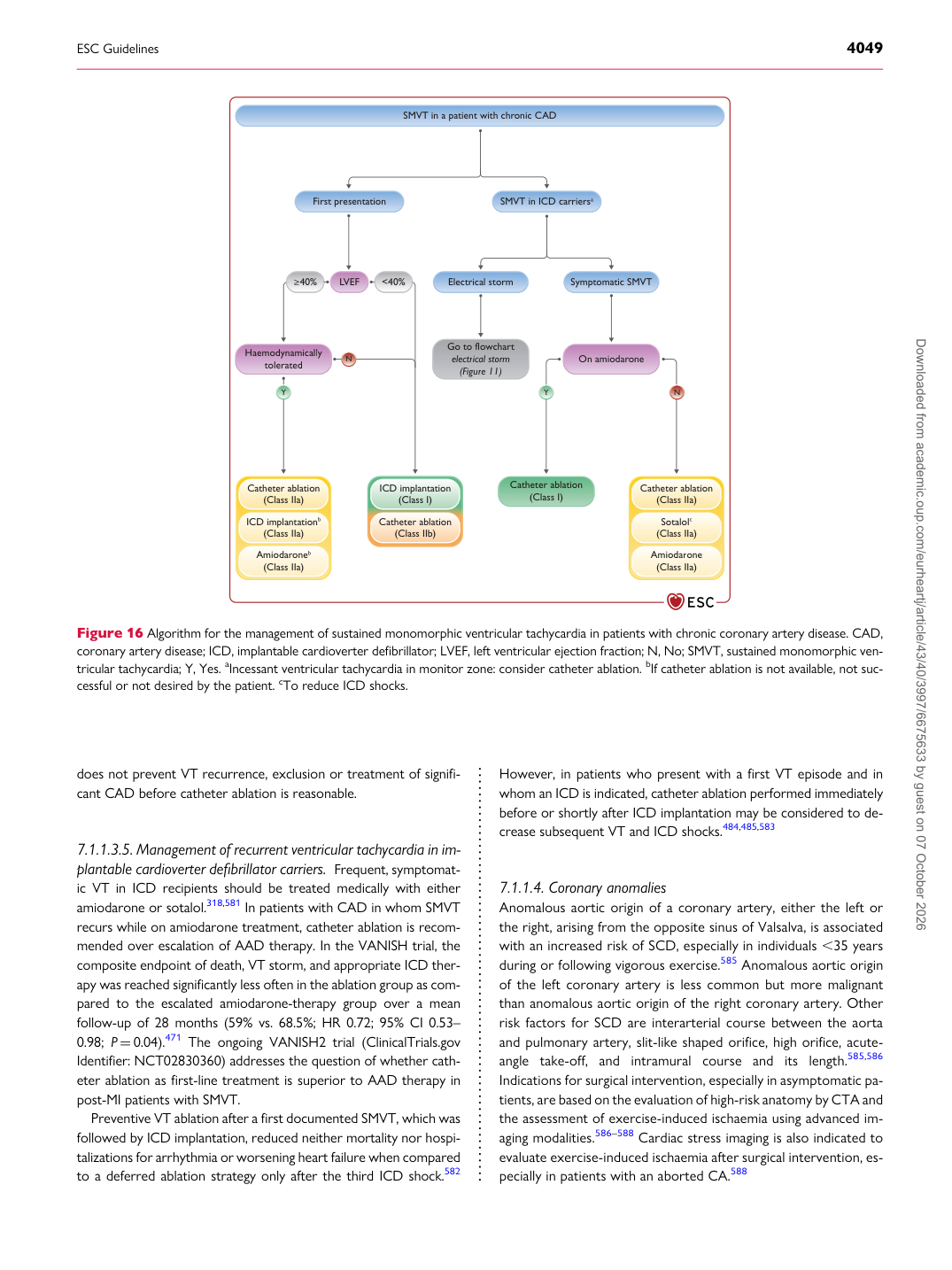
plantable cardioverter defibrillator carriers. Frequent, symptomatic VT in ICD recipients should be treated medically with either amiodarone or sotalol.318,581 In patients with CAD in whom SMVT recurs while on amiodarone treatment, catheter ablation is recommended over escalation of AAD therapy. In the VANISH trial, the composite endpoint of death, VT storm, and appropriate ICD therapy was reached significantly less often in the ablation group as compared to the escalated amiodarone-therapy group over a mean follow-up of 28 months (59% vs. 68.5%; HR 0.72; 95% CI 0.53– 0.98; P = 0.04).471 The ongoing VANISH2 trial (ClinicalTrials.gov Identifier: NCT02830360) addresses the question of whether catheter ablation as first-line treatment is superior to AAD therapy in post-MI patients with SMVT. Preventive VT ablation after a first documented SMVT, which was followed by ICD implantation, reduced neither mortality nor hospitalizations for arrhythmia or worsening heart failure when compared to a deferred ablation strategy only after the third ICD shock.582 However, in patients who present with a first VT episode and in whom an ICD is indicated, catheter ablation performed immediately before or shortly after ICD implantation may be considered to decrease subsequent VT and ICD shocks.484,485,583

7.1.1.4 Coronary anomalies

Anomalous aortic origin of a coronary artery, either the left or the right, arising from the opposite sinus of Valsalva, is associated with an increased risk of SCD, especially in individuals ,35 years during or following vigorous exercise.585 Anomalous aortic origin of the left coronary artery is less common but more malignant than anomalous aortic origin of the right coronary artery. Other risk factors for SCD are interarterial course between the aorta and pulmonary artery, slit-like shaped orifice, high orifice, acuteangle take-off, and intramural course and its length.585,586 Indications for surgical intervention, especially in asymptomatic patients, are based on the evaluation of high-risk anatomy by CTA and the assessment of exercise-induced ischaemia using advanced imaging modalities.586–588 Cardiac stress imaging is also indicated to evaluate exercise-induced ischaemia after surgical intervention, especially in patients with an aborted CA.588

SMVT in a patient with ch r onic C AD

ICD implantation

(Class I) Catheter ablation

(Class IIb)

Catheter ablation

(Class IIa)

Amioda r one b (Class IIa) Catheter ablation

(Class IIa)

Amioda r one (Class IIa)

Catheter ablation

(Class I)

Y Y

N

N

Haemodynamical l y

tolerated On amioda r one

Go to fl o wcha r t elect r ical storm (Figu r e 11) Symptomatic SMVT

SMVT in ICD ca r riers a

First p r esentation

Electrical storm

L VE

L L F <40%

≥ 40%

Sotalol c (Class IIa)

ICD implantation b

(Class IIa)

Figure 16 Algorithm for the management of sustained monomorphic ventricular tachycardia in patients with chronic coronary artery disease. CAD, coronary artery disease; ICD, implantable cardioverter defibrillator; LVEF, left ventricular ejection fraction; N, No; SMVT, sustained monomorphic ventricular tachycardia; Y, Yes. aIncessant ventricular tachycardia in monitor zone: consider catheter ablation. bIf catheter ablation is not available, not successful or not desired by the patient. cTo reduce ICD shocks. Downloaded from academic.oup.com/eurheartj/article/43/40/3997/6675633 by guest on 07 October 2026