p.52 抽出テキスト
meta-analysis demonstrated a 28% mortality reduction (HR 0.72; 95% CI 0.60–0.87; P = 0.0006) almost entirely due to reduction of arrhythmic death (HR 0.50; 95% CI 0.37–0.67; P , 0.0001) in the ICD group.352 This translates to an extension of survival of 4.4 months over a mean follow-up of 6 years by the ICD. Around 80% of the study population suffered from CAD. Patients with well-tolerated SMVT were excluded from secondary prevention trials (Figure 16).

7.1.1.3.4 Management of patients with haemodynamically toler-

ated ventricular tachycardia and preserved and mildly reduced ejection fraction. With the better understanding of the mechanisms of VT after MI, as well as improved ablation and imaging technologies, catheter ablation has become an option for the treatment of haemodynamically well-tolerated VT in selected post-MI patients with preserved or mildly reduced EF, even without ICD back-up. One small monocentric retrospective trial studied patients with CAD, LVEF .40%, and haemodynamically tolerated VT who underwent catheter ablation as first-line therapy.580 The investigators could abolish 90% of the clinical and 58% of all inducible VTs. Subsequently, 42% of the patients received an ICD. After a mean follow-up of 3.8 years, 42% of the patients died irrespective of the presence or absence of an ICD (P = 0.47).

A larger multicentre retrospective study looked at 166 patients with an LVEF .30% presenting with well-tolerated SMVT, which were treated by catheter ablation only, and compared the outcome to a control group of 378 patients implanted with an ICD.480 Of the 166 patients undergoing ablation as first therapy, 55% suffered from CAD. The mean LVEF was 50%, and after a mean follow-up of 32 months, overall mortality did not differ between the groups (12%). These data suggest that either ICD implantation or ablation in experienced centres should be considered in patients with a preserved or mildly reduced EF presenting with haemodynamically tolerated SMVT. Of note, although ICDs have been commonly implanted in this population, the secondary preventive ICD trials failed to show a survival benefit in patients with an LVEF ≥35%.352 Although SMVT is rarely caused by ischaemia and revascularization alone

NSVT or unexplained syncope NYHA class ≥ II

L VEF L L ≤ 30%

L VEF L L ≤ 35%

L VEF 36–40% L L

N

N

N

Patient with ch r onic C AD

L VEF

L L e valuation 6–12 w eeks after acute MI in patients with L VEF

L L ≤ 40% at discharge (Class I)

ILR implantation a

(Class I) PES

(Class I) ICD

(Class I)

No SMVT inducible and unexplained syncope SMVT inducible

ICD implantation

(Class IIa)

F oll o w-up

ICD implantation

(Class IIa)

Y Y

Y

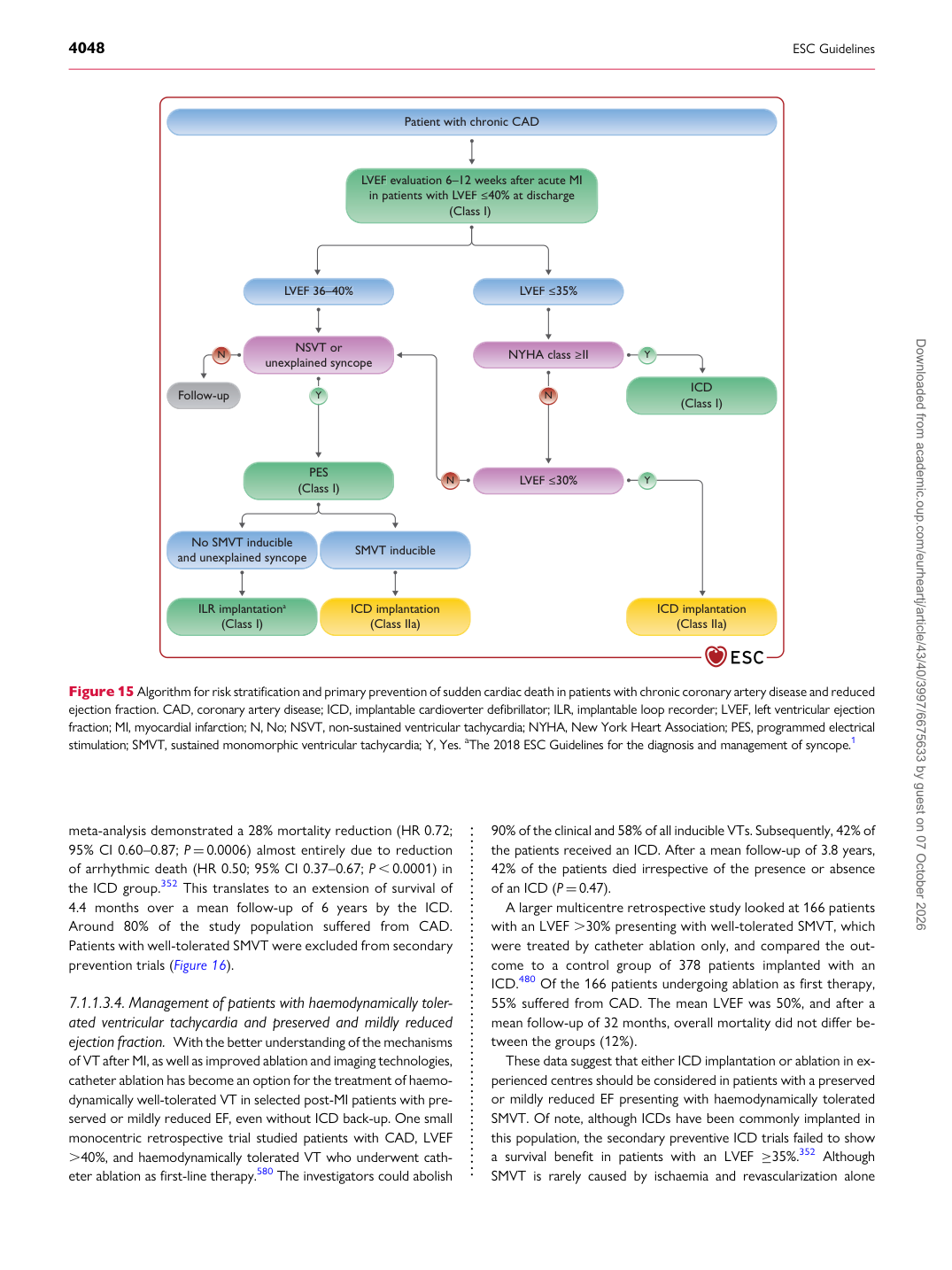
Figure 15 Algorithm for risk stratification and primary prevention of sudden cardiac death in patients with chronic coronary artery disease and reduced ejection fraction. CAD, coronary artery disease; ICD, implantable cardioverter defibrillator; ILR, implantable loop recorder; LVEF, left ventricular ejection fraction; MI, myocardial infarction; N, No; NSVT, non-sustained ventricular tachycardia; NYHA, New York Heart Association; PES, programmed electrical stimulation; SMVT, sustained monomorphic ventricular tachycardia; Y, Yes. aThe 2018 ESC Guidelines for the diagnosis and management of syncope.1 Downloaded from academic.oup.com/eurheartj/article/43/40/3997/6675633 by guest on 07 October 2026