p.51 抽出テキスト
heart failure symptoms NYHA class II and III, primary preventive ICD implantation is recommended.356 ICD implantation should also be considered for asymptomatic patients with an EF ≤30%.354 In this population, mortality reduction by an ICD has been demonstrated in four RCTs.353–356 In patients with CAD, a reduced LVEF (≤40%), and asymptomatic NSVT, inducibility by PES identifies patients who benefit from an ICD, independent from NYHA class.355 Since the publication of the aforementioned trials, early revascularization strategies and modern heart failure medication have reduced the overall risk of SCD in heart failure patients.577 Although total mortality has been reduced, the relative reduction by the ICD is a consistent 27%, which has been corroborated in two recent large prospective registry studies enrolling 2327 European patients between 2014 and 2018 (EU-CERT-ICD)357 and 2610 Swedish patients enrolled between 2000 and 2016 (SwedeHF registry).358

7.1.1.3.2 Primary prevention of sudden cardiac death in patients with

preserved or mildly reduced ejection fraction. There are no data supporting primary prophylactic ICD implantation in post-infarct patients with preserved or mildly reduced LVEF. These patients are heterogeneous with regard to their potential arrhythmic substrate, and efforts are under way to identify those with the highest risk for SCD. PES is recommended in post-infarct patients in whom syncope remains unexplained after non-invasive evaluation to guide patient management (Figure 15).146 In the PRESERVE-EF study, 41 of 575 post-infarct patients with an LVEF ≥40% and one non-invasive ECG risk factor more than 40 days post-MI were inducible for VT/VF during PES and received an ICD.151 During the 32-month follow-up period, no SCD occurred and 9 of 37 ICD patients received an appropriate ICD therapy. However, the role of appropriate ICD treatment as surrogate for SCD in patients with preserved LVEF is unknown, and randomized trials are needed. Prophylactic treatment with AADs other than beta-blockers is not indicated regardless of the LVEF.556,578,579

7.1.1.3.3 Secondary prevention of sudden cardiac death. The

three pivotal secondary prevention ICD trials enrolled 1866 patients between 1990 and 1997.349–351 A patient-level

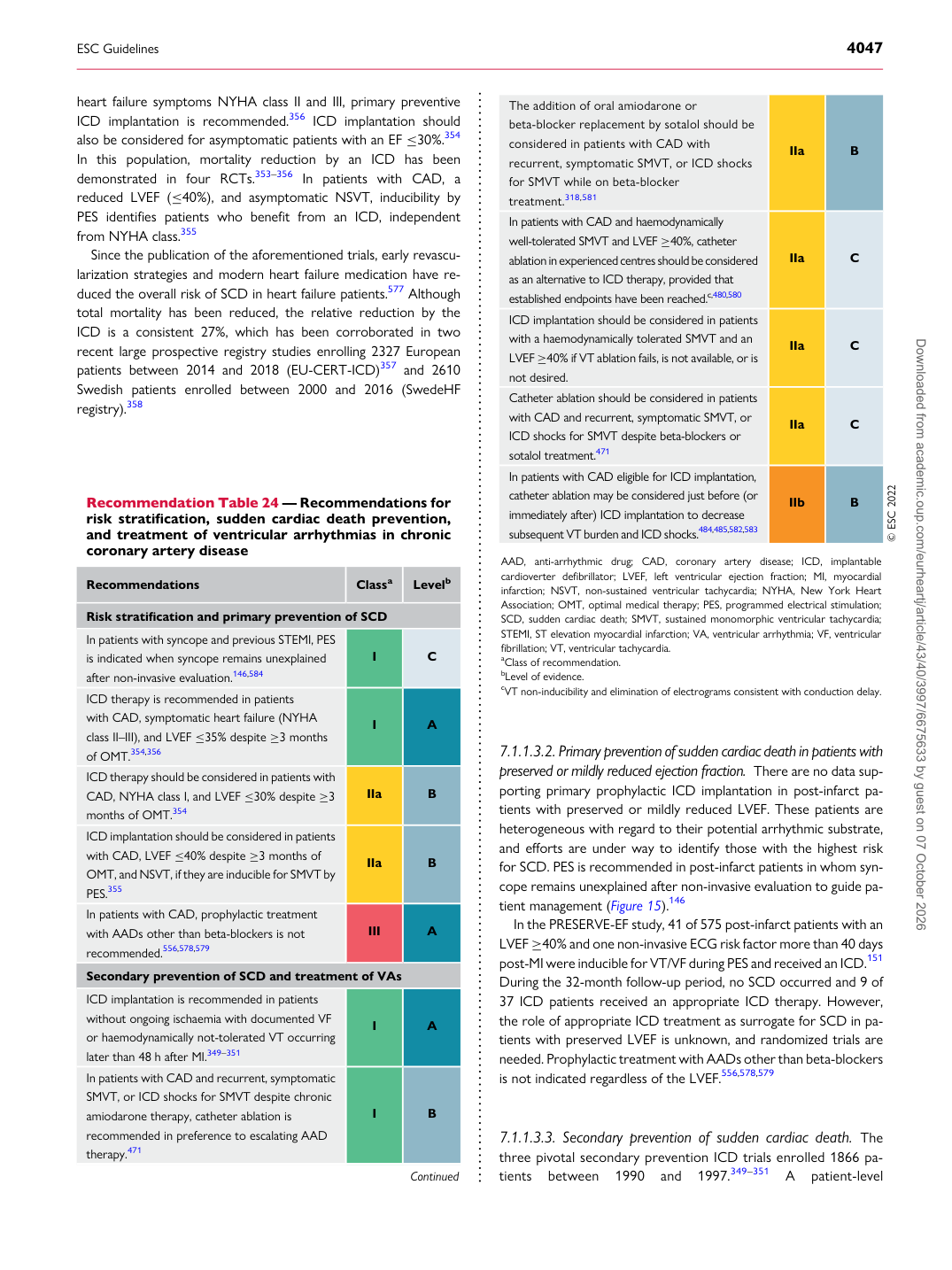
Recommendation Table 24 — Recommendations for risk stratification, sudden cardiac death prevention, and treatment of ventricular arrhythmias in chronic coronary artery disease

Recommendations Classa Levelb

Risk stratification and primary prevention of SCD In patients with syncope and previous STEMI, PES is indicated when syncope remains unexplained after non-invasive evaluation.146,584 I C ICD therapy is recommended in patients with CAD, symptomatic heart failure (NYHA class II–III), and LVEF ≤35% despite ≥3 months of OMT.354,356 I A ICD therapy should be considered in patients with CAD, NYHA class I, and LVEF ≤30% despite ≥3 months of OMT.354 IIa B ICD implantation should be considered in patients with CAD, LVEF ≤40% despite ≥3 months of OMT, and NSVT, if they are inducible for SMVT by PES.355 IIa B In patients with CAD, prophylactic treatment with AADs other than beta-blockers is not recommended.556,578,579 III A Secondary prevention of SCD and treatment of VAs ICD implantation is recommended in patients without ongoing ischaemia with documented VF or haemodynamically not-tolerated VT occurring later than 48 h after MI.349–351 I A In patients with CAD and recurrent, symptomatic SMVT, or ICD shocks for SMVT despite chronic amiodarone therapy, catheter ablation is recommended in preference to escalating AAD therapy.471 I B

Continued The addition of oral amiodarone or

beta-blocker replacement by sotalol should be considered in patients with CAD with recurrent, symptomatic SMVT, or ICD shocks for SMVT while on beta-blocker treatment.318,581 IIa B In patients with CAD and haemodynamically well-tolerated SMVT and LVEF ≥40%, catheter ablationinexperiencedcentresshouldbeconsidered as an alternative to ICD therapy, provided that established endpoints have been reached.c,480,580 IIa C ICD implantation should be considered in patients with a haemodynamically tolerated SMVT and an LVEF ≥40% if VT ablation fails, is not available, or is not desired. IIa C Catheter ablation should be considered in patients with CAD and recurrent, symptomatic SMVT, or ICD shocks for SMVT despite beta-blockers or sotalol treatment.471 IIa C In patients with CAD eligible for ICD implantation, catheter ablation may be considered just before (or immediately after) ICD implantation to decrease subsequent VT burden and ICD shocks.484,485,582,583 IIb B © ESC 2022

AAD, anti-arrhythmic drug; CAD, coronary artery disease; ICD, implantable cardioverter defibrillator; LVEF, left ventricular ejection fraction; MI, myocardial infarction; NSVT, non-sustained ventricular tachycardia; NYHA, New York Heart Association; OMT, optimal medical therapy; PES, programmed electrical stimulation; SCD, sudden cardiac death; SMVT, sustained monomorphic ventricular tachycardia; STEMI, ST elevation myocardial infarction; VA, ventricular arrhythmia; VF, ventricular fibrillation; VT, ventricular tachycardia. aClass of recommendation. bLevel of evidence. cVT non-inducibility and elimination of electrograms consistent with conduction delay. Downloaded from academic.oup.com/eurheartj/article/43/40/3997/6675633 by guest on 07 October 2026