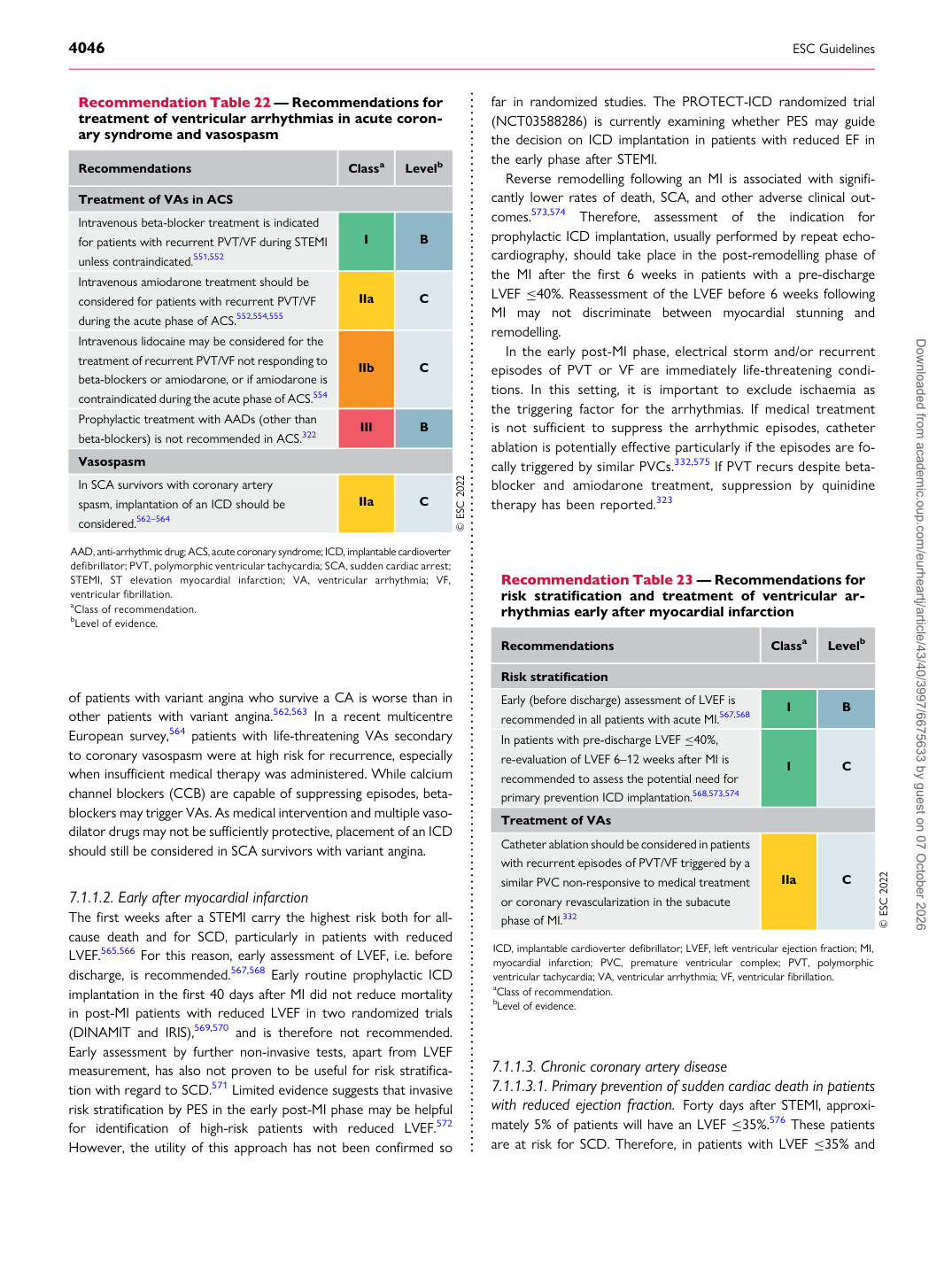
p.50 抽出テキスト
of patients with variant angina who survive a CA is worse than in other patients with variant angina.562,563 In a recent multicentre European survey,564 patients with life-threatening VAs secondary to coronary vasospasm were at high risk for recurrence, especially when insufficient medical therapy was administered. While calcium channel blockers (CCB) are capable of suppressing episodes, betablockers may trigger VAs. As medical intervention and multiple vasodilator drugs may not be sufficiently protective, placement of an ICD should still be considered in SCA survivors with variant angina.

7.1.1.2 Early after myocardial infarction

The first weeks after a STEMI carry the highest risk both for allcause death and for SCD, particularly in patients with reduced LVEF.565,566 For this reason, early assessment of LVEF, i.e. before discharge, is recommended.567,568 Early routine prophylactic ICD implantation in the first 40 days after MI did not reduce mortality in post-MI patients with reduced LVEF in two randomized trials (DINAMIT and IRIS),569,570 and is therefore not recommended. Early assessment by further non-invasive tests, apart from LVEF measurement, has also not proven to be useful for risk stratification with regard to SCD.571 Limited evidence suggests that invasive risk stratification by PES in the early post-MI phase may be helpful for identification of high-risk patients with reduced LVEF.572 However, the utility of this approach has not been confirmed so far in randomized studies. The PROTECT-ICD randomized trial (NCT03588286) is currently examining whether PES may guide the decision on ICD implantation in patients with reduced EF in the early phase after STEMI.

Reverse remodelling following an MI is associated with significantly lower rates of death, SCA, and other adverse clinical outcomes.573,574 Therefore, assessment of the indication for prophylactic ICD implantation, usually performed by repeat echocardiography, should take place in the post-remodelling phase of the MI after the first 6 weeks in patients with a pre-discharge LVEF ≤40%. Reassessment of the LVEF before 6 weeks following MI may not discriminate between myocardial stunning and remodelling. In the early post-MI phase, electrical storm and/or recurrent episodes of PVT or VF are immediately life-threatening conditions. In this setting, it is important to exclude ischaemia as the triggering factor for the arrhythmias. If medical treatment is not sufficient to suppress the arrhythmic episodes, catheter ablation is potentially effective particularly if the episodes are focally triggered by similar PVCs.332,575 If PVT recurs despite betablocker and amiodarone treatment, suppression by quinidine therapy has been reported.323

7.1.1.3 Chronic coronary artery disease

7.1.1.3.1. Primary prevention of sudden cardiac death in patients with reduced ejection fraction. Forty days after STEMI, approximately 5% of patients will have an LVEF ≤35%.576 These patients are at risk for SCD. Therefore, in patients with LVEF ≤35% and

Recommendation Table 22 — Recommendations for treatment of ventricular arrhythmias in acute coronary syndrome and vasospasm

Recommendations Classa Levelb

Treatment of VAs in ACS Intravenous beta-blocker treatment is indicated for patients with recurrent PVT/VF during STEMI unless contraindicated.551,552 I B Intravenous amiodarone treatment should be considered for patients with recurrent PVT/VF during the acute phase of ACS.552,554,555 IIa C Intravenous lidocaine may be considered for the treatment of recurrent PVT/VF not responding to beta-blockers or amiodarone, or if amiodarone is contraindicated during the acute phase of ACS.554 IIb C Prophylactic treatment with AADs (other than beta-blockers) is not recommended in ACS.322 III B Vasospasm In SCA survivors with coronary artery spasm, implantation of an ICD should be considered.562–564 IIa C © ESC 2022

AAD, anti-arrhythmic drug; ACS, acute coronary syndrome; ICD, implantable cardioverter defibrillator; PVT, polymorphic ventricular tachycardia; SCA, sudden cardiac arrest; STEMI, ST elevation myocardial infarction; VA, ventricular arrhythmia; VF, ventricular fibrillation. aClass of recommendation. bLevel of evidence. Recommendation Table 23 — Recommendations for risk stratification and treatment of ventricular arrhythmias early after myocardial infarction

Recommendations Classa Levelb

Risk stratification Early (before discharge) assessment of LVEF is recommended in all patients with acute MI.567,568 I B In patients with pre-discharge LVEF ≤40%, re-evaluation of LVEF 6–12 weeks after MI is recommended to assess the potential need for primary prevention ICD implantation.568,573,574 I C Treatment of VAs Catheter ablation should be considered in patients with recurrent episodes of PVT/VF triggered by a similar PVC non-responsive to medical treatment or coronary revascularization in the subacute phase of MI.332 IIa C © ESC 2022

ICD, implantable cardioverter defibrillator; LVEF, left ventricular ejection fraction; MI, myocardial infarction; PVC, premature ventricular complex; PVT, polymorphic ventricular tachycardia; VA, ventricular arrhythmia; VF, ventricular fibrillation. aClass of recommendation. bLevel of evidence. Downloaded from academic.oup.com/eurheartj/article/43/40/3997/6675633 by guest on 07 October 2026