p.49 抽出テキスト
the impact of VA occurring .48 h after STEMI on late SCD in contemporary patients undergoing acute PCI. 7.1.1.1.2 Vasospasm. Coronary artery spasms might have an im-

portant role in the pathogenesis of VA. The long-term prognosis

Prevention and treatment of  VAs in the acute phase of STEMI

Beta-blocker i.v. prior to PCI, if not contraindicateda,b

(Class IIa)

Urgent CAG and revascularizationa

(Class I)

Further revascularization if appropriatea

(Class I) Repletion of K+, Mg2+ a

(Class I) Beta-blocker i.v.b

(Class I)

Amiodarone i.v.

(Class IIa) Lidocaine i.v. (Class IIb) Deep sedation/intubation c

(Class IIb)

Sedation (for comfort)c

(Class I)

VA

Recurrent VA

Autonomic modulationc

(Class IIb)

Catheter ablationd

(Class IIa)

Mechanical circulatory support c

(Class IIb)

Overdrive pacinga

(Class IIa)

Recurrent VA

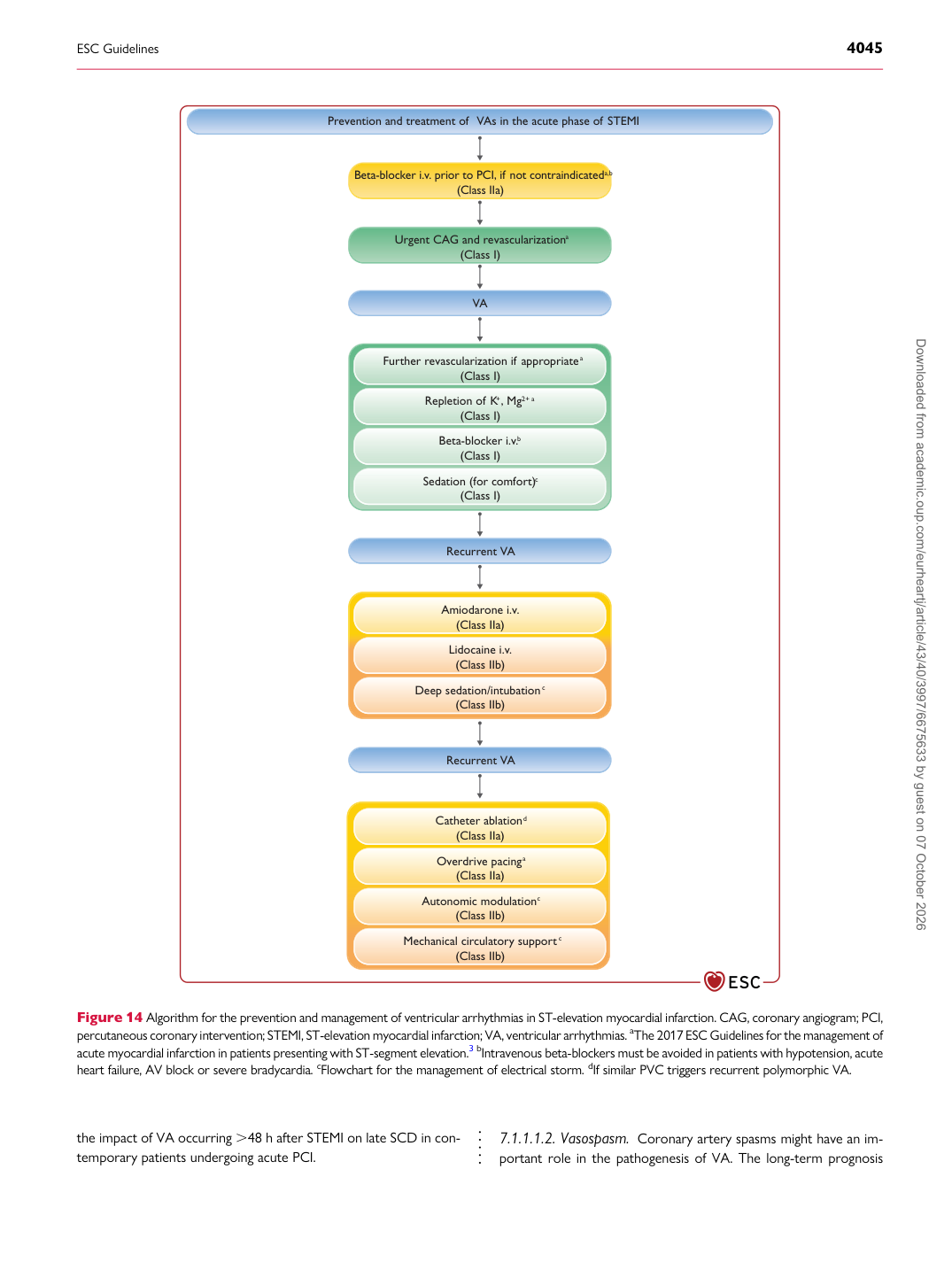
Figure 14 Algorithm for the prevention and management of ventricular arrhythmias in ST-elevation myocardial infarction. CAG, coronary angiogram; PCI, percutaneous coronary intervention; STEMI, ST-elevation myocardial infarction; VA, ventricular arrhythmias. aThe 2017 ESC Guidelines for the management of acute myocardial infarction in patients presenting with ST-segment elevation.3 bIntravenous beta-blockers must be avoided in patients with hypotension, acute heart failure, AV block or severe bradycardia. cFlowchart for the management of electrical storm. dIf similar PVC triggers recurrent polymorphic VA. Downloaded from academic.oup.com/eurheartj/article/43/40/3997/6675633 by guest on 07 October 2026