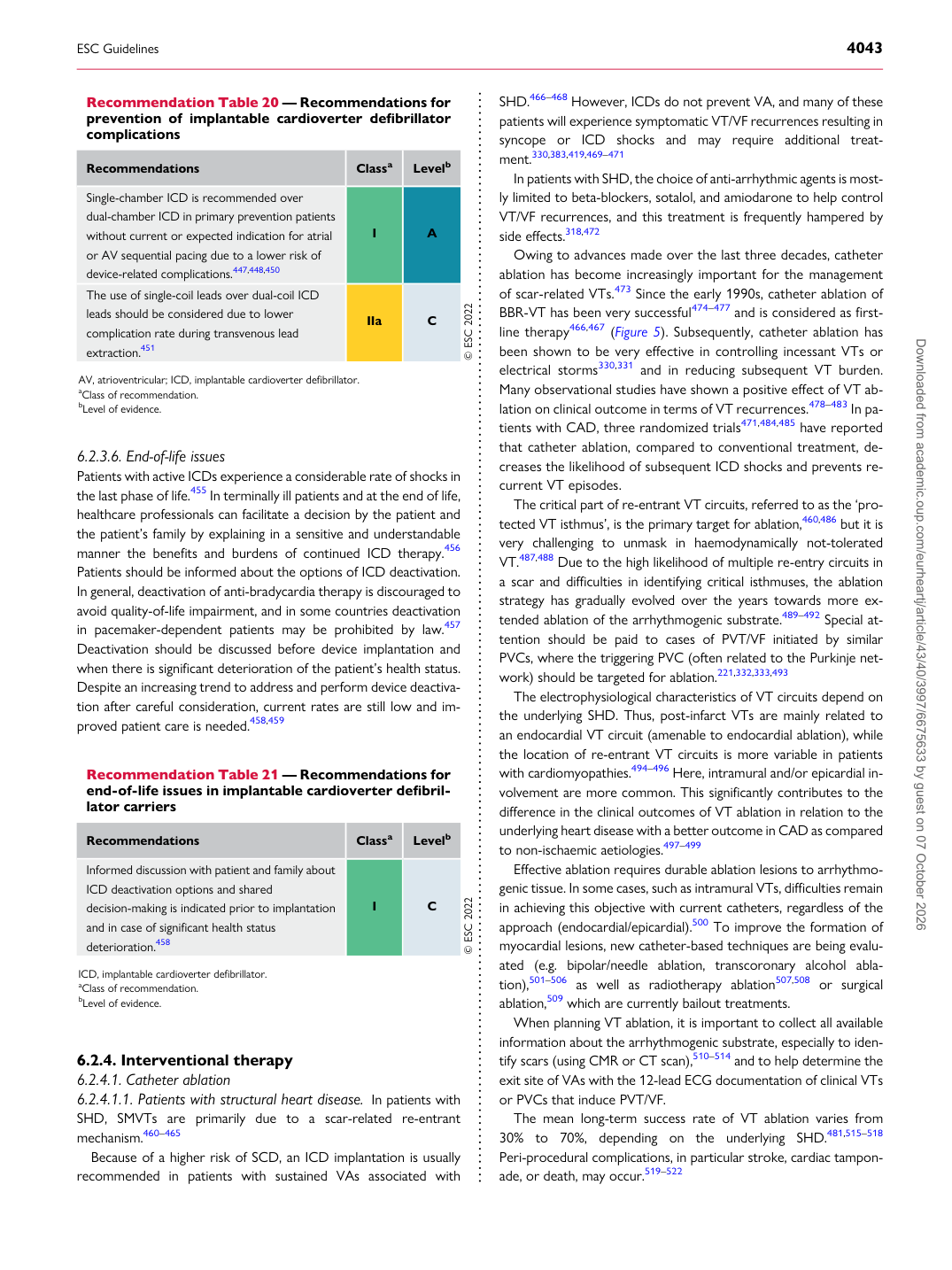
p.47 抽出テキスト
6.2.3.6 End-of-life issues

Patients with active ICDs experience a considerable rate of shocks in the last phase of life.455 In terminally ill patients and at the end of life, healthcare professionals can facilitate a decision by the patient and the patient’s family by explaining in a sensitive and understandable manner the benefits and burdens of continued ICD therapy.456 Patients should be informed about the options of ICD deactivation. In general, deactivation of anti-bradycardia therapy is discouraged to avoid quality-of-life impairment, and in some countries deactivation in pacemaker-dependent patients may be prohibited by law.457 Deactivation should be discussed before device implantation and when there is significant deterioration of the patient’s health status. Despite an increasing trend to address and perform device deactivation after careful consideration, current rates are still low and improved patient care is needed.458,459

6.2.4 Interventional therapy

6.2.4.1. Catheter ablation 6.2.4.1.1. Patients with structural heart disease. In patients with SHD, SMVTs are primarily due to a scar-related re-entrant mechanism.460–465 Because of a higher risk of SCD, an ICD implantation is usually recommended in patients with sustained VAs associated with SHD.466–468 However, ICDs do not prevent VA, and many of these patients will experience symptomatic VT/VF recurrences resulting in syncope or ICD shocks and may require additional treatment.330,383,419,469–471

In patients with SHD, the choice of anti-arrhythmic agents is mostly limited to beta-blockers, sotalol, and amiodarone to help control VT/VF recurrences, and this treatment is frequently hampered by side effects.318,472 Owing to advances made over the last three decades, catheter ablation has become increasingly important for the management of scar-related VTs.473 Since the early 1990s, catheter ablation of BBR-VT has been very successful474–477 and is considered as firstline therapy466,467 (Figure 5). Subsequently, catheter ablation has been shown to be very effective in controlling incessant VTs or electrical storms330,331 and in reducing subsequent VT burden. Many observational studies have shown a positive effect of VT ablation on clinical outcome in terms of VT recurrences.478–483 In patients with CAD, three randomized trials471,484,485 have reported that catheter ablation, compared to conventional treatment, decreases the likelihood of subsequent ICD shocks and prevents recurrent VT episodes. The critical part of re-entrant VT circuits, referred to as the ‘protected VT isthmus’, is the primary target for ablation,460,486 but it is very challenging to unmask in haemodynamically not-tolerated VT.487,488 Due to the high likelihood of multiple re-entry circuits in a scar and difficulties in identifying critical isthmuses, the ablation strategy has gradually evolved over the years towards more extended ablation of the arrhythmogenic substrate.489–492 Special attention should be paid to cases of PVT/VF initiated by similar PVCs, where the triggering PVC (often related to the Purkinje network) should be targeted for ablation.221,332,333,493 The electrophysiological characteristics of VT circuits depend on the underlying SHD. Thus, post-infarct VTs are mainly related to an endocardial VT circuit (amenable to endocardial ablation), while the location of re-entrant VT circuits is more variable in patients with cardiomyopathies.494–496 Here, intramural and/or epicardial involvement are more common. This significantly contributes to the difference in the clinical outcomes of VT ablation in relation to the underlying heart disease with a better outcome in CAD as compared to non-ischaemic aetiologies.497–499 Effective ablation requires durable ablation lesions to arrhythmogenic tissue. In some cases, such as intramural VTs, difficulties remain in achieving this objective with current catheters, regardless of the approach (endocardial/epicardial).500 To improve the formation of myocardial lesions, new catheter-based techniques are being evaluated (e.g. bipolar/needle ablation, transcoronary alcohol ablation),501–506 as well as radiotherapy ablation507,508 or surgical ablation,509 which are currently bailout treatments. When planning VT ablation, it is important to collect all available information about the arrhythmogenic substrate, especially to identify scars (using CMR or CT scan),510–514 and to help determine the exit site of VAs with the 12-lead ECG documentation of clinical VTs or PVCs that induce PVT/VF. The mean long-term success rate of VT ablation varies from 30% to 70%, depending on the underlying SHD.481,515–518 Peri-procedural complications, in particular stroke, cardiac tamponade, or death, may occur.519–522

Recommendation Table 21 — Recommendations for end-of-life issues in implantable cardioverter defibrillator carriers

Recommendations Classa Levelb

Informed discussion with patient and family about ICD deactivation options and shared decision-making is indicated prior to implantation and in case of significant health status deterioration.458 I C © ESC 2022

ICD, implantable cardioverter defibrillator. aClass of recommendation. bLevel of evidence.

Recommendation Table 20 — Recommendations for prevention of implantable cardioverter defibrillator complications

Recommendations Classa Levelb

Single-chamber ICD is recommended over dual-chamber ICD in primary prevention patients without current or expected indication for atrial or AV sequential pacing due to a lower risk of device-related complications.447,448,450 I A The use of single-coil leads over dual-coil ICD leads should be considered due to lower complication rate during transvenous lead extraction.451 IIa C © ESC 2022

AV, atrioventricular; ICD, implantable cardioverter defibrillator. aClass of recommendation. bLevel of evidence. Downloaded from academic.oup.com/eurheartj/article/43/40/3997/6675633 by guest on 07 October 2026