p.46 抽出テキスト
6.2.3.3 Psychosocial impact of implantable cardioverter

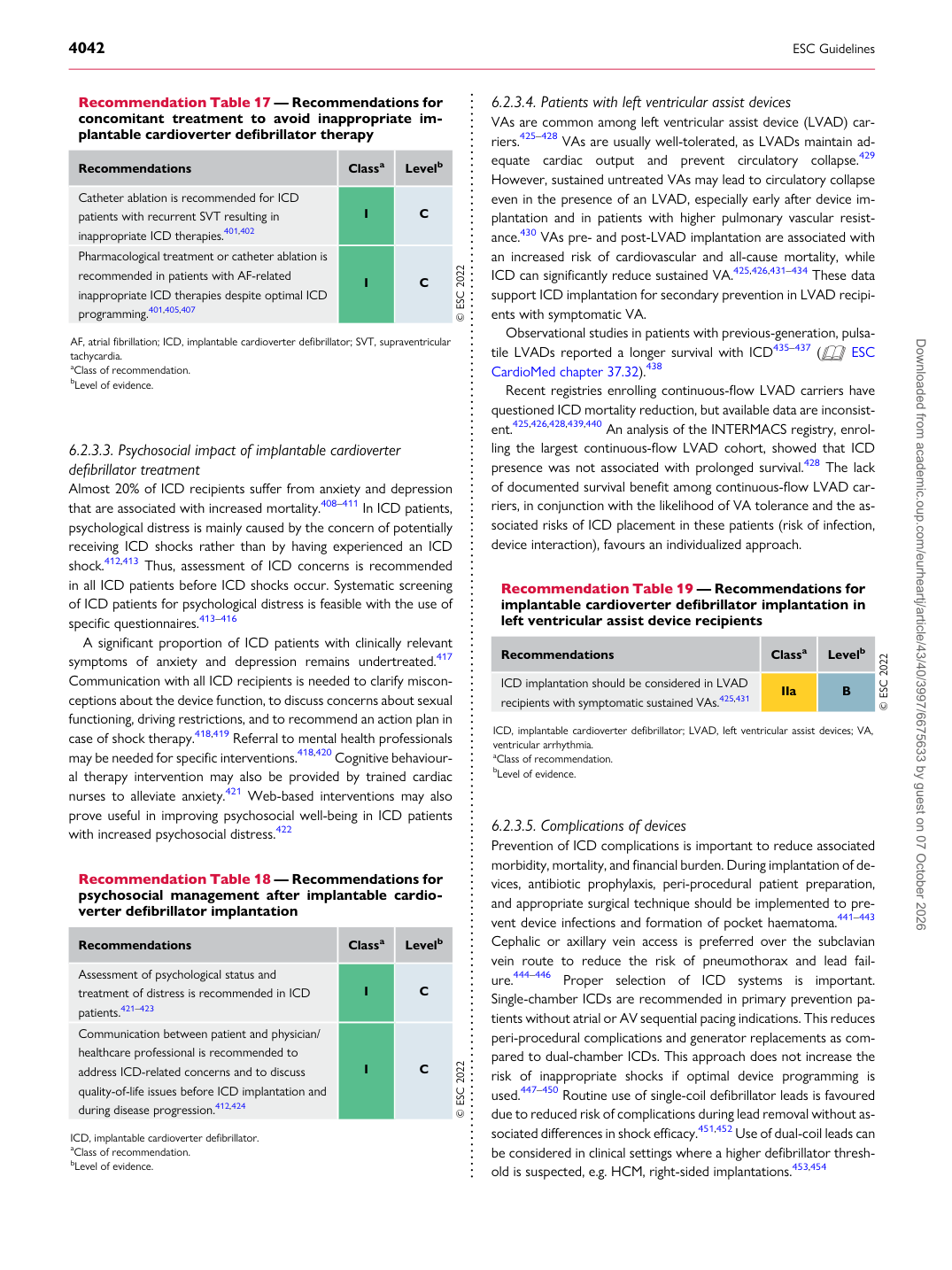
defibrillator treatment Almost 20% of ICD recipients suffer from anxiety and depression that are associated with increased mortality.408–411 In ICD patients, psychological distress is mainly caused by the concern of potentially receiving ICD shocks rather than by having experienced an ICD shock.412,413 Thus, assessment of ICD concerns is recommended in all ICD patients before ICD shocks occur. Systematic screening of ICD patients for psychological distress is feasible with the use of specific questionnaires.413–416 A significant proportion of ICD patients with clinically relevant symptoms of anxiety and depression remains undertreated.417 Communication with all ICD recipients is needed to clarify misconceptions about the device function, to discuss concerns about sexual functioning, driving restrictions, and to recommend an action plan in case of shock therapy.418,419 Referral to mental health professionals may be needed for specific interventions.418,420 Cognitive behavioural therapy intervention may also be provided by trained cardiac nurses to alleviate anxiety.421 Web-based interventions may also prove useful in improving psychosocial well-being in ICD patients with increased psychosocial distress.422 6.2.3.4 Patients with left ventricular assist devices

VAs are common among left ventricular assist device (LVAD) carriers.425–428 VAs are usually well-tolerated, as LVADs maintain adequate cardiac output and prevent circulatory collapse.429 However, sustained untreated VAs may lead to circulatory collapse even in the presence of an LVAD, especially early after device implantation and in patients with higher pulmonary vascular resistance.430 VAs pre- and post-LVAD implantation are associated with an increased risk of cardiovascular and all-cause mortality, while ICD can significantly reduce sustained VA.425,426,431–434 These data support ICD implantation for secondary prevention in LVAD recipients with symptomatic VA. Observational studies in patients with previous-generation, pulsatile LVADs reported a longer survival with ICD435–437 ( ESC CardioMed chapter 37.32).438 Recent registries enrolling continuous-flow LVAD carriers have questioned ICD mortality reduction, but available data are inconsistent.425,426,428,439,440 An analysis of the INTERMACS registry, enrolling the largest continuous-flow LVAD cohort, showed that ICD presence was not associated with prolonged survival.428 The lack of documented survival benefit among continuous-flow LVAD carriers, in conjunction with the likelihood of VA tolerance and the associated risks of ICD placement in these patients (risk of infection, device interaction), favours an individualized approach.

6.2.3.5 Complications of devices

Prevention of ICD complications is important to reduce associated morbidity, mortality, and financial burden. During implantation of devices, antibiotic prophylaxis, peri-procedural patient preparation, and appropriate surgical technique should be implemented to prevent device infections and formation of pocket haematoma.441–443 Cephalic or axillary vein access is preferred over the subclavian vein route to reduce the risk of pneumothorax and lead failure.444–446 Proper selection of ICD systems is important. Single-chamber ICDs are recommended in primary prevention patients without atrial or AV sequential pacing indications. This reduces peri-procedural complications and generator replacements as compared to dual-chamber ICDs. This approach does not increase the risk of inappropriate shocks if optimal device programming is used.447–450 Routine use of single-coil defibrillator leads is favoured due to reduced risk of complications during lead removal without associated differences in shock efficacy.451,452 Use of dual-coil leads can be considered in clinical settings where a higher defibrillator threshold is suspected, e.g. HCM, right-sided implantations.453,454

Recommendation Table 17 — Recommendations for concomitant treatment to avoid inappropriate implantable cardioverter defibrillator therapy

Recommendations Classa Levelb

Catheter ablation is recommended for ICD patients with recurrent SVT resulting in inappropriate ICD therapies.401,402 I C Pharmacological treatment or catheter ablation is recommended in patients with AF-related inappropriate ICD therapies despite optimal ICD programming.401,405,407 I C © ESC 2022

AF, atrial fibrillation; ICD, implantable cardioverter defibrillator; SVT, supraventricular tachycardia. aClass of recommendation. bLevel of evidence.

Recommendation Table 18 — Recommendations for psychosocial management after implantable cardioverter defibrillator implantation

Recommendations Classa Levelb

Assessment of psychological status and treatment of distress is recommended in ICD patients.421–423 I C Communication between patient and physician/ healthcare professional is recommended to address ICD-related concerns and to discuss quality-of-life issues before ICD implantation and during disease progression.412,424 I C © ESC 2022

ICD, implantable cardioverter defibrillator. aClass of recommendation. bLevel of evidence. Recommendation Table 19 — Recommendations for implantable cardioverter defibrillator implantation in left ventricular assist device recipients

Recommendations Classa Levelb

ICD implantation should be considered in LVAD recipients with symptomatic sustained VAs.425,431 IIa B © ESC 2022

ICD, implantable cardioverter defibrillator; LVAD, left ventricular assist devices; VA, ventricular arrhythmia. aClass of recommendation. bLevel of evidence. Downloaded from academic.oup.com/eurheartj/article/43/40/3997/6675633 by guest on 07 October 2026