p.45 抽出テキスト
6.2.3 Special aspects of device therapy

6.2.3.1. Optimization of device programming Optimization of ICD programming is essential to minimize the burden of ICD therapy and to improve patient outcome.373–375 Detailed recommendations are available in expert consensus papers.376,377 Bradycardia mode should be customized to prevent unnecessary RV pacing, thus reducing heart failure hospitalizations and all-cause mortality378–380 ( ESC CardioMed chapter 43.21).381 A tachycardia detection programming strategy incorporating prolonged settings and high rate thresholds (≥188 b.p.m. Advance III trial,382 ≥200 MADIT-RIT383) reduces ICD therapies and all-cause mortality without increasing the risk of syncope.373,382,383 The evidence is stronger for primary prevention compared to secondary prevention indications382 ( ESC CardioMed chapter 43.21).381 Consistent use of SVT/VT discriminators even in rates up to 230 b.p.m. is recommended in ICD recipients without complete heart block to reduce inappropriate therapies.383–385 Proper atrial sensing is a prerequisite for activation of dual-chamber discriminators376 ( ESC CardioMed chapter 43.21).381 In general, a multi-zone detection programming is favoured to enable tailored use of detection and therapy settings at different tachycardia rates.383,386 A single-zone programming with a high cut-off rate may be considered in patients with a high likelihood of VF only (e.g. primary electrical diseases).387 In subcutaneous ICDs, a dual-zone configuration should be adopted. Standardized programming including a lower ‘conditional shock’ zone with activated discrimination algorithms and a higher ‘shock zone’ based on rate criteria only has been shown to reduce inappropriate shock rates without compromising patient safety.388–390 Systematic use of ATP before shock delivery, also for very fast ventricular tachyarrhythmias, has been shown to reduce shock therapy without increase in arrhythmic syncope.375,384,391 Burst ATP is preferred over ramp due to increased efficacy in first tachycardia termination.392 Incorporation of remote monitoring into follow-up practice of ICD recipients should be promoted to optimize surveillance of device integrity, to enable prompt detection and management of actionable events, and to prevent occurrence of inappropriate shocks393–396 ( ESC CardioMed chapter 43. 21).381 The proposed recommendations for optimal device programming are applicable to the majority of ICD recipients. Customization may be needed in individual patients. 6.2.3.2 Concomitant treatment to avoid inappropriate

implantable cardioverter defibrillator therapy Apart from optimization of device programming, pharmacological and/or invasive management may prevent inappropriate ICD therapy. Beta-blockers (carvedilol superior to metoprolol in MADIT-CRT) should be titrated to the maximal tolerated dose in heart failure patients to reduce the risk of inappropriate therapy.400 In patients with inappropriate therapies due to recurrent SVT, catheter ablation should be first-line treatment, given its high success and low complication rate.302,401–403 In case of AF-related inappropriate therapies, unresponsive to optimized pharmacological rate control treatment, individualized treatment strategy (rate vs. rhythm) dependent on patient characteristics is suggested.348 In patients with early AF, adoption of a rhythm control strategy improved patient outcome in the EAST-AFNET 4 trial.404 In CRT-defibrillator patients, AV node ablation has been associated with reduced inappropriate ICD shocks and lower hospitalization rates compared to drug treatment405 ( ESC CardioMed chapter 41.14).406

The WCD may be considered in the early phase after MI in selected patients.371,372 IIb B © ESC 2022

ICD, implantable cardioverter defibrillator; WCD, wearable cardioverter defibrillator. aClass of recommendation. bLevel of evidence.

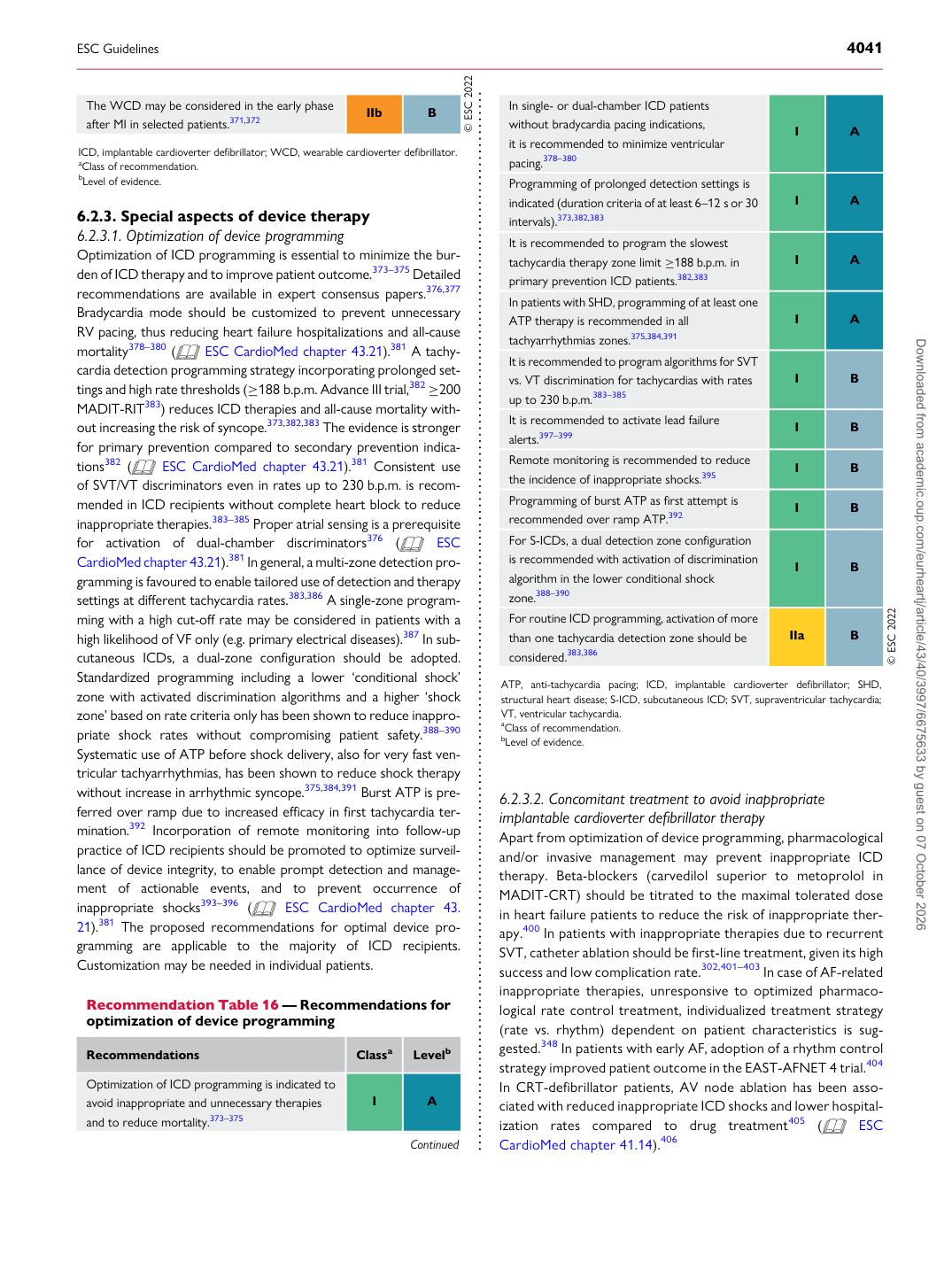
Recommendation Table 16 — Recommendations for optimization of device programming

Recommendations Classa Levelb

Optimization of ICD programming is indicated to avoid inappropriate and unnecessary therapies and to reduce mortality.373–375 I A

Continued In single- or dual-chamber ICD patients

without bradycardia pacing indications, it is recommended to minimize ventricular pacing.378–380 I A Programming of prolonged detection settings is indicated (duration criteria of at least 6–12 s or 30 intervals).373,382,383 I A It is recommended to program the slowest tachycardia therapy zone limit ≥188 b.p.m. in primary prevention ICD patients.382,383 I A In patients with SHD, programming of at least one ATP therapy is recommended in all tachyarrhythmias zones.375,384,391 I A It is recommended to program algorithms for SVT vs. VT discrimination for tachycardias with rates up to 230 b.p.m.383–385 I B It is recommended to activate lead failure alerts.397–399 I B Remote monitoring is recommended to reduce the incidence of inappropriate shocks.395 I B Programming of burst ATP as first attempt is recommended over ramp ATP.392 I B For S-ICDs, a dual detection zone configuration is recommended with activation of discrimination algorithm in the lower conditional shock zone.388–390 I B For routine ICD programming, activation of more than one tachycardia detection zone should be considered.383,386 IIa B © ESC 2022

ATP, anti-tachycardia pacing; ICD, implantable cardioverter defibrillator; SHD, structural heart disease; S-ICD, subcutaneous ICD; SVT, supraventricular tachycardia; VT, ventricular tachycardia. aClass of recommendation. bLevel of evidence. Downloaded from academic.oup.com/eurheartj/article/43/40/3997/6675633 by guest on 07 October 2026