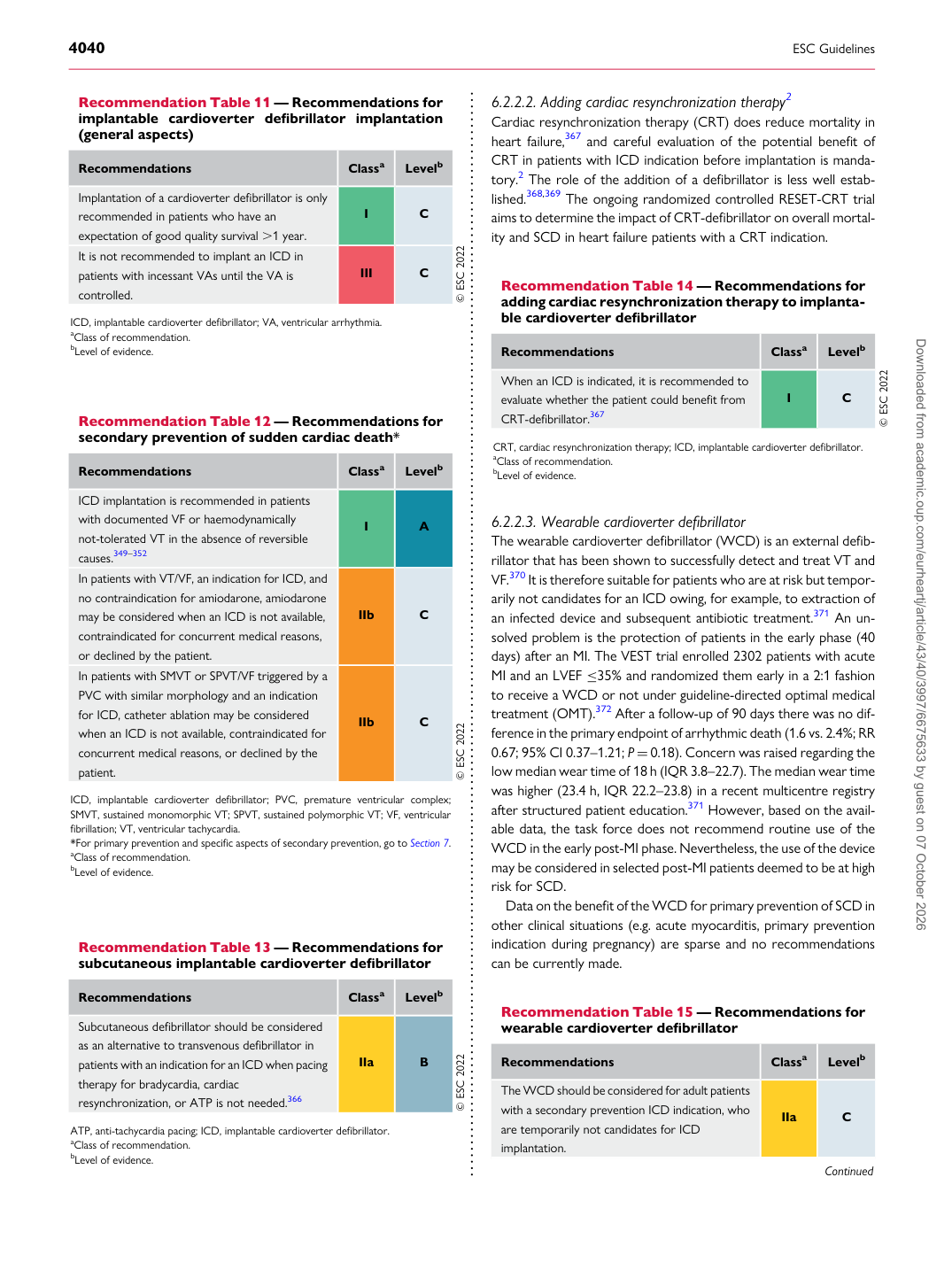
p.44 抽出テキスト
6.2.2.2. Adding cardiac resynchronization therapy2 Cardiac resynchronization therapy (CRT) does reduce mortality in heart failure,367 and careful evaluation of the potential benefit of CRT in patients with ICD indication before implantation is mandatory.2 The role of the addition of a defibrillator is less well established.368,369 The ongoing randomized controlled RESET-CRT trial aims to determine the impact of CRT-defibrillator on overall mortality and SCD in heart failure patients with a CRT indication.

6.2.2.3 Wearable cardioverter defibrillator

The wearable cardioverter defibrillator (WCD) is an external defibrillator that has been shown to successfully detect and treat VT and VF.370 It is therefore suitable for patients who are at risk but temporarily not candidates for an ICD owing, for example, to extraction of an infected device and subsequent antibiotic treatment.371 An unsolved problem is the protection of patients in the early phase (40 days) after an MI. The VEST trial enrolled 2302 patients with acute MI and an LVEF ≤35% and randomized them early in a 2:1 fashion to receive a WCD or not under guideline-directed optimal medical treatment (OMT).372 After a follow-up of 90 days there was no difference in the primary endpoint of arrhythmic death (1.6 vs. 2.4%; RR 0.67; 95% CI 0.37–1.21; P = 0.18). Concern was raised regarding the low median wear time of 18 h (IQR 3.8–22.7). The median wear time was higher (23.4 h, IQR 22.2–23.8) in a recent multicentre registry after structured patient education.371 However, based on the available data, the task force does not recommend routine use of the WCD in the early post-MI phase. Nevertheless, the use of the device may be considered in selected post-MI patients deemed to be at high risk for SCD. Data on the benefit of the WCD for primary prevention of SCD in other clinical situations (e.g. acute myocarditis, primary prevention indication during pregnancy) are sparse and no recommendations can be currently made.

Recommendation Table 12 — Recommendations for secondary prevention of sudden cardiac death*

Recommendations Classa Levelb

ICD implantation is recommended in patients with documented VF or haemodynamically not-tolerated VT in the absence of reversible causes.349–352 I A In patients with VT/VF, an indication for ICD, and no contraindication for amiodarone, amiodarone may be considered when an ICD is not available, contraindicated for concurrent medical reasons, or declined by the patient. IIb C In patients with SMVT or SPVT/VF triggered by a PVC with similar morphology and an indication for ICD, catheter ablation may be considered when an ICD is not available, contraindicated for concurrent medical reasons, or declined by the patient. IIb C © ESC 2022

ICD, implantable cardioverter defibrillator; PVC, premature ventricular complex; SMVT, sustained monomorphic VT; SPVT, sustained polymorphic VT; VF, ventricular fibrillation; VT, ventricular tachycardia. *For primary prevention and specific aspects of secondary prevention, go to Section 7. aClass of recommendation. bLevel of evidence. Recommendation Table 14 — Recommendations for adding cardiac resynchronization therapy to implantable cardioverter defibrillator

Recommendations Classa Levelb

When an ICD is indicated, it is recommended to evaluate whether the patient could benefit from CRT-defibrillator.367 I C © ESC 2022

CRT, cardiac resynchronization therapy; ICD, implantable cardioverter defibrillator. aClass of recommendation. bLevel of evidence.

Recommendation Table 11 — Recommendations for implantable cardioverter defibrillator implantation (general aspects)

Recommendations Classa Levelb

Implantation of a cardioverter defibrillator is only recommended in patients who have an expectation of good quality survival .1 year. I C It is not recommended to implant an ICD in patients with incessant VAs until the VA is controlled. III C © ESC 2022

ICD, implantable cardioverter defibrillator; VA, ventricular arrhythmia. aClass of recommendation. bLevel of evidence.

Recommendation Table 15 — Recommendations for wearable cardioverter defibrillator

Recommendations Classa Levelb

The WCD should be considered for adult patients with a secondary prevention ICD indication, who are temporarily not candidates for ICD implantation. IIa C

Continued

Recommendation Table 13 — Recommendations for subcutaneous implantable cardioverter defibrillator

Recommendations Classa Levelb

Subcutaneous defibrillator should be considered as an alternative to transvenous defibrillator in patients with an indication for an ICD when pacing therapy for bradycardia, cardiac resynchronization, or ATP is not needed.366 IIa B © ESC 2022

ATP, anti-tachycardia pacing; ICD, implantable cardioverter defibrillator. aClass of recommendation. bLevel of evidence. Downloaded from academic.oup.com/eurheartj/article/43/40/3997/6675633 by guest on 07 October 2026