p.43 抽出テキスト
a primary prevention ICD.357,360–362 Women have been underrepresented in all primary prevention trials and data suggest that they may benefit less.361 In general, the SCD risk needs to be weighed against the individual’s competing risk of a non-arrhythmic death.363,364 In the context of patient-centred medicine, physicians and healthcare professionals should engage ICD candidates and recipients in a joint decision process. Communication of relevant information, ensuring a good understanding of the benefits, risks, and potential consequences of different options, to enable the patient to partake in decision-making is mandatory. This shared decision-making process should discuss the different scenarios including primary prevention ICD implantation, consideration of ICD generator replacement, and end-of-life care. Importantly, the perception of ‘good quality of life’ depends on numerous factors that are weighed differently by people with different cultural, religious, and socioeconomic backgrounds. Although clinical prediction scores, such as the MADIT-ICD benefit score,365 may provide helpful additional information, clinical decision-making should not only rely on such scores. Complications of ICD therapy include inappropriate therapies, lead fractures, and device-related infections. A subcutaneous implantable cardioverter defibrillator (S-ICD) has been introduced to address problems related to transvenous leads. S-ICD has no intravascular lead and therefore cannot deliver ATP. In the PRAETORIAN trial, 849 patients with an ICD but no pacing indication were randomized to an S-ICD or a transvenous ICD.366 Over a mean follow-up of 49 months, non-inferiority was shown for the primary endpoint of device-related complications and inappropriate shocks. The rate of inappropriate shocks was 9.7% in the S-ICD group and 7.3% in the ICD group (HR 1.43; 95% CI 0.89–2.30) and the rate of device related complications was 5.9% in the S-ICD and 9.8% in the ICD group (HR 0.69; 95% CI 0.44–1.09). There was also no difference in the secondary endpoint of death and appropriate shocks, but the trial had not been powered to show noninferiority for this secondary endpoint. Of note, more than 80% of the included patients were in NYHA class I and II and the included patients were younger than in prior ICD trials.

Patient r equiring a drug associated with QT p r olongation a

Assessment of patient risk p r ofile be f o

f f r e initiation

ECG at baselin e , after 1 d

, a y and after1–2

a a

w eeks of initiation or inc r ease in dosage c

Conti n ue t r eatment

In f orm patient about warning symptoms (syncope)

f f Cont r ol changes in r enal and hepatic function

Be a wa

a a r e of potential drug interactions

Initiate t r eatment

QTc >500 ms Contraindicated : Do not initiate t

: r eatment

Sta r t drug if st r ong indication with close f oll

f f o w-up

Long QT synd r ome or baseline QTc >500 ms b

Hypokalaemia/ h ypomagnesaemia/

Renal failu r e/li v er failu r e/

L V L L h ype r t r op h y/ Hea r t failu r e/ A d ditional QT p r olonging drug

N

N

N Consider to change to dif f f f e

f f r ent drug

If st r ong indication , consider to

, r educe dose

Consider to assess drug serum l e v el

Y Y Y

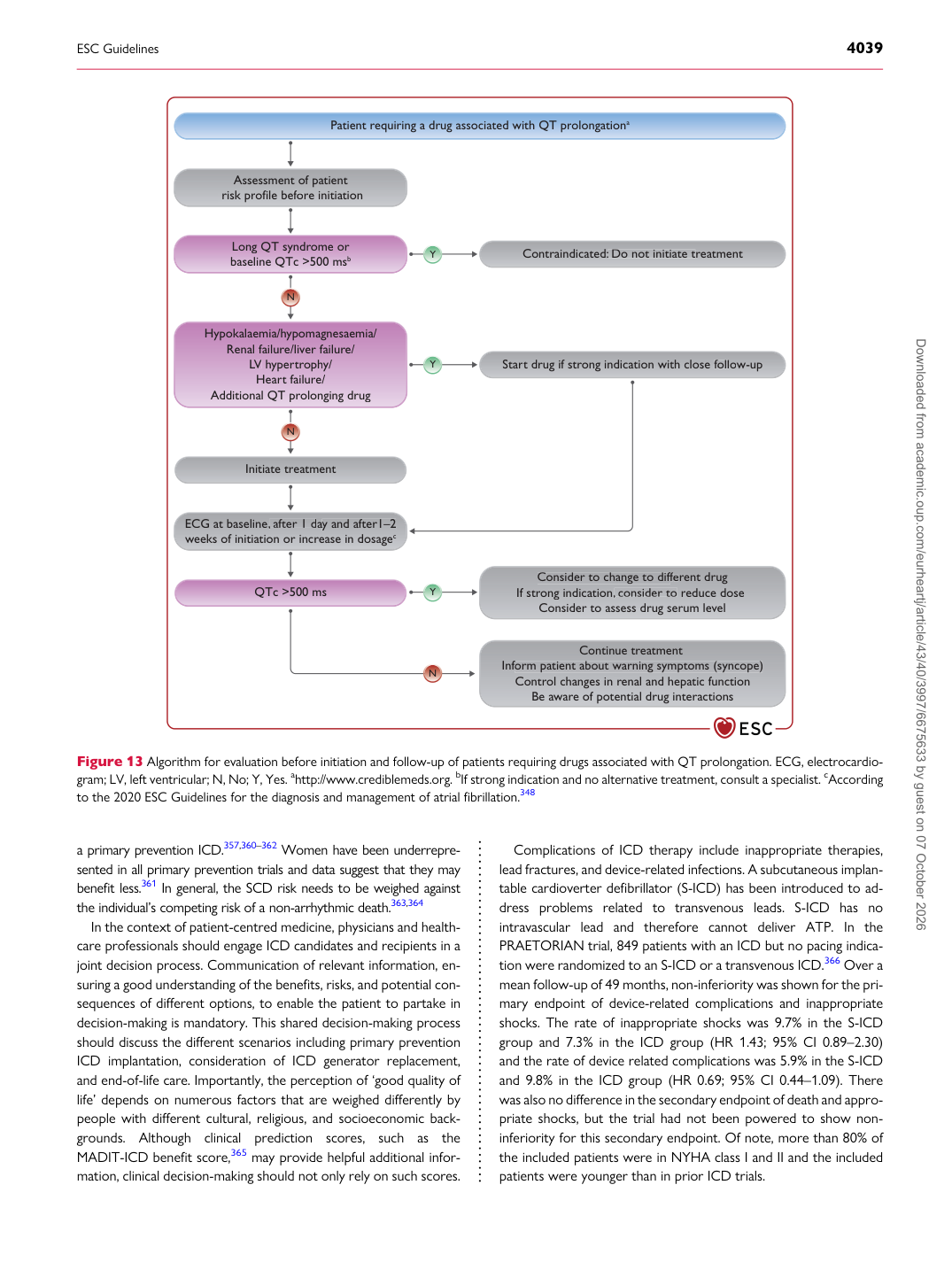
Figure 13 Algorithm for evaluation before initiation and follow-up of patients requiring drugs associated with QT prolongation. ECG, electrocardiogram; LV, left ventricular; N, No; Y, Yes. ahttp://www.crediblemeds.org. bIf strong indication and no alternative treatment, consult a specialist. cAccording to the 2020 ESC Guidelines for the diagnosis and management of atrial fibrillation.348 Downloaded from academic.oup.com/eurheartj/article/43/40/3997/6675633 by guest on 07 October 2026