p.42 抽出テキスト
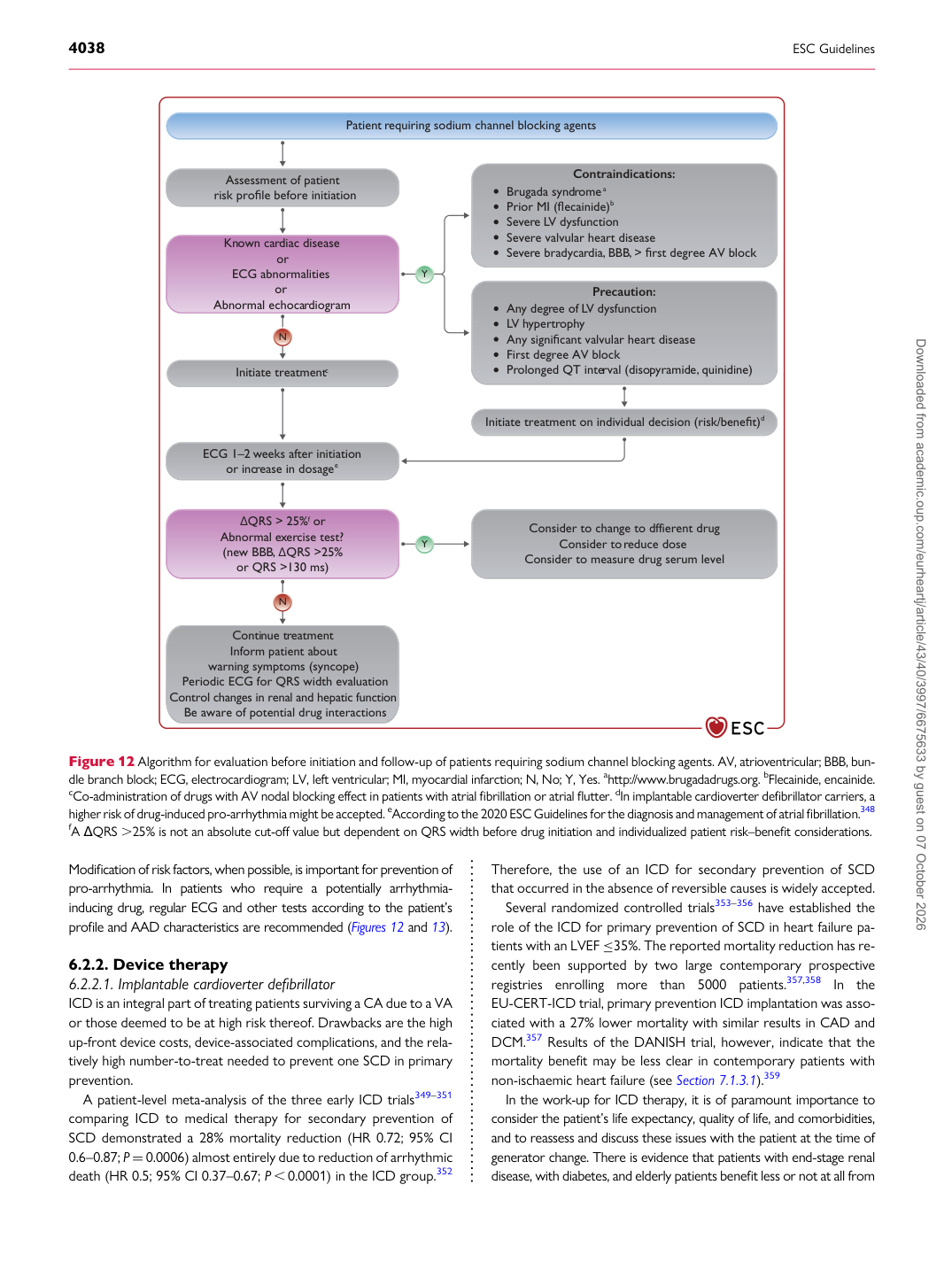
Modification of risk factors, when possible, is important for prevention of pro-arrhythmia. In patients who require a potentially arrhythmiainducing drug, regular ECG and other tests according to the patient’s profile and AAD characteristics are recommended (Figures 12 and 13).

6.2.2 Device therapy

6.2.2.1. Implantable cardioverter defibrillator ICD is an integral part of treating patients surviving a CA due to a VA or those deemed to be at high risk thereof. Drawbacks are the high up-front device costs, device-associated complications, and the relatively high number-to-treat needed to prevent one SCD in primary prevention.

A patient-level meta-analysis of the three early ICD trials349–351 comparing ICD to medical therapy for secondary prevention of SCD demonstrated a 28% mortality reduction (HR 0.72; 95% CI 0.6–0.87; P = 0.0006) almost entirely due to reduction of arrhythmic death (HR 0.5; 95% CI 0.37–0.67; P , 0.0001) in the ICD group.352 Therefore, the use of an ICD for secondary prevention of SCD that occurred in the absence of reversible causes is widely accepted.

Several randomized controlled trials353–356 have established the role of the ICD for primary prevention of SCD in heart failure patients with an LVEF ≤35%. The reported mortality reduction has recently been supported by two large contemporary prospective registries enrolling more than 5000 patients.357,358 In the EU-CERT-ICD trial, primary prevention ICD implantation was associated with a 27% lower mortality with similar results in CAD and DCM.357 Results of the DANISH trial, however, indicate that the mortality benefit may be less clear in contemporary patients with non-ischaemic heart failure (see Section 7.1.3.1).359 In the work-up for ICD therapy, it is of paramount importance to consider the patient’s life expectancy, quality of life, and comorbidities, and to reassess and discuss these issues with the patient at the time of generator change. There is evidence that patients with end-stage renal disease, with diabetes, and elderly patients benefit less or not at all from

Patient requiring sodium channel blocking agents

Assessment of patient risk profile before initiation

ECG 1–2 weeks after initiation

or increase in dosagee

Initiate treatmentc

Initiate treatment on individual decision (risk/benefit)d

Known cardiac disease

or ECG abnormalities or Abnormal echocardiogram

ΔQRS > 25%f or Abnormal exercise test? (new BBB, ΔQRS >25%

or QRS >130 ms) Contraindications:

N

N Brugada syndrome a

Prior MI (flecainide)b Severe LV dysfunction Severe valvular heart disease Severe bradycardia, BBB, > first degree AV block

Precaution: Any degree of LV dysfunction LV hypertrophy Any significant valvular heart disease First degree AV block Prolonged QT interval (disopyramide, quinidine)

Consider to change to dffierent drug Consider to reduce dose Consider to measure drug serum level

Y

Y

Continue treatment Inform patient about warning symptoms (syncope) Periodic ECG for QRS width evaluation Control changes in renal and hepatic function

Be aware of potential drug interactions

Figure 12 Algorithm for evaluation before initiation and follow-up of patients requiring sodium channel blocking agents. AV, atrioventricular; BBB, bundle branch block; ECG, electrocardiogram; LV, left ventricular; MI, myocardial infarction; N, No; Y, Yes. ahttp://www.brugadadrugs.org. bFlecainide, encainide. cCo-administration of drugs with AV nodal blocking effect in patients with atrial fibrillation or atrial flutter. dIn implantable cardioverter defibrillator carriers, a higher risk of drug-induced pro-arrhythmia might be accepted. eAccording to the 2020 ESC Guidelines for the diagnosis and management of atrial fibrillation.348 fA ΔQRS .25% is not an absolute cut-off value but dependent on QRS width before drug initiation and individualized patient risk–benefit considerations. Downloaded from academic.oup.com/eurheartj/article/43/40/3997/6675633 by guest on 07 October 2026