p.38 抽出テキスト
6.2 Long-term management

6.2.1. Pharmacotherapy Optimal medical treatment of the underlying cardiac disease, including the maximal tolerated doses of heart failure medication, is mandatory.341 In patients with heart failure with reduced ejection fraction (HfrEF), the 2021 ESC Guidelines for the diagnosis and treatment of acute and chronic heart failure recommend angiotensinconverting enzyme inhibitor (ACE-I)/angiotensin receptor blocker (ARB)/angiotensin receptor neprilysin inhibitors (ARNIs), mineralocorticoid receptor antagonists (MRAs), beta-blockers, and sodium– glucose co-transporter 2 (SGLT2) inhibitors to reduce mortality due to heart failure and SCD.342

AADs have an important role as adjunctive therapy in the management of VA, especially in symptomatic patients (Table 8). Until now, no AAD except for beta-blockers has demonstrated reduction in allcause mortality. Each drug has a significant potential for causing adverse events, including pro-arrhythmia. For example, numerous AADs, as well as a large number of drugs with other therapeutic indications, can prolong the QT interval (http://www.crediblemeds.org) and provoke TdP, have negative chronotropic effects, may deteriorate heart failure, and cause bradycardia. Several drugs increase the risk of VA in patients with BrS (http://www.brugadadrugs.org).

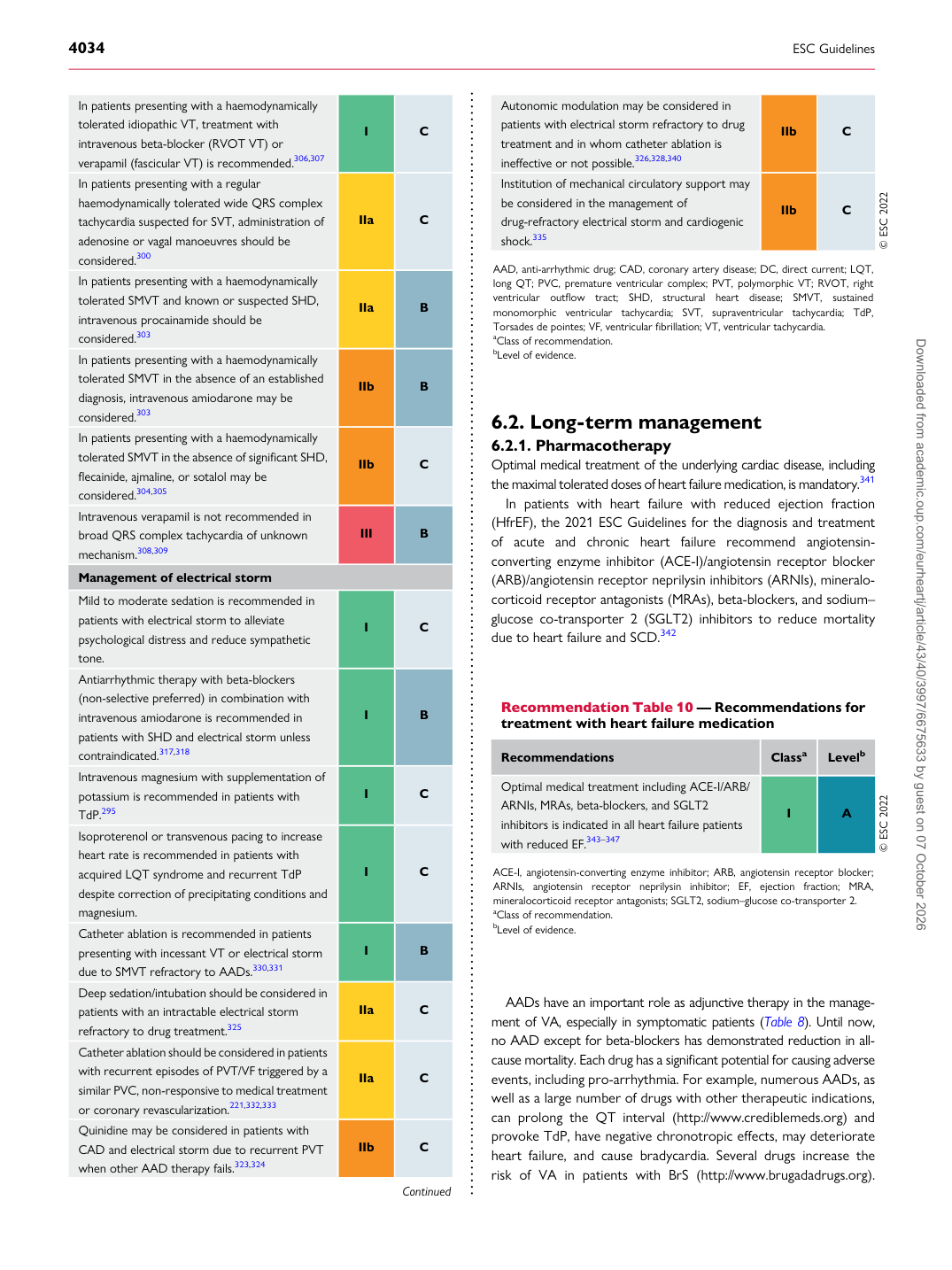
In patients presenting with a haemodynamically tolerated idiopathic VT, treatment with intravenous beta-blocker (RVOT VT) or verapamil (fascicular VT) is recommended.306,307 I C In patients presenting with a regular haemodynamically tolerated wide QRS complex tachycardia suspected for SVT, administration of adenosine or vagal manoeuvres should be considered.300 IIa C In patients presenting with a haemodynamically tolerated SMVT and known or suspected SHD, intravenous procainamide should be considered.303 IIa B In patients presenting with a haemodynamically tolerated SMVT in the absence of an established diagnosis, intravenous amiodarone may be considered.303 IIb B In patients presenting with a haemodynamically tolerated SMVT in the absence of significant SHD, flecainide, ajmaline, or sotalol may be considered.304,305 IIb C Intravenous verapamil is not recommended in broad QRS complex tachycardia of unknown mechanism.308,309 III B Management of electrical storm Mild to moderate sedation is recommended in patients with electrical storm to alleviate psychological distress and reduce sympathetic tone. I C Antiarrhythmic therapy with beta-blockers (non-selective preferred) in combination with intravenous amiodarone is recommended in patients with SHD and electrical storm unless contraindicated.317,318 I B Intravenous magnesium with supplementation of potassium is recommended in patients with TdP.295 I C Isoproterenol or transvenous pacing to increase heart rate is recommended in patients with acquired LQT syndrome and recurrent TdP despite correction of precipitating conditions and magnesium. I C Catheter ablation is recommended in patients presenting with incessant VT or electrical storm due to SMVT refractory to AADs.330,331 I B Deep sedation/intubation should be considered in patients with an intractable electrical storm refractory to drug treatment.325 IIa C Catheter ablation should be considered in patients with recurrent episodes of PVT/VF triggered by a similar PVC, non-responsive to medical treatment or coronary revascularization.221,332,333 IIa C Quinidine may be considered in patients with CAD and electrical storm due to recurrent PVT when other AAD therapy fails.323,324 IIb C

Continued Autonomic modulation may be considered in

patients with electrical storm refractory to drug treatment and in whom catheter ablation is ineffective or not possible.326,328,340 IIb C Institution of mechanical circulatory support may be considered in the management of drug-refractory electrical storm and cardiogenic shock.335 IIb C © ESC 2022

AAD, anti-arrhythmic drug; CAD, coronary artery disease; DC, direct current; LQT, long QT; PVC, premature ventricular complex; PVT, polymorphic VT; RVOT, right ventricular outflow tract; SHD, structural heart disease; SMVT, sustained monomorphic ventricular tachycardia; SVT, supraventricular tachycardia; TdP, Torsades de pointes; VF, ventricular fibrillation; VT, ventricular tachycardia. aClass of recommendation. bLevel of evidence.

Recommendation Table 10 — Recommendations for treatment with heart failure medication

Recommendations Classa Levelb

Optimal medical treatment including ACE-I/ARB/ ARNIs, MRAs, beta-blockers, and SGLT2 inhibitors is indicated in all heart failure patients with reduced EF.343–347 I A © ESC 2022

ACE-I, angiotensin-converting enzyme inhibitor; ARB, angiotensin receptor blocker; ARNIs, angiotensin receptor neprilysin inhibitor; EF, ejection fraction; MRA, mineralocorticoid receptor antagonists; SGLT2, sodium–glucose co-transporter 2. aClass of recommendation. bLevel of evidence. Downloaded from academic.oup.com/eurheartj/article/43/40/3997/6675633 by guest on 07 October 2026