p.37 抽出テキスト
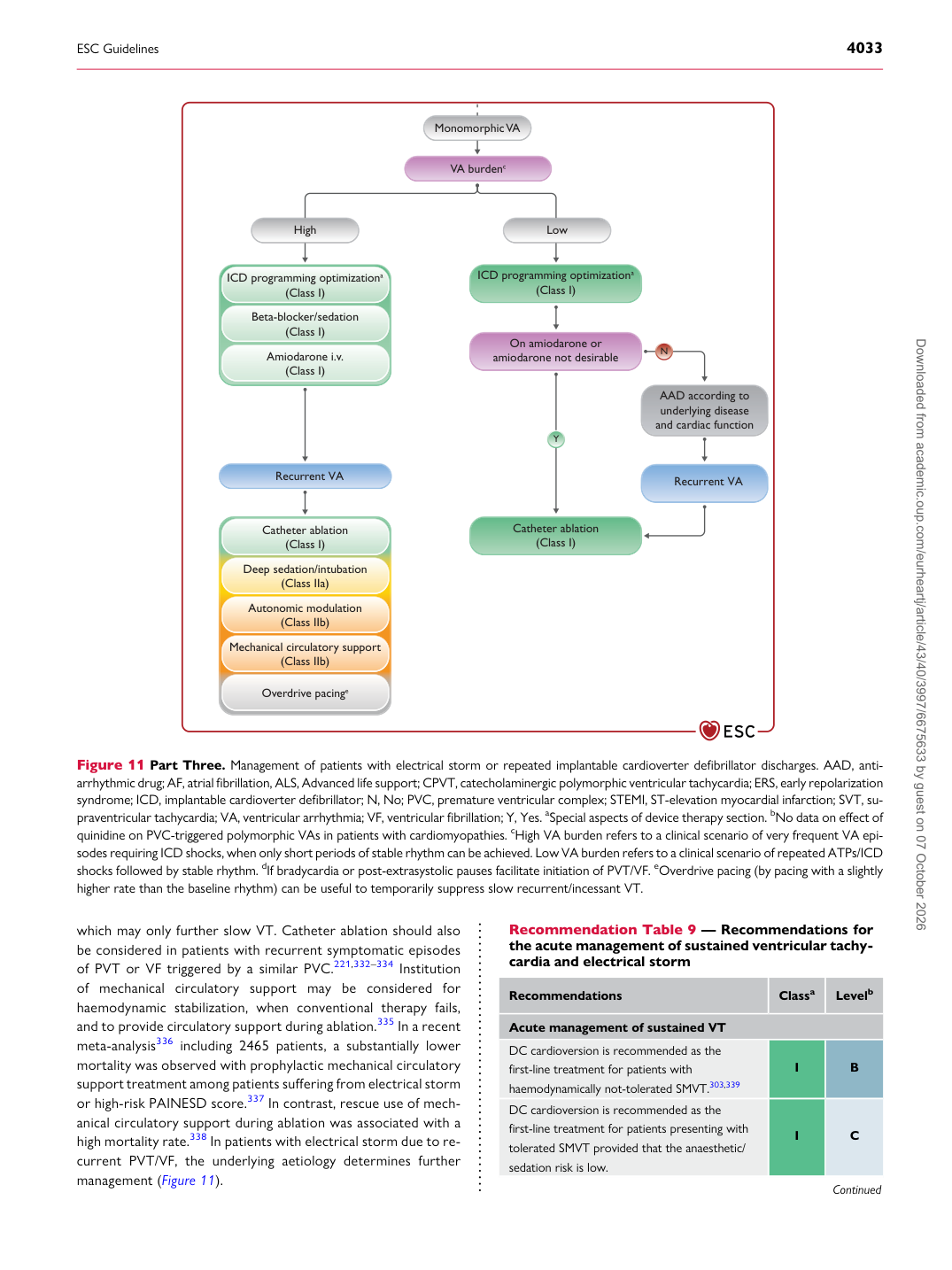
which may only further slow VT. Catheter ablation should also be considered in patients with recurrent symptomatic episodes of PVT or VF triggered by a similar PVC.221,332–334 Institution of mechanical circulatory support may be considered for haemodynamic stabilization, when conventional therapy fails, and to provide circulatory support during ablation.335 In a recent meta-analysis336 including 2465 patients, a substantially lower mortality was observed with prophylactic mechanical circulatory support treatment among patients suffering from electrical storm or high-risk PAINESD score.337 In contrast, rescue use of mechanical circulatory support during ablation was associated with a high mortality rate.338 In patients with electrical storm due to recurrent PVT/VF, the underlying aetiology determines further management (Figure 11). N

Y

VA burdenc

MonomorphicVA

High Low

ICD programming optimizationa

(Class I) ICD programming optimizationa

(Class I)

On amiodarone or amiodarone not desirable

Catheter ablation

(Class I) AAD according to underlying disease and cardiac function

Beta-blocker/sedation

(Class I)

Catheter ablation

(Class I) Deep sedation/intubation

(Class IIa) Autonomic modulation

(Class IIb) Mechanical circulatory support

(Class IIb)

Overdrive pacinge

Amiodarone i.v.

(Class I)

Recurrent VA Recurrent VA

Figure 11 Part Three. Management of patients with electrical storm or repeated implantable cardioverter defibrillator discharges. AAD, antiarrhythmic drug; AF, atrial fibrillation, ALS, Advanced life support; CPVT, catecholaminergic polymorphic ventricular tachycardia; ERS, early repolarization syndrome; ICD, implantable cardioverter defibrillator; N, No; PVC, premature ventricular complex; STEMI, ST-elevation myocardial infarction; SVT, supraventricular tachycardia; VA, ventricular arrhythmia; VF, ventricular fibrillation; Y, Yes. aSpecial aspects of device therapy section. bNo data on effect of quinidine on PVC-triggered polymorphic VAs in patients with cardiomyopathies. cHigh VA burden refers to a clinical scenario of very frequent VA episodes requiring ICD shocks, when only short periods of stable rhythm can be achieved. Low VA burden refers to a clinical scenario of repeated ATPs/ICD shocks followed by stable rhythm. dIf bradycardia or post-extrasystolic pauses facilitate initiation of PVT/VF. eOverdrive pacing (by pacing with a slightly higher rate than the baseline rhythm) can be useful to temporarily suppress slow recurrent/incessant VT.

Recommendation Table 9 — Recommendations for the acute management of sustained ventricular tachycardia and electrical storm

Recommendations Classa Levelb

Acute management of sustained VT DC cardioversion is recommended as the first-line treatment for patients with haemodynamically not-tolerated SMVT.303,339 I B DC cardioversion is recommended as the first-line treatment for patients presenting with tolerated SMVT provided that the anaesthetic/ sedation risk is low. I C

Continued Downloaded from academic.oup.com/eurheartj/article/43/40/3997/6675633 by guest on 07 October 2026