p.36 抽出テキスト
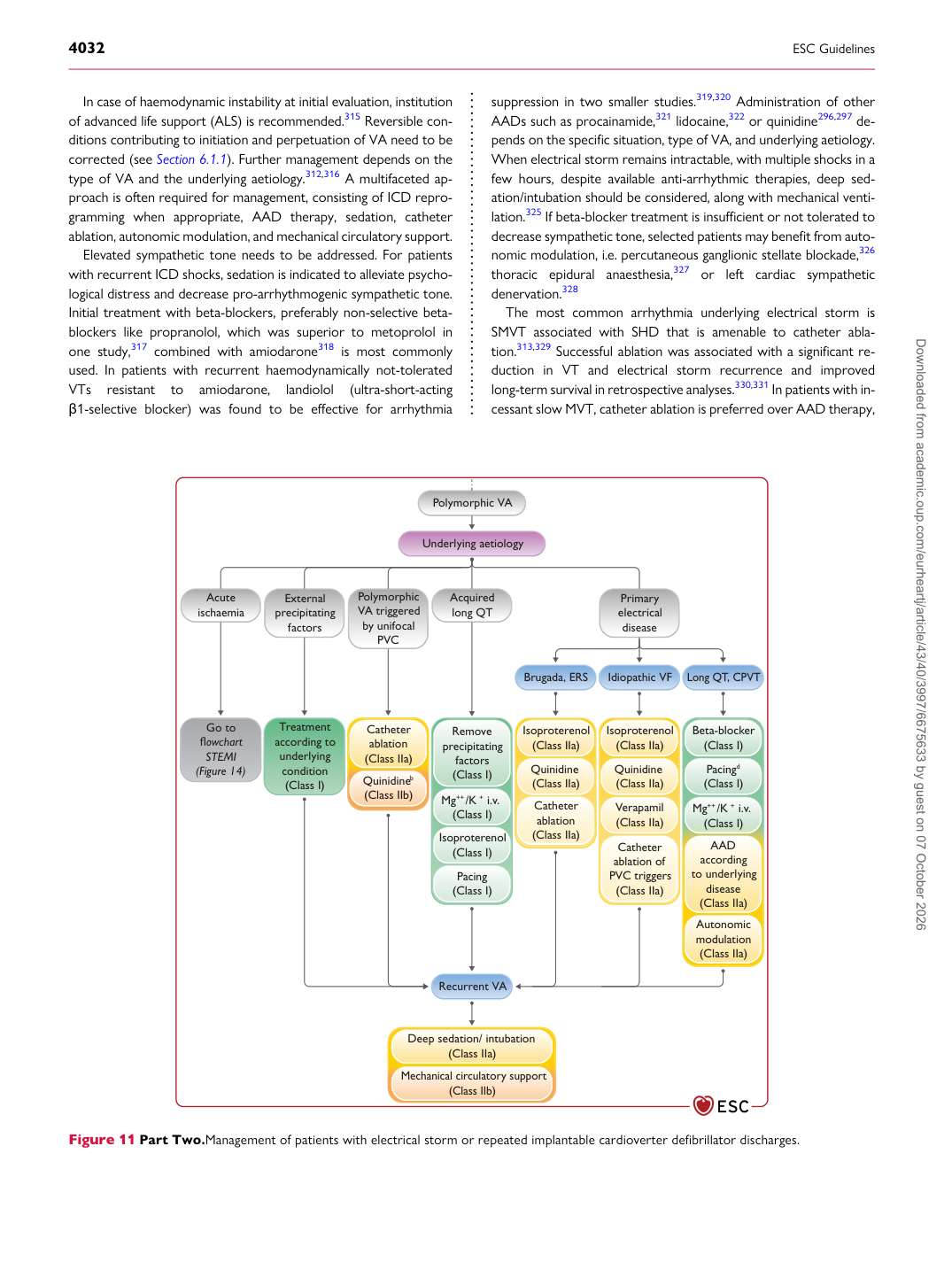
In case of haemodynamic instability at initial evaluation, institution of advanced life support (ALS) is recommended.315 Reversible conditions contributing to initiation and perpetuation of VA need to be corrected (see Section 6.1.1). Further management depends on the type of VA and the underlying aetiology.312,316 A multifaceted approach is often required for management, consisting of ICD reprogramming when appropriate, AAD therapy, sedation, catheter ablation, autonomic modulation, and mechanical circulatory support. Elevated sympathetic tone needs to be addressed. For patients with recurrent ICD shocks, sedation is indicated to alleviate psychological distress and decrease pro-arrhythmogenic sympathetic tone. Initial treatment with beta-blockers, preferably non-selective betablockers like propranolol, which was superior to metoprolol in one study,317 combined with amiodarone318 is most commonly used. In patients with recurrent haemodynamically not-tolerated VTs resistant to amiodarone, landiolol (ultra-short-acting β1-selective blocker) was found to be effective for arrhythmia suppression in two smaller studies.319,320 Administration of other AADs such as procainamide,321 lidocaine,322 or quinidine296,297 depends on the specific situation, type of VA, and underlying aetiology. When electrical storm remains intractable, with multiple shocks in a few hours, despite available anti-arrhythmic therapies, deep sedation/intubation should be considered, along with mechanical ventilation.325 If beta-blocker treatment is insufficient or not tolerated to decrease sympathetic tone, selected patients may benefit from autonomic modulation, i.e. percutaneous ganglionic stellate blockade,326

thoracic epidural anaesthesia,327 or left cardiac sympathetic denervation.328 The most common arrhythmia underlying electrical storm is SMVT associated with SHD that is amenable to catheter ablation.313,329 Successful ablation was associated with a significant reduction in VT and electrical storm recurrence and improved long-term survival in retrospective analyses.330,331 In patients with incessant slow MVT, catheter ablation is preferred over AAD therapy,

Underlying aetiology

Go to flowchart STEMI (Figure 14) Treatment according to

underlying condition (Class I) Polymorphic VA

Acute ischaemia External precipitating

factors Polymorphic VA triggered

by unifocal

PVC Acquired

long QT Primary electrical

disease

Catheter ablation (Class IIa)

Catheter ablation (Class IIa)

Remove precipitating

factors (Class I) Mg++/K + i.v.

(Class I) Mg++/K + i.v.

(Class I)

Isoproterenol

(Class I) Isoproterenol

(Class IIa)

Brugada, ERS

Recurrent VA Idiopathic VF Long QT, CPVT

Quinidine (Class IIa)

Catheter ablation of PVC triggers (Class IIa)

Autonomic modulation (Class IIa)

AAD according to underlying disease (Class IIa)

Isoproterenol

(Class IIa) Beta-blocker

(Class I)

Quinidine (Class IIa) Verapamil (Class IIa)

Pacing (Class I) Pacingd

(Class I) Quinidineb (Class IIb)

Deep sedation/ intubation

(Class IIa) Mechanical circulatory support

(Class IIb)

Figure 11 Part Two.Management of patients with electrical storm or repeated implantable cardioverter defibrillator discharges. Downloaded from academic.oup.com/eurheartj/article/43/40/3997/6675633 by guest on 07 October 2026