p.35 抽出テキスト
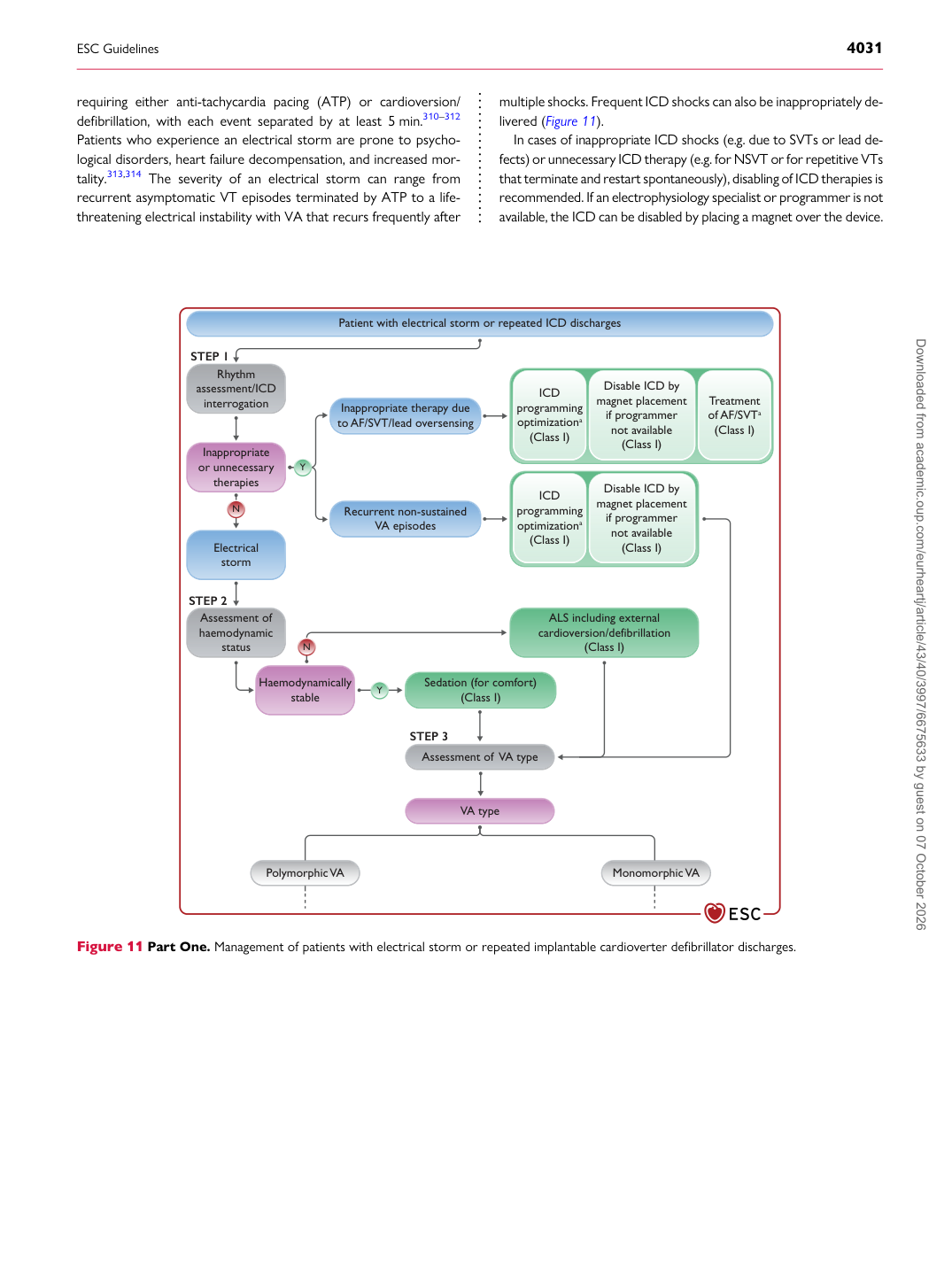
requiring either anti-tachycardia pacing (ATP) or cardioversion/ defibrillation, with each event separated by at least 5 min.310–312 Patients who experience an electrical storm are prone to psychological disorders, heart failure decompensation, and increased mortality.313,314 The severity of an electrical storm can range from recurrent asymptomatic VT episodes terminated by ATP to a lifethreatening electrical instability with VA that recurs frequently after multiple shocks. Frequent ICD shocks can also be inappropriately delivered (Figure 11).

In cases of inappropriate ICD shocks (e.g. due to SVTs or lead defects) or unnecessary ICD therapy (e.g. for NSVT or for repetitive VTs that terminate and restart spontaneously), disabling of ICD therapies is recommended. If an electrophysiology specialist or programmer is not available, the ICD can be disabled by placing a magnet over the device.

Patient with electrical storm or repeated ICD discharges

ALS including external cardioversion/defibrillation

(Class I)

Rhythm assessment/ICD interrogation Inappropriate therapy due to AF/SVT/lead oversensing

Recurrent non-sustained

VA episodes

Inappropriate or unnecessary

therapies

Electrical storm

Sedation (for comfort)

(Class I)

Assessment of haemodynamic

status

N

N

Y

Y Haemodynamically

stable

VA type

Assessment of VA type

STEP 1

STEP 2

STEP 3 ICD programming optimizationa

(Class I) Treatment of AF/SVTa

(Class I)

Disable ICD by magnet placement

if programmer not available

(Class I)

ICD programming optimizationa

(Class I) Disable ICD by magnet placement

if programmer not available

(Class I)

PolymorphicVA MonomorphicVA

Figure 11 Part One. Management of patients with electrical storm or repeated implantable cardioverter defibrillator discharges. Downloaded from academic.oup.com/eurheartj/article/43/40/3997/6675633 by guest on 07 October 2026