p.33 抽出テキスト
6.1.2 Acute management of sustained

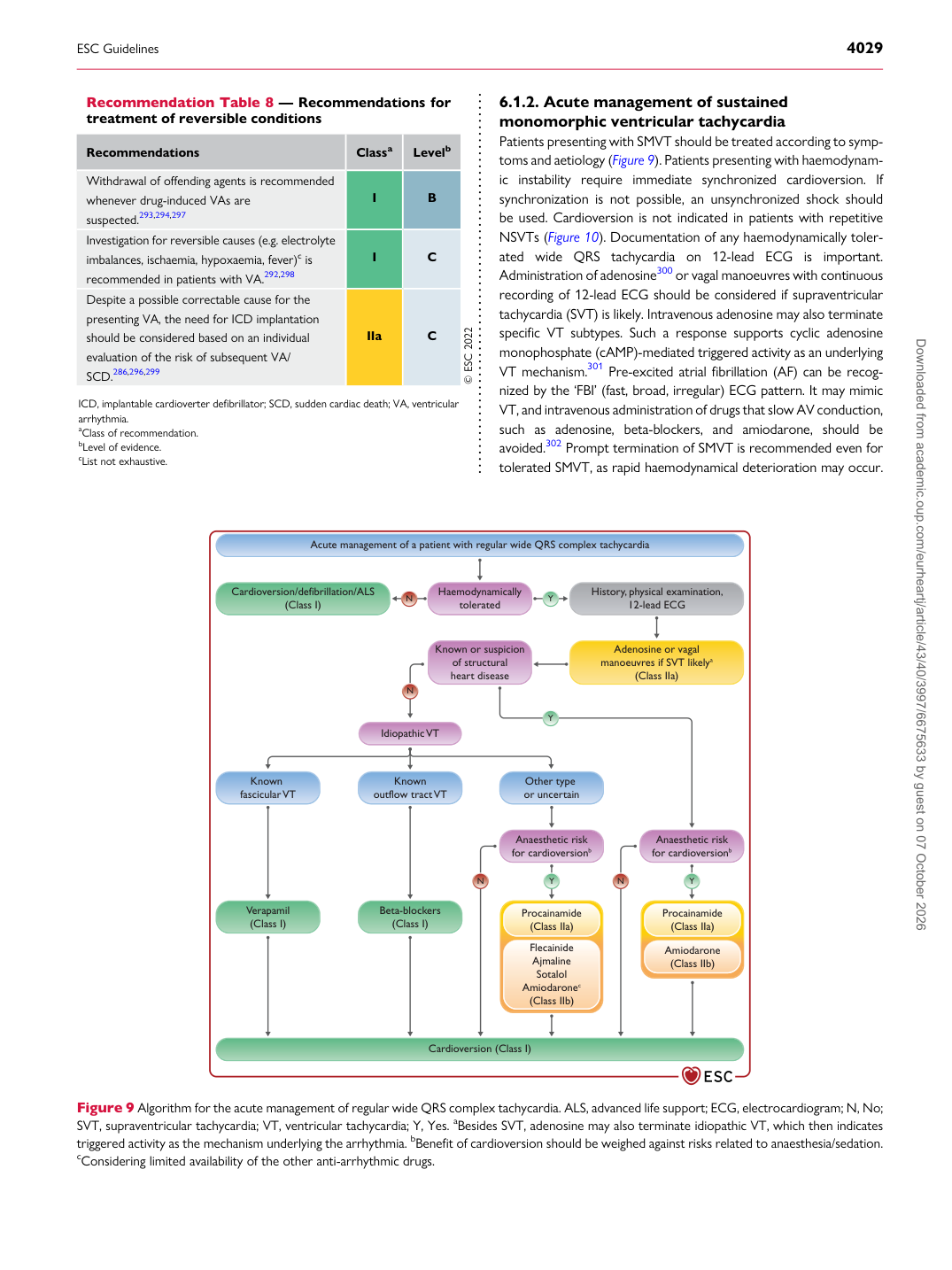
monomorphic ventricular tachycardia Patients presenting with SMVT should be treated according to symptoms and aetiology (Figure 9). Patients presenting with haemodynamic instability require immediate synchronized cardioversion. If synchronization is not possible, an unsynchronized shock should be used. Cardioversion is not indicated in patients with repetitive NSVTs (Figure 10). Documentation of any haemodynamically tolerated wide QRS tachycardia on 12-lead ECG is important. Administration of adenosine300 or vagal manoeuvres with continuous recording of 12-lead ECG should be considered if supraventricular tachycardia (SVT) is likely. Intravenous adenosine may also terminate specific VT subtypes. Such a response supports cyclic adenosine monophosphate (cAMP)-mediated triggered activity as an underlying VT mechanism.301 Pre-excited atrial fibrillation (AF) can be recognized by the ‘FBI’ (fast, broad, irregular) ECG pattern. It may mimic VT, and intravenous administration of drugs that slow AV conduction, such as adenosine, beta-blockers, and amiodarone, should be avoided.302 Prompt termination of SMVT is recommended even for tolerated SMVT, as rapid haemodynamical deterioration may occur.

Recommendation Table 8 — Recommendations for treatment of reversible conditions

Recommendations Classa Levelb

Withdrawal of offending agents is recommended whenever drug-induced VAs are suspected.293,294,297 I B Investigation for reversible causes (e.g. electrolyte imbalances, ischaemia, hypoxaemia, fever)c is recommended in patients with VA.292,298 I C Despite a possible correctable cause for the presenting VA, the need for ICD implantation should be considered based on an individual evaluation of the risk of subsequent VA/ SCD.286,296,299 IIa C © ESC 2022

ICD, implantable cardioverter defibrillator; SCD, sudden cardiac death; VA, ventricular arrhythmia. aClass of recommendation. bLevel of evidence. cList not exhaustive.

N

N

N

Acute management of a patient with regular wide QRS complex tachycardia

Cardioversion (Class I)

Procainamide

(Class IIa) Flecainide Ajmaline Sotalol Amiodaronec (Class IIb) Procainamide

(Class IIa)

Amiodarone (Class IIb)

Verapamil (Class I)

Cardioversion/defibrillation/ALS

(Class I) History, physical examination,

12-lead ECG

Known or suspicion

of structural heart disease Adenosine or vagal manoeuvres if SVT likelya

(Class IIa)

Beta-blockers

(Class I) Anaesthetic risk for cardioversionb

Haemodynamically

tolerated

Other type or uncertain

Known outflow tractVT

Known fascicularVT

Y N Anaesthetic risk for cardioversionb

Y

Y

Y IdiopathicVT

Figure 9 Algorithm for the acute management of regular wide QRS complex tachycardia. ALS, advanced life support; ECG, electrocardiogram; N, No; SVT, supraventricular tachycardia; VT, ventricular tachycardia; Y, Yes. aBesides SVT, adenosine may also terminate idiopathic VT, which then indicates triggered activity as the mechanism underlying the arrhythmia. bBenefit of cardioversion should be weighed against risks related to anaesthesia/sedation. cConsidering limited availability of the other anti-arrhythmic drugs. Downloaded from academic.oup.com/eurheartj/article/43/40/3997/6675633 by guest on 07 October 2026