p.31 抽出テキスト
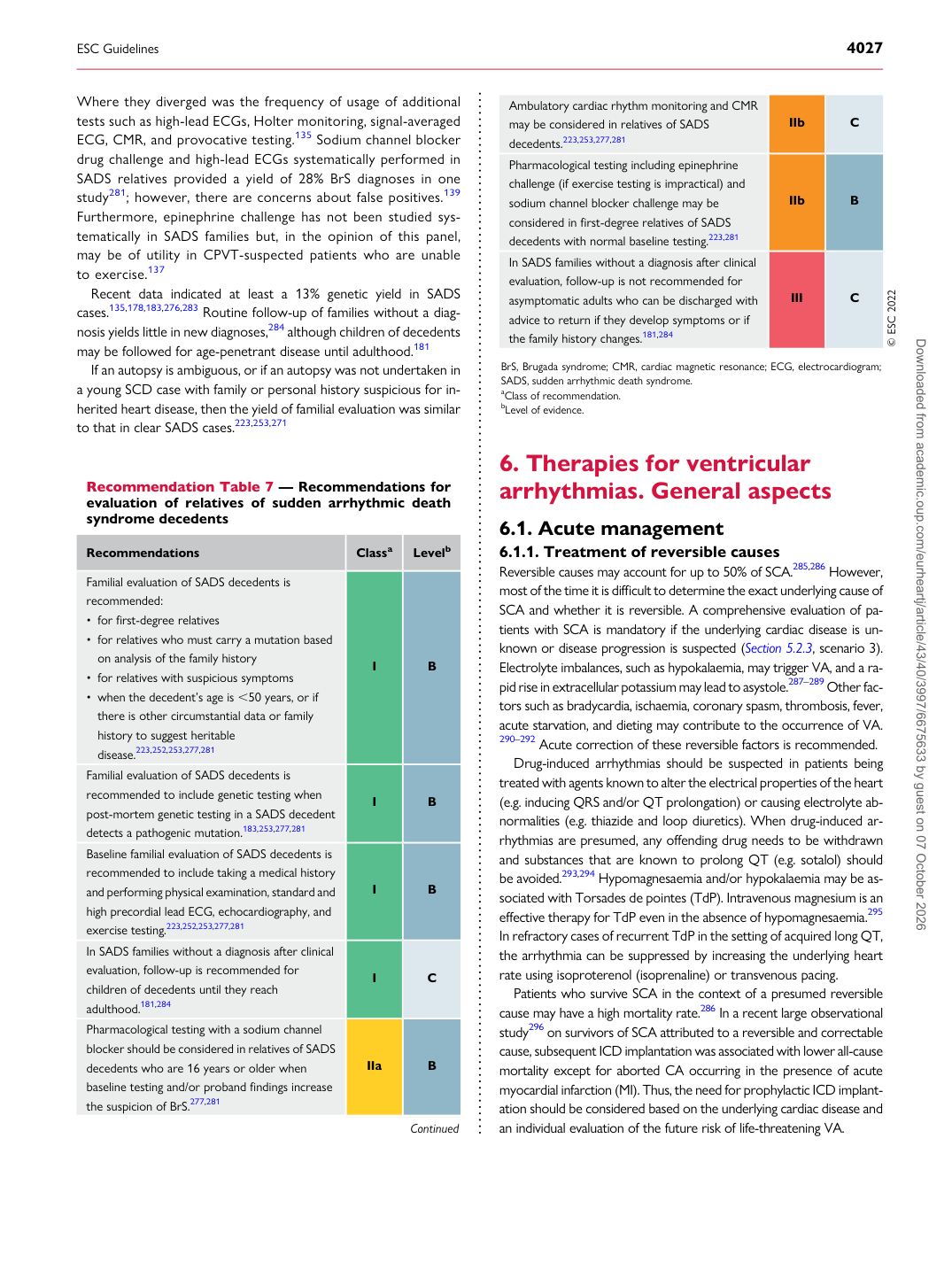
Where they diverged was the frequency of usage of additional tests such as high-lead ECGs, Holter monitoring, signal-averaged ECG, CMR, and provocative testing.135 Sodium channel blocker drug challenge and high-lead ECGs systematically performed in SADS relatives provided a yield of 28% BrS diagnoses in one study281; however, there are concerns about false positives.139 Furthermore, epinephrine challenge has not been studied systematically in SADS families but, in the opinion of this panel, may be of utility in CPVT-suspected patients who are unable to exercise.137 Recent data indicated at least a 13% genetic yield in SADS cases.135,178,183,276,283 Routine follow-up of families without a diagnosis yields little in new diagnoses,284 although children of decedents may be followed for age-penetrant disease until adulthood.181 If an autopsy is ambiguous, or if an autopsy was not undertaken in a young SCD case with family or personal history suspicious for inherited heart disease, then the yield of familial evaluation was similar to that in clear SADS cases.223,253,271

6 Therapies for ventricular

arrhythmias. General aspects

6.1 Acute management

6.1.1. Treatment of reversible causes Reversible causes may account for up to 50% of SCA.285,286 However, most of the time it is difficult to determine the exact underlying cause of SCA and whether it is reversible. A comprehensive evaluation of patients with SCA is mandatory if the underlying cardiac disease is unknown or disease progression is suspected (Section 5.2.3, scenario 3). Electrolyte imbalances, such as hypokalaemia, may trigger VA, and a rapid rise in extracellular potassium may lead to asystole.287–289 Other factors such as bradycardia, ischaemia, coronary spasm, thrombosis, fever, acute starvation, and dieting may contribute to the occurrence of VA. 290–292 Acute correction of these reversible factors is recommended. Drug-induced arrhythmias should be suspected in patients being treated with agents known to alter the electrical properties of the heart (e.g. inducing QRS and/or QT prolongation) or causing electrolyte abnormalities (e.g. thiazide and loop diuretics). When drug-induced arrhythmias are presumed, any offending drug needs to be withdrawn and substances that are known to prolong QT (e.g. sotalol) should be avoided.293,294 Hypomagnesaemia and/or hypokalaemia may be associated with Torsades de pointes (TdP). Intravenous magnesium is an effective therapy for TdP even in the absence of hypomagnesaemia.295 In refractory cases of recurrent TdP in the setting of acquired long QT, the arrhythmia can be suppressed by increasing the underlying heart rate using isoproterenol (isoprenaline) or transvenous pacing. Patients who survive SCA in the context of a presumed reversible cause may have a high mortality rate.286 In a recent large observational study296 on survivors of SCA attributed to a reversible and correctable cause, subsequent ICD implantation was associated with lower all-cause mortality except for aborted CA occurring in the presence of acute myocardial infarction (MI). Thus, the need for prophylactic ICD implantation should be considered based on the underlying cardiac disease and an individual evaluation of the future risk of life-threatening VA.

Recommendation Table 7 — Recommendations for evaluation of relatives of sudden arrhythmic death syndrome decedents

Recommendations Classa Levelb

Familial evaluation of SADS decedents is recommended: • for first-degree relatives • for relatives who must carry a mutation based on analysis of the family history • for relatives with suspicious symptoms • when the decedent’s age is ,50 years, or if there is other circumstantial data or family

history to suggest heritable disease.223,252,253,277,281 I B Familial evaluation of SADS decedents is recommended to include genetic testing when post-mortem genetic testing in a SADS decedent detects a pathogenic mutation.183,253,277,281 I B Baseline familial evaluation of SADS decedents is recommended to include taking a medical history and performing physical examination, standard and high precordial lead ECG, echocardiography, and exercise testing.223,252,253,277,281 I B In SADS families without a diagnosis after clinical evaluation, follow-up is recommended for children of decedents until they reach adulthood.181,284 I C Pharmacological testing with a sodium channel blocker should be considered in relatives of SADS decedents who are 16 years or older when baseline testing and/or proband findings increase the suspicion of BrS.277,281 IIa B

Continued Ambulatory cardiac rhythm monitoring and CMR

may be considered in relatives of SADS decedents.223,253,277,281 IIb C Pharmacological testing including epinephrine challenge (if exercise testing is impractical) and sodium channel blocker challenge may be considered in first-degree relatives of SADS decedents with normal baseline testing.223,281 IIb B In SADS families without a diagnosis after clinical evaluation, follow-up is not recommended for asymptomatic adults who can be discharged with advice to return if they develop symptoms or if the family history changes.181,284 III C © ESC 2022

BrS, Brugada syndrome; CMR, cardiac magnetic resonance; ECG, electrocardiogram; SADS, sudden arrhythmic death syndrome. aClass of recommendation. bLevel of evidence. Downloaded from academic.oup.com/eurheartj/article/43/40/3997/6675633 by guest on 07 October 2026