p.30 抽出テキスト
Su d den death victim

S a v

a a e tissue f or potential genetic testing

f f

(Class I)

Comp r ehensi v e autopsy a

(Class I)

Re f er first-deg

f f r ee r elati v es f or ca f f r diac assessment

(Class I) P ost-mo r tem genetic testing

with genetic counselling c

(Class I)

S a v

a a e blood f or potential t

f f o xicolo g y testing

(Class I)

T argeted genetic testing

T

T

(Class I)

Re f er first-deg

f f r ee r elati v es f or ca

f f r diac assessment

(Class I) T o

T

T xicolo g y testing

(Class I)

Collect detailed description about:

Non-ca r diac cause of SD SCD of non-inherited cause

Cause diagnosed Negati v e autopsy

Go to Scena r io 5: Relatives of unexplained SD decedent

S ADS decedent age <50 y ears or ci r cumstances or

fami l y histo r y suggesti v e

of heritable disease

SCD of suspected inherited cause b

Cause of death not due

to drug o v e r dose

Su d den a r r h ythmic death synd r ome

(SADS)

Drug o v e r dose

(Class I)

Ci r cumstances of death Symptoms and prior histo r y of deceased Fami l y histo r y

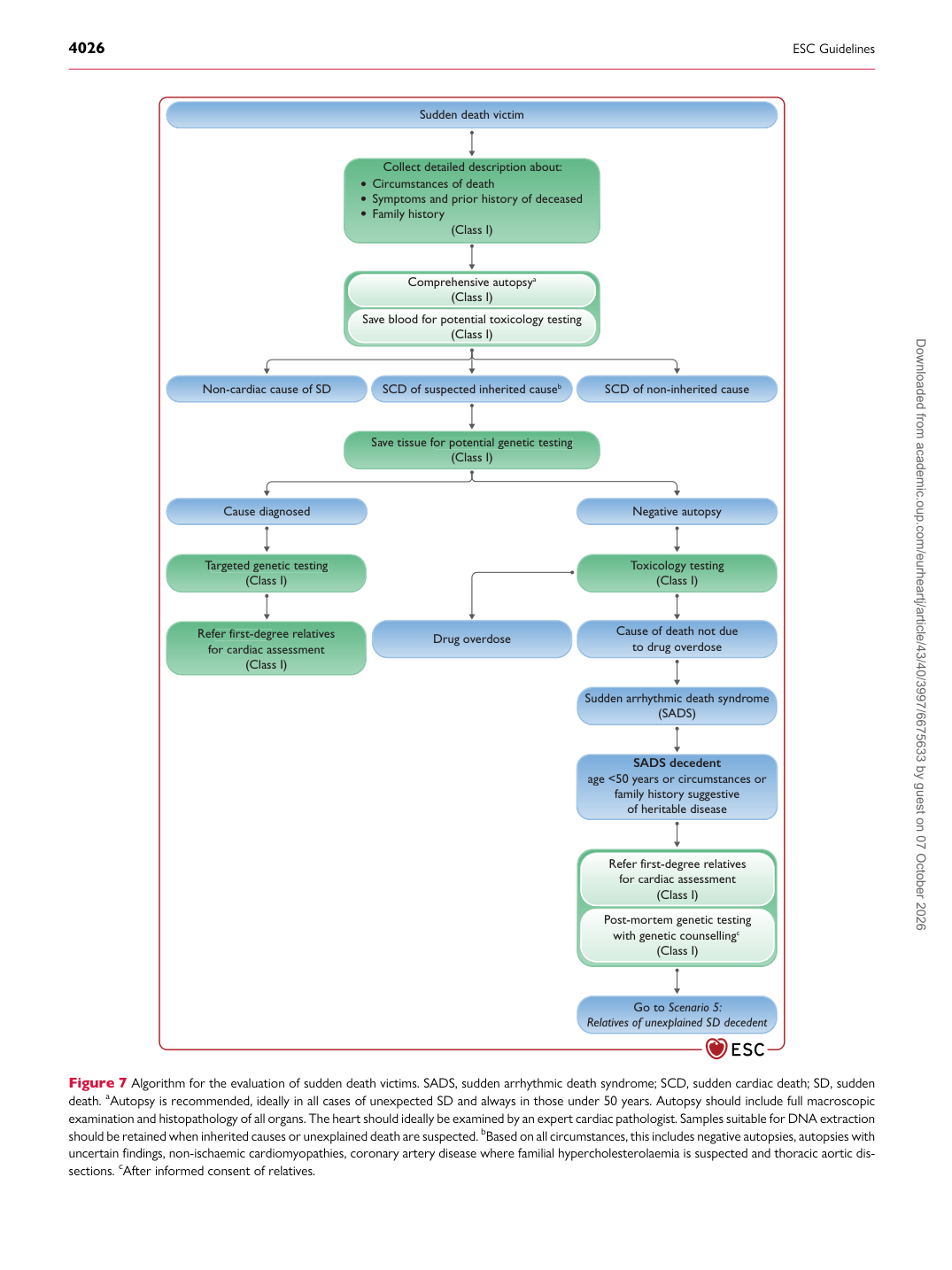
Figure 7 Algorithm for the evaluation of sudden death victims. SADS, sudden arrhythmic death syndrome; SCD, sudden cardiac death; SD, sudden death. aAutopsy is recommended, ideally in all cases of unexpected SD and always in those under 50 years. Autopsy should include full macroscopic examination and histopathology of all organs. The heart should ideally be examined by an expert cardiac pathologist. Samples suitable for DNA extraction should be retained when inherited causes or unexplained death are suspected. bBased on all circumstances, this includes negative autopsies, autopsies with uncertain findings, non-ischaemic cardiomyopathies, coronary artery disease where familial hypercholesterolaemia is suspected and thoracic aortic dissections. cAfter informed consent of relatives. Downloaded from academic.oup.com/eurheartj/article/43/40/3997/6675633 by guest on 07 October 2026