p.29 抽出テキスト
C AD/co r ona r y anoma l y

LGE on CMR

Prima r y electrical disease

Echoca r diogram suggesti v e of C AD/ ca r dio m y opat h y/valvular hea r t disease/other SHD

N

Ca r diac CT/ C A G (if p r e vious l y not per f ormed)

f f

(Class I)

N

High lead and r epeated 12-lead ECGs

(Class I)

N

CMR (Class I)

N

V asospasm

V

V Y

Fu r ther e valuation acco r ding to most

li k e

k

k l y diagnosis. If SMV T ,

T

T g o to scena r io 2: P atient with

P P f i f f r st SMVT episode d C AD/Co r ona r y

anoma l y

Y

Prima r y electrical disease

Y

Y

Y

Y

Y

N

P ositi v e

Idiopathic VF

T est

T

T f or co

f f r ona r y vasospam

(Class IIb)

N

N Prima r y electrical disease

N

Suspicion of vasospasm e

E x e r cise test (Class I)

Sodium channel bloc k er test (Class I)

k

k

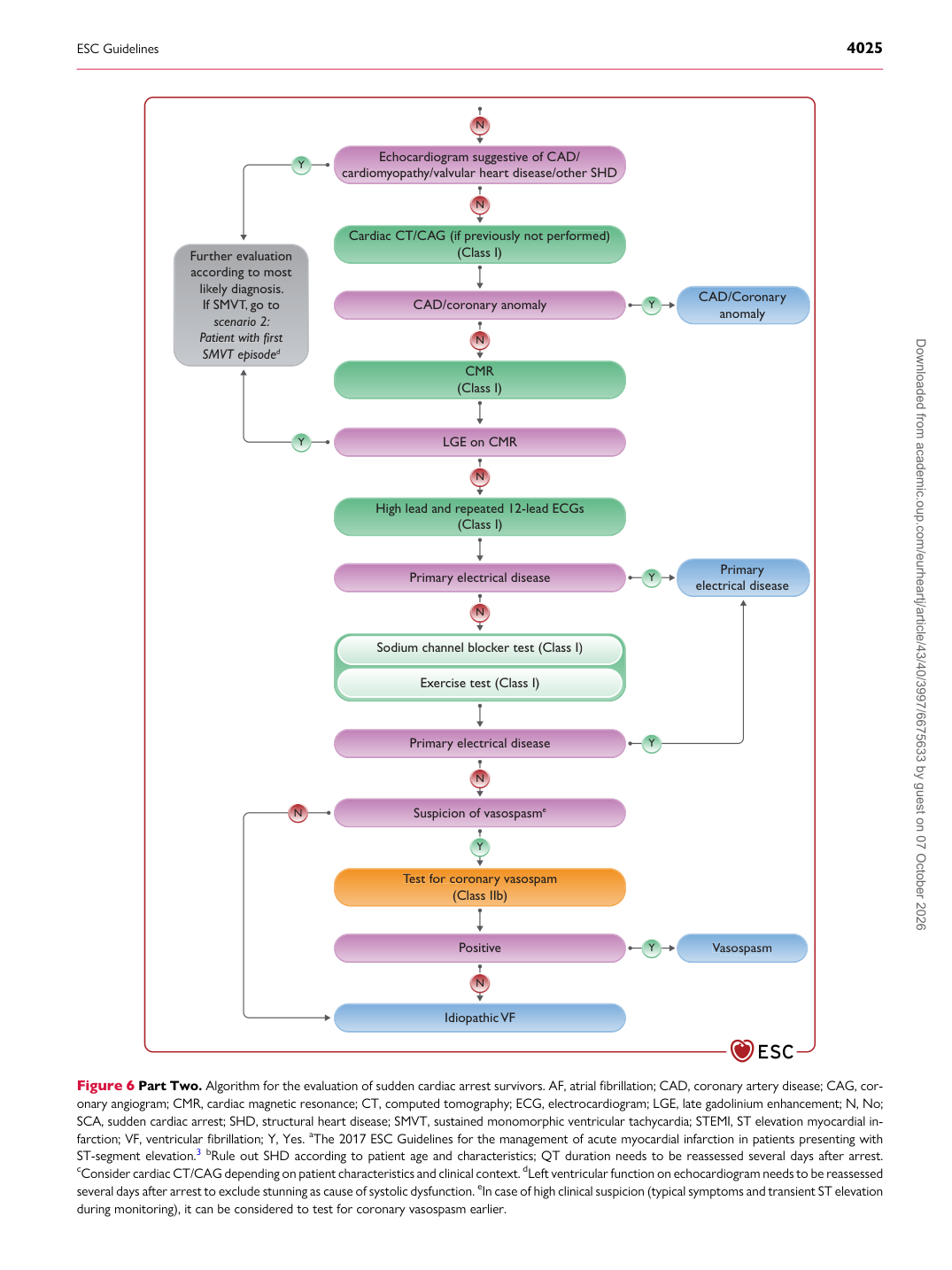
Figure 6 Part Two. Algorithm for the evaluation of sudden cardiac arrest survivors. AF, atrial fibrillation; CAD, coronary artery disease; CAG, coronary angiogram; CMR, cardiac magnetic resonance; CT, computed tomography; ECG, electrocardiogram; LGE, late gadolinium enhancement; N, No; SCA, sudden cardiac arrest; SHD, structural heart disease; SMVT, sustained monomorphic ventricular tachycardia; STEMI, ST elevation myocardial infarction; VF, ventricular fibrillation; Y, Yes. aThe 2017 ESC Guidelines for the management of acute myocardial infarction in patients presenting with ST-segment elevation.3 bRule out SHD according to patient age and characteristics; QT duration needs to be reassessed several days after arrest. cConsider cardiac CT/CAG depending on patient characteristics and clinical context. dLeft ventricular function on echocardiogram needs to be reassessed several days after arrest to exclude stunning as cause of systolic dysfunction. eIn case of high clinical suspicion (typical symptoms and transient ST elevation during monitoring), it can be considered to test for coronary vasospasm earlier. Downloaded from academic.oup.com/eurheartj/article/43/40/3997/6675633 by guest on 07 October 2026