p.27 抽出テキスト
5.2.4 Scenario 4: Sudden death victim

An algorithm for the evaluation of SD victims is presented in Figure 7. Potential genetic cardiac disease can be identified in 25–49% of cases of SCD in the young (,50 years of age). This may also affect relatives of the deceased.25,56,59 To find the cause of death, it is important to collect all available data on prior symptoms, comorbidities, and family history.25,56,215,262,263 The main role of autopsy in SD is to establish the cause of death. An expert cardiac pathologist alters the initial diagnosis in 41% of cases, highlighting the need for expert evaluation.263–265 Inherited cardiac diseases identified at autopsy include cardiomyopathies (HCM, DCM, ARVC) and premature CAD.25,27,56,266 A toxicology screen can reveal drug overdose or polypharmacy in 31–56% of young SD cases.267,268 In autopsy-negative cases with negative toxicology, the term sudden arrhythmic death syndrome (SADS) may be applied and primary electrical diseases are potential causes.56,183,223,253 Retaining tissue for DNA extraction is important for post-mortem genetic analysis, where the yield can be as high as one out of three.183,269,270 Clinical evaluation of first-degree relatives is important if the cause of death after autopsy is unknown (Section 5.2.5, scenario 5) or suspected to be inherited, with a reported combined diagnostic yield of genetic and clinical evaluation of 18–53%.252,266,271 Post-mortem genetic testing on the deceased, targeted to the cause of death, identified mutations in around one-third of cases.56,266,269

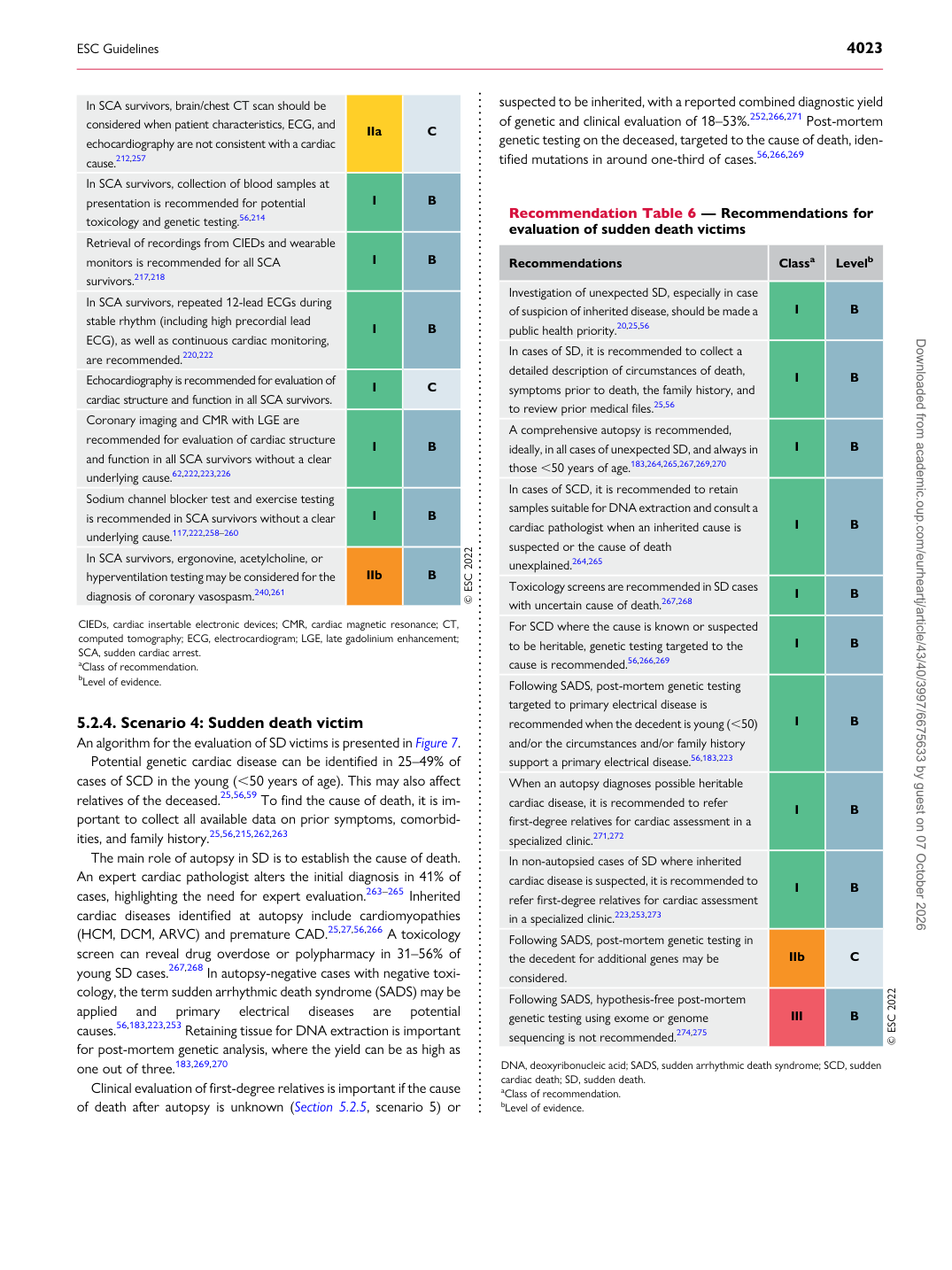
In SCA survivors, brain/chest CT scan should be considered when patient characteristics, ECG, and echocardiography are not consistent with a cardiac cause.212,257 IIa C In SCA survivors, collection of blood samples at presentation is recommended for potential toxicology and genetic testing.56,214 I B Retrieval of recordings from CIEDs and wearable monitors is recommended for all SCA survivors.217,218 I B In SCA survivors, repeated 12-lead ECGs during stable rhythm (including high precordial lead ECG), as well as continuous cardiac monitoring, are recommended.220,222 I B Echocardiography is recommended for evaluation of cardiac structure and function in all SCA survivors. I C Coronary imaging and CMR with LGE are recommended for evaluation of cardiac structure and function in all SCA survivors without a clear underlying cause.62,222,223,226 I B Sodium channel blocker test and exercise testing is recommended in SCA survivors without a clear underlying cause.117,222,258–260 I B In SCA survivors, ergonovine, acetylcholine, or hyperventilation testing may be considered for the diagnosis of coronary vasospasm.240,261 IIb B © ESC 2022

CIEDs, cardiac insertable electronic devices; CMR, cardiac magnetic resonance; CT, computed tomography; ECG, electrocardiogram; LGE, late gadolinium enhancement; SCA, sudden cardiac arrest. aClass of recommendation. bLevel of evidence. Recommendation Table 6 — Recommendations for evaluation of sudden death victims

Recommendations Classa Levelb

Investigation of unexpected SD, especially in case of suspicion of inherited disease, should be made a public health priority.20,25,56 I B In cases of SD, it is recommended to collect a detailed description of circumstances of death, symptoms prior to death, the family history, and to review prior medical files.25,56 I B A comprehensive autopsy is recommended, ideally, in all cases of unexpected SD, and always in those ,50 years of age.183,264,265,267,269,270 I B In cases of SCD, it is recommended to retain samples suitable for DNA extraction and consult a cardiac pathologist when an inherited cause is suspected or the cause of death unexplained.264,265 I B Toxicology screens are recommended in SD cases with uncertain cause of death.267,268 I B For SCD where the cause is known or suspected to be heritable, genetic testing targeted to the cause is recommended.56,266,269 I B Following SADS, post-mortem genetic testing targeted to primary electrical disease is recommended when the decedent is young (,50) and/or the circumstances and/or family history support a primary electrical disease.56,183,223 I B When an autopsy diagnoses possible heritable cardiac disease, it is recommended to refer first-degree relatives for cardiac assessment in a specialized clinic.271,272 I B In non-autopsied cases of SD where inherited cardiac disease is suspected, it is recommended to refer first-degree relatives for cardiac assessment in a specialized clinic.223,253,273 I B Following SADS, post-mortem genetic testing in the decedent for additional genes may be considered. IIb C Following SADS, hypothesis-free post-mortem genetic testing using exome or genome sequencing is not recommended.274,275 III B © ESC 2022

DNA, deoxyribonucleic acid; SADS, sudden arrhythmic death syndrome; SCD, sudden cardiac death; SD, sudden death. aClass of recommendation. bLevel of evidence. Downloaded from academic.oup.com/eurheartj/article/43/40/3997/6675633 by guest on 07 October 2026