p.24 抽出テキスト
5.2.3 Scenario 3: Sudden cardiac arrest survivor

An algorithm for the evaluation of sudden cardiac arrest survivors is presented in Figure 6. Urgent CAG is recommended for patients presenting with ST elevation myocardial infarction (STEMI).203–206 Despite disparate findings of pooled data analyses,207–211 three randomized controlled trials (RCTs) have found no significant benefit for early CAG in cardiac arrest (CA) without ST-elevation. In case of electrical instability after CA, suspicious for ongoing ischaemia, this panel found a CAG indicated. Brain and chest CT scan may acutely identify non-cardiac causes of aborted SD,212 as well as blood test results for pertinent toxicological analysis.213–215 Retention and storage of suitable blood samples will allow subsequent diagnostic evaluation, including DNA analysis.213

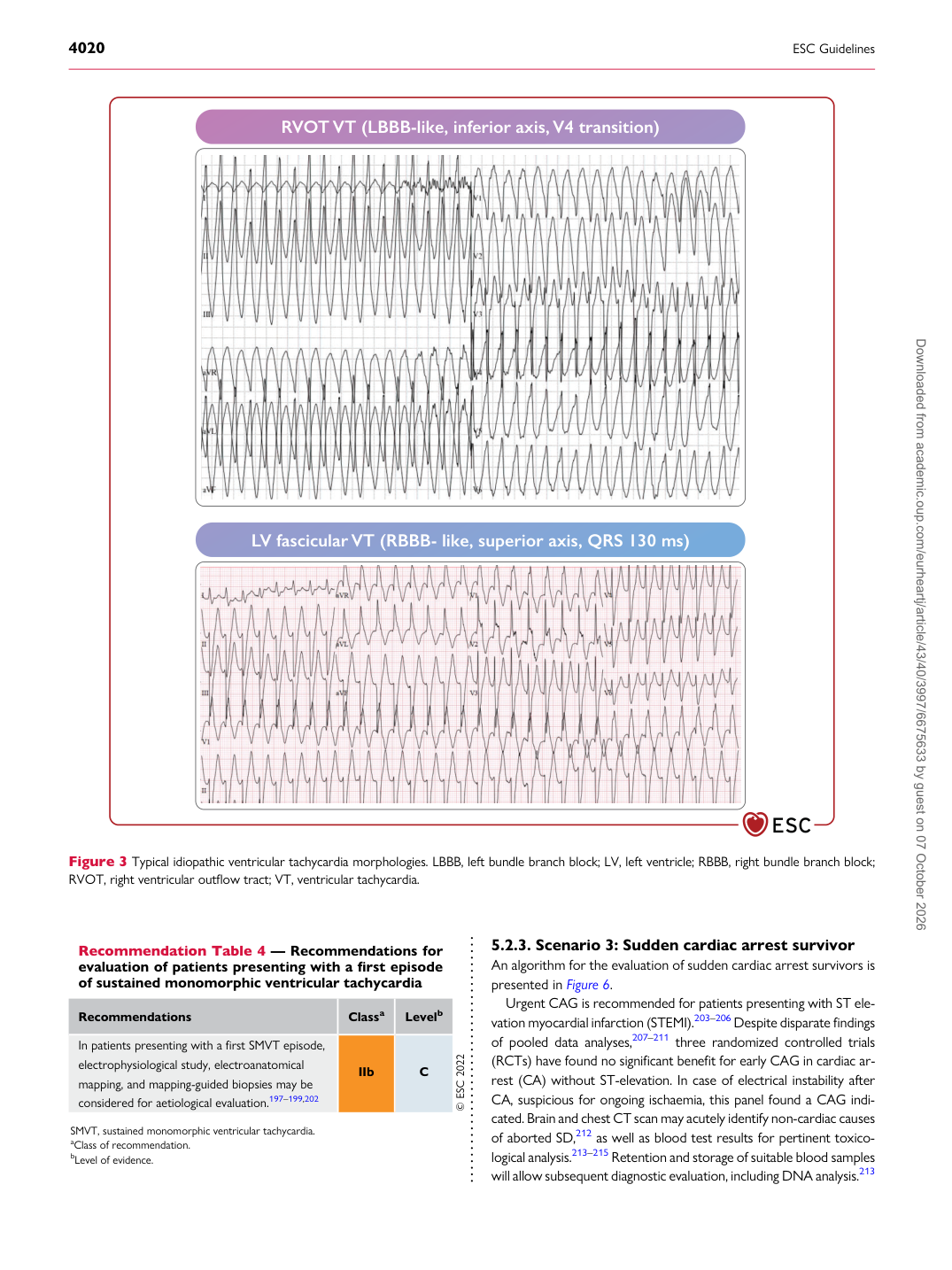
LV fascicular VT (RBBB- like, superior axis, QRS 130 ms)

RVOT VT (LBBB-like, inferior axis, V4 transition)

Figure 3 Typical idiopathic ventricular tachycardia morphologies. LBBB, left bundle branch block; LV, left ventricle; RBBB, right bundle branch block; RVOT, right ventricular outflow tract; VT, ventricular tachycardia.

Recommendation Table 4 — Recommendations for evaluation of patients presenting with a first episode of sustained monomorphic ventricular tachycardia

Recommendations Classa Levelb

In patients presenting with a first SMVT episode, electrophysiological study, electroanatomical mapping, and mapping-guided biopsies may be considered for aetiological evaluation.197–199,202 IIb C © ESC 2022

SMVT, sustained monomorphic ventricular tachycardia. aClass of recommendation. bLevel of evidence. Downloaded from academic.oup.com/eurheartj/article/43/40/3997/6675633 by guest on 07 October 2026