p.22 抽出テキスト
5.2 Diagnostic evaluation at first

presentation with ventricular arrhythmia in patients without known cardiac disease VA and (aborted) SCD are common first manifestations of a previously not known cardiac condition. A comprehensive diagnostic evaluation is provided for five frequently encountered scenarios.

5.2.1 Scenario 1: Incidental finding of a

non-sustained ventricular tachycardia An algorithm for the evaluation of patients presenting with an incidental finding of NSVT is presented in Figure 2. Incidental NSVT is a common finding during routine cardiological evaluation (e.g. for non-cardiac diseases, pre-initiation of oncological treatments, pre-participation in sports) and monitoring before induction of anaesthesia/sedation for non-cardiac procedures.184 Patients with incidentally found NSVT require further evaluation. A recent syncope suspicious for cardiac origin is a high-risk symptom and may prompt admission to hospital.1,185 The morphology of NSVT (polymorphic or monomorphic) is important to assess. Typical MVT morphologies (Figure 3) can suggest an idiopathic origin with favourable prognosis. In contrast, short-coupled PVC initiating non-sustained PVT or monomorphic NSVT with short cycle length (usually ,300 ms, average 245 + 28, in one series) may identify patients at higher risk of SCD.186,187 Resting 12-lead ECG is a first-line evaluation and may show signs of SHD or primary electrical diseases ( ESC CardioMed chapter 8.6).188 Echocardiography is the firstline imaging modality that provides important information about cardiac function and potential SHD ( ESC CardioMed 10.3, 10.10, 10.12).120,189,190 Holter monitoring is useful to assess the frequency of NSVT and related PVCs ( ESC CardioMed chapter 8.9).191 In addition, an at least 3-lead Holter (V1, two inferior leads) may give a first estimate if NSVT/PVC are unifocal or multifocal and of the NSVT site(s) of origin. The latter is important if the NSVT has not been previously documented on a 12-lead ECG.192

An exercise test can be helpful to capture the 12-lead ECG of NSVT and to identify exercise-induced arrhythmias. Increasing arrhythmias with exercise, not suggestive of idiopathic origin, should raise suspicion of SHD and may necessitate advice to refrain from physical exercise until diagnosis and initiation of appropriate treatment. Underlying significant CAD should be ruled out according to the patient’s pre-test probability. CMR should be considered when cardiomyopathies or inflammatory diseases are suspected on initial evaluation ( ESC CardioMed chapter 10.4).193 In addition, CMR can identify areas of fibrosis as substrates of NSVT.129

5.2.2 Scenario 2: First presentation of sustained

monomorphic ventricular tachycardia An algorithm for the evaluation of patients presenting with a first SMVT episode is presented in Figure 4. The majority of patients presenting with SMVT have underlying SHD. SMVT in SHD is mainly due to scar-related re-entry and only occasionally due to re-entry involving a diseased conduction system or due to focal sources.

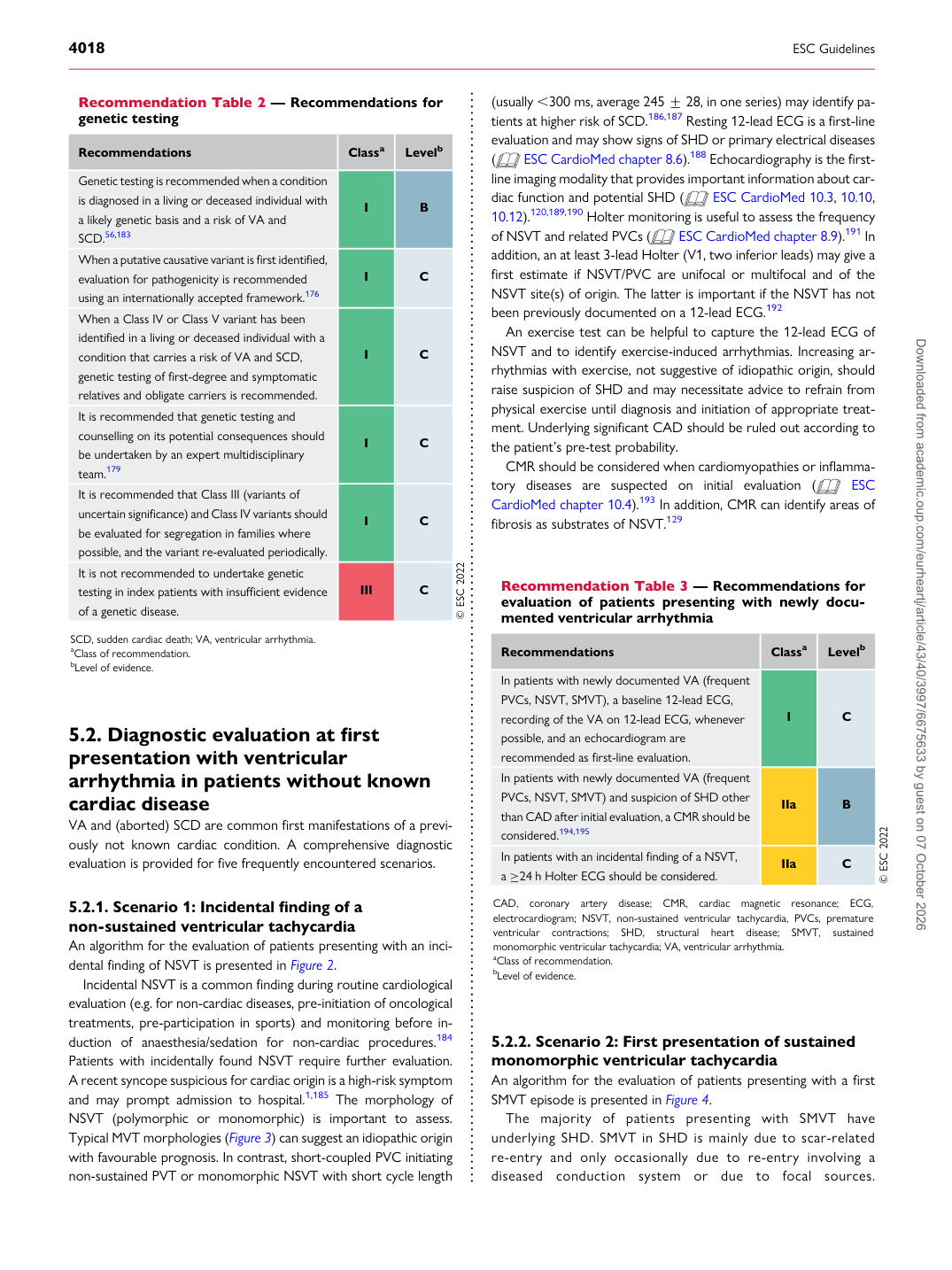
Recommendation Table 3 — Recommendations for evaluation of patients presenting with newly documented ventricular arrhythmia

Recommendations Classa Levelb

In patients with newly documented VA (frequent PVCs, NSVT, SMVT), a baseline 12-lead ECG, recording of the VA on 12-lead ECG, whenever possible, and an echocardiogram are recommended as first-line evaluation. I C In patients with newly documented VA (frequent PVCs, NSVT, SMVT) and suspicion of SHD other than CAD after initial evaluation, a CMR should be considered.194,195 IIa B In patients with an incidental finding of a NSVT, a ≥24 h Holter ECG should be considered. IIa C © ESC 2022

CAD, coronary artery disease; CMR, cardiac magnetic resonance; ECG, electrocardiogram; NSVT, non-sustained ventricular tachycardia, PVCs, premature ventricular contractions; SHD, structural heart disease; SMVT, sustained monomorphic ventricular tachycardia; VA, ventricular arrhythmia. aClass of recommendation. bLevel of evidence.

Recommendation Table 2 — Recommendations for genetic testing

Recommendations Classa Levelb

Genetic testing is recommended when a condition is diagnosed in a living or deceased individual with a likely genetic basis and a risk of VA and SCD.56,183 I B When a putative causative variant is first identified, evaluation for pathogenicity is recommended using an internationally accepted framework.176 I C When a Class IV or Class V variant has been identified in a living or deceased individual with a condition that carries a risk of VA and SCD, genetic testing of first-degree and symptomatic relatives and obligate carriers is recommended. I C It is recommended that genetic testing and counselling on its potential consequences should be undertaken by an expert multidisciplinary team.179 I C It is recommended that Class III (variants of uncertain significance) and Class IV variants should be evaluated for segregation in families where possible, and the variant re-evaluated periodically. I C It is not recommended to undertake genetic testing in index patients with insufficient evidence of a genetic disease. III C © ESC 2022

SCD, sudden cardiac death; VA, ventricular arrhythmia. aClass of recommendation. bLevel of evidence. Downloaded from academic.oup.com/eurheartj/article/43/40/3997/6675633 by guest on 07 October 2026