p.13 抽出テキスト
The second part of the guidelines is structured according to disease-specific management, providing a link to the updated ESC CardioMed chapter for additional content. Risk stratification, SCD prevention, treatment of VA, and management of family members are addressed in a systematic fashion. Indications for cardiac magnetic resonance (CMR) imaging, genetic testing, and updated indications for catheter ablation of ventricular arrhythmias are presented. Flowcharts summarizing the workflow for diagnostic and treatment are provided for the disease entities. The colour-coding of the flowcharts reflects the class of recommendation according to this guideline and other ESC Guidelines.1–3

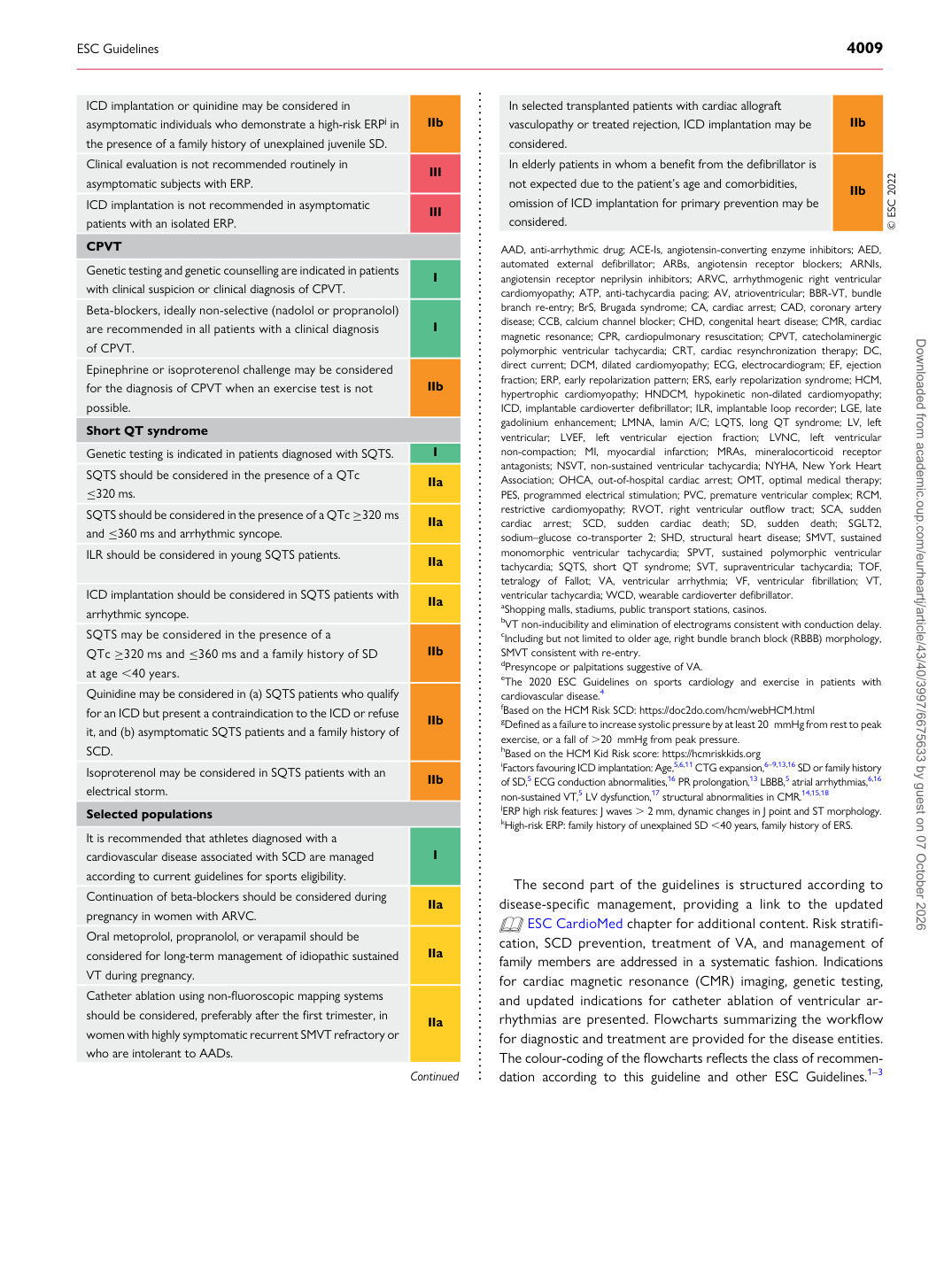
ICD implantation or quinidine may be considered in asymptomatic individuals who demonstrate a high-risk ERPj in the presence of a family history of unexplained juvenile SD. IIb Clinical evaluation is not recommended routinely in asymptomatic subjects with ERP. III ICD implantation is not recommended in asymptomatic patients with an isolated ERP. III CPVT Genetic testing and genetic counselling are indicated in patients with clinical suspicion or clinical diagnosis of CPVT. I Beta-blockers, ideally non-selective (nadolol or propranolol) are recommended in all patients with a clinical diagnosis of CPVT. I Epinephrine or isoproterenol challenge may be considered for the diagnosis of CPVT when an exercise test is not possible. IIb Short QT syndrome Genetic testing is indicated in patients diagnosed with SQTS. I SQTS should be considered in the presence of a QTc ≤320 ms. IIa SQTS should be considered in the presence of a QTc ≥320 ms and ≤360 ms and arrhythmic syncope. IIa ILR should be considered in young SQTS patients. IIa

ICD implantation should be considered in SQTS patients with arrhythmic syncope. IIa SQTS may be considered in the presence of a QTc ≥320 ms and ≤360 ms and a family history of SD at age ,40 years. IIb Quinidine may be considered in (a) SQTS patients who qualify for an ICD but present a contraindication to the ICD or refuse it, and (b) asymptomatic SQTS patients and a family history of SCD. IIb Isoproterenol may be considered in SQTS patients with an electrical storm. IIb Selected populations It is recommended that athletes diagnosed with a cardiovascular disease associated with SCD are managed according to current guidelines for sports eligibility. I Continuation of beta-blockers should be considered during pregnancy in women with ARVC. IIa Oral metoprolol, propranolol, or verapamil should be considered for long-term management of idiopathic sustained VT during pregnancy. IIa Catheter ablation using non-fluoroscopic mapping systems should be considered, preferably after the first trimester, in women with highly symptomatic recurrent SMVT refractory or who are intolerant to AADs. IIa

Continued In selected transplanted patients with cardiac allograft

vasculopathy or treated rejection, ICD implantation may be considered. IIb In elderly patients in whom a benefit from the defibrillator is not expected due to the patient’s age and comorbidities, omission of ICD implantation for primary prevention may be considered. IIb © ESC 2022

AAD, anti-arrhythmic drug; ACE-Is, angiotensin-converting enzyme inhibitors; AED, automated external defibrillator; ARBs, angiotensin receptor blockers; ARNIs, angiotensin receptor neprilysin inhibitors; ARVC, arrhythmogenic right ventricular cardiomyopathy; ATP, anti-tachycardia pacing; AV, atrioventricular; BBR-VT, bundle branch re-entry; BrS, Brugada syndrome; CA, cardiac arrest; CAD, coronary artery disease; CCB, calcium channel blocker; CHD, congenital heart disease; CMR, cardiac magnetic resonance; CPR, cardiopulmonary resuscitation; CPVT, catecholaminergic polymorphic ventricular tachycardia; CRT, cardiac resynchronization therapy; DC, direct current; DCM, dilated cardiomyopathy; ECG, electrocardiogram; EF, ejection fraction; ERP, early repolarization pattern; ERS, early repolarization syndrome; HCM, hypertrophic cardiomyopathy; HNDCM, hypokinetic non-dilated cardiomyopathy; ICD, implantable cardioverter defibrillator; ILR, implantable loop recorder; LGE, late gadolinium enhancement; LMNA, lamin A/C; LQTS, long QT syndrome; LV, left ventricular; LVEF, left ventricular ejection fraction; LVNC, left ventricular non-compaction; MI, myocardial infarction; MRAs, mineralocorticoid receptor antagonists; NSVT, non-sustained ventricular tachycardia; NYHA, New York Heart Association; OHCA, out-of-hospital cardiac arrest; OMT, optimal medical therapy; PES, programmed electrical stimulation; PVC, premature ventricular complex; RCM, restrictive cardiomyopathy; RVOT, right ventricular outflow tract; SCA, sudden cardiac arrest; SCD, sudden cardiac death; SD, sudden death; SGLT2, sodium–glucose co-transporter 2; SHD, structural heart disease; SMVT, sustained monomorphic ventricular tachycardia; SPVT, sustained polymorphic ventricular tachycardia; SQTS, short QT syndrome; SVT, supraventricular tachycardia; TOF, tetralogy of Fallot; VA, ventricular arrhythmia; VF, ventricular fibrillation; VT, ventricular tachycardia; WCD, wearable cardioverter defibrillator. aShopping malls, stadiums, public transport stations, casinos. bVT non-inducibility and elimination of electrograms consistent with conduction delay. cIncluding but not limited to older age, right bundle branch block (RBBB) morphology, SMVT consistent with re-entry. dPresyncope or palpitations suggestive of VA. eThe 2020 ESC Guidelines on sports cardiology and exercise in patients with cardiovascular disease.4 fBased on the HCM Risk SCD: https://doc2do.com/hcm/webHCM.html gDefined as a failure to increase systolic pressure by at least 20 mmHg from rest to peak exercise, or a fall of .20 mmHg from peak pressure. hBased on the HCM Kid Risk score: https://hcmriskkids.org iFactors favouring ICD implantation: Age,5,6,11 CTG expansion,6–9,13,16 SD or family history of SD,5 ECG conduction abnormalities,16 PR prolongation,13 LBBB,5 atrial arrhythmias,6,16 non-sustained VT,5 LV dysfunction,17 structural abnormalities in CMR.14,15,18 jERP high risk features: J waves . 2 mm, dynamic changes in J point and ST morphology. kHigh-risk ERP: family history of unexplained SD ,40 years, family history of ERS. Downloaded from academic.oup.com/eurheartj/article/43/40/3997/6675633 by guest on 07 October 2026