p.12 抽出テキスト
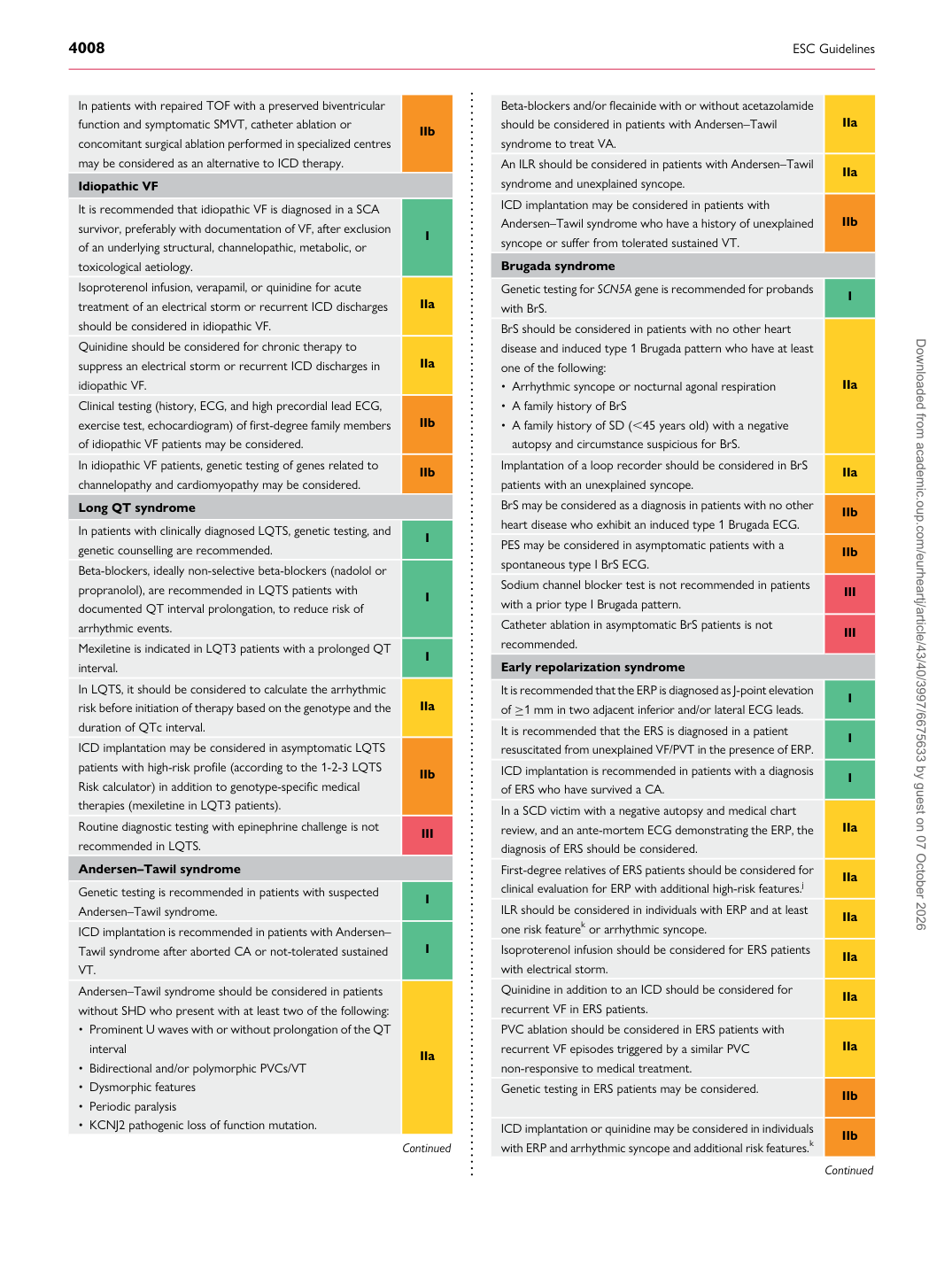
In patients with repaired TOF with a preserved biventricular function and symptomatic SMVT, catheter ablation or concomitant surgical ablation performed in specialized centres may be considered as an alternative to ICD therapy. IIb Idiopathic VF It is recommended that idiopathic VF is diagnosed in a SCA survivor, preferably with documentation of VF, after exclusion of an underlying structural, channelopathic, metabolic, or toxicological aetiology. I Isoproterenol infusion, verapamil, or quinidine for acute treatment of an electrical storm or recurrent ICD discharges should be considered in idiopathic VF. IIa Quinidine should be considered for chronic therapy to suppress an electrical storm or recurrent ICD discharges in idiopathic VF. IIa Clinical testing (history, ECG, and high precordial lead ECG, exercise test, echocardiogram) of first-degree family members of idiopathic VF patients may be considered. IIb In idiopathic VF patients, genetic testing of genes related to channelopathy and cardiomyopathy may be considered. IIb Long QT syndrome In patients with clinically diagnosed LQTS, genetic testing, and genetic counselling are recommended. I Beta-blockers, ideally non-selective beta-blockers (nadolol or propranolol), are recommended in LQTS patients with documented QT interval prolongation, to reduce risk of arrhythmic events. I Mexiletine is indicated in LQT3 patients with a prolonged QT interval. I In LQTS, it should be considered to calculate the arrhythmic risk before initiation of therapy based on the genotype and the duration of QTc interval. IIa ICD implantation may be considered in asymptomatic LQTS patients with high-risk profile (according to the 1-2-3 LQTS Risk calculator) in addition to genotype-specific medical therapies (mexiletine in LQT3 patients). IIb Routine diagnostic testing with epinephrine challenge is not recommended in LQTS. III Andersen–Tawil syndrome Genetic testing is recommended in patients with suspected Andersen–Tawil syndrome. I ICD implantation is recommended in patients with Andersen– Tawil syndrome after aborted CA or not-tolerated sustained VT. I Andersen–Tawil syndrome should be considered in patients without SHD who present with at least two of the following: • Prominent U waves with or without prolongation of the QT

interval • Bidirectional and/or polymorphic PVCs/VT • Dysmorphic features • Periodic paralysis • KCNJ2 pathogenic loss of function mutation. IIa

Continued Beta-blockers and/or flecainide with or without acetazolamide

should be considered in patients with Andersen–Tawil syndrome to treat VA. IIa An ILR should be considered in patients with Andersen–Tawil syndrome and unexplained syncope. IIa ICD implantation may be considered in patients with Andersen–Tawil syndrome who have a history of unexplained syncope or suffer from tolerated sustained VT. IIb Brugada syndrome Genetic testing for SCN5A gene is recommended for probands with BrS. I BrS should be considered in patients with no other heart disease and induced type 1 Brugada pattern who have at least one of the following: • Arrhythmic syncope or nocturnal agonal respiration • A family history of BrS • A family history of SD (,45 years old) with a negative

autopsy and circumstance suspicious for BrS. IIa Implantation of a loop recorder should be considered in BrS patients with an unexplained syncope. IIa BrS may be considered as a diagnosis in patients with no other heart disease who exhibit an induced type 1 Brugada ECG. IIb PES may be considered in asymptomatic patients with a spontaneous type I BrS ECG. IIb Sodium channel blocker test is not recommended in patients with a prior type I Brugada pattern. III Catheter ablation in asymptomatic BrS patients is not recommended. III Early repolarization syndrome It is recommended that the ERP is diagnosed as J-point elevation of ≥1 mm in two adjacent inferior and/or lateral ECG leads. I It is recommended that the ERS is diagnosed in a patient resuscitated from unexplained VF/PVT in the presence of ERP. I ICD implantation is recommended in patients with a diagnosis of ERS who have survived a CA. I In a SCD victim with a negative autopsy and medical chart review, and an ante-mortem ECG demonstrating the ERP, the diagnosis of ERS should be considered. IIa First-degree relatives of ERS patients should be considered for clinical evaluation for ERP with additional high-risk features.j IIa ILR should be considered in individuals with ERP and at least one risk featurek or arrhythmic syncope. IIa Isoproterenol infusion should be considered for ERS patients with electrical storm. IIa Quinidine in addition to an ICD should be considered for recurrent VF in ERS patients. IIa PVC ablation should be considered in ERS patients with recurrent VF episodes triggered by a similar PVC non-responsive to medical treatment. IIa Genetic testing in ERS patients may be considered. IIb

ICD implantation or quinidine may be considered in individuals with ERP and arrhythmic syncope and additional risk features.k IIb

Continued Downloaded from academic.oup.com/eurheartj/article/43/40/3997/6675633 by guest on 07 October 2026