p.11 抽出テキスト
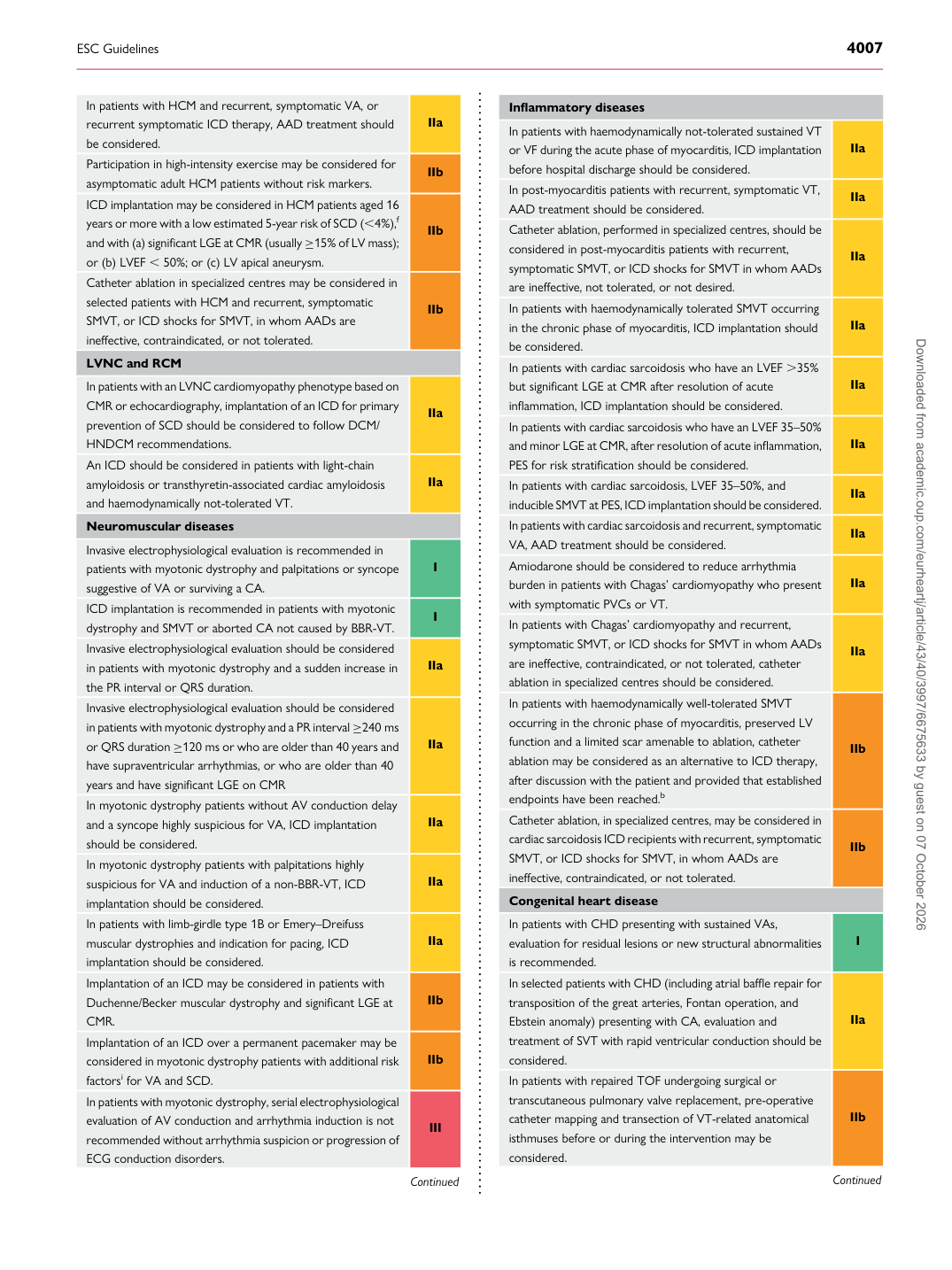
In patients with HCM and recurrent, symptomatic VA, or recurrent symptomatic ICD therapy, AAD treatment should be considered. IIa Participation in high-intensity exercise may be considered for asymptomatic adult HCM patients without risk markers. IIb ICD implantation may be considered in HCM patients aged 16 years or more with a low estimated 5-year risk of SCD (,4%),f and with (a) significant LGE at CMR (usually ≥15% of LV mass); or (b) LVEF , 50%; or (c) LV apical aneurysm. IIb Catheter ablation in specialized centres may be considered in selected patients with HCM and recurrent, symptomatic SMVT, or ICD shocks for SMVT, in whom AADs are ineffective, contraindicated, or not tolerated. IIb LVNC and RCM In patients with an LVNC cardiomyopathy phenotype based on CMR or echocardiography, implantation of an ICD for primary prevention of SCD should be considered to follow DCM/ HNDCM recommendations. IIa An ICD should be considered in patients with light-chain amyloidosis or transthyretin-associated cardiac amyloidosis and haemodynamically not-tolerated VT. IIa Neuromuscular diseases Invasive electrophysiological evaluation is recommended in patients with myotonic dystrophy and palpitations or syncope suggestive of VA or surviving a CA. I ICD implantation is recommended in patients with myotonic dystrophy and SMVT or aborted CA not caused by BBR-VT. I Invasive electrophysiological evaluation should be considered in patients with myotonic dystrophy and a sudden increase in the PR interval or QRS duration. IIa Invasive electrophysiological evaluation should be considered in patients with myotonic dystrophy and a PR interval ≥240 ms or QRS duration ≥120 ms or who are older than 40 years and have supraventricular arrhythmias, or who are older than 40 years and have significant LGE on CMR IIa In myotonic dystrophy patients without AV conduction delay and a syncope highly suspicious for VA, ICD implantation should be considered. IIa In myotonic dystrophy patients with palpitations highly suspicious for VA and induction of a non-BBR-VT, ICD implantation should be considered. IIa In patients with limb-girdle type 1B or Emery–Dreifuss muscular dystrophies and indication for pacing, ICD implantation should be considered. IIa Implantation of an ICD may be considered in patients with Duchenne/Becker muscular dystrophy and significant LGE at CMR. IIb Implantation of an ICD over a permanent pacemaker may be considered in myotonic dystrophy patients with additional risk factorsi for VA and SCD. IIb In patients with myotonic dystrophy, serial electrophysiological evaluation of AV conduction and arrhythmia induction is not recommended without arrhythmia suspicion or progression of ECG conduction disorders. III

Continued Inflammatory diseases

In patients with haemodynamically not-tolerated sustained VT or VF during the acute phase of myocarditis, ICD implantation before hospital discharge should be considered. IIa In post-myocarditis patients with recurrent, symptomatic VT, AAD treatment should be considered. IIa Catheter ablation, performed in specialized centres, should be considered in post-myocarditis patients with recurrent, symptomatic SMVT, or ICD shocks for SMVT in whom AADs are ineffective, not tolerated, or not desired. IIa In patients with haemodynamically tolerated SMVT occurring in the chronic phase of myocarditis, ICD implantation should be considered. IIa In patients with cardiac sarcoidosis who have an LVEF .35% but significant LGE at CMR after resolution of acute inflammation, ICD implantation should be considered. IIa In patients with cardiac sarcoidosis who have an LVEF 35–50% and minor LGE at CMR, after resolution of acute inflammation, PES for risk stratification should be considered. IIa In patients with cardiac sarcoidosis, LVEF 35–50%, and inducible SMVT at PES, ICD implantation should be considered. IIa In patients with cardiac sarcoidosis and recurrent, symptomatic VA, AAD treatment should be considered. IIa Amiodarone should be considered to reduce arrhythmia burden in patients with Chagas’ cardiomyopathy who present with symptomatic PVCs or VT. IIa In patients with Chagas’ cardiomyopathy and recurrent, symptomatic SMVT, or ICD shocks for SMVT in whom AADs are ineffective, contraindicated, or not tolerated, catheter ablation in specialized centres should be considered. IIa In patients with haemodynamically well-tolerated SMVT occurring in the chronic phase of myocarditis, preserved LV function and a limited scar amenable to ablation, catheter ablation may be considered as an alternative to ICD therapy, after discussion with the patient and provided that established endpoints have been reached.b IIb Catheter ablation, in specialized centres, may be considered in cardiac sarcoidosis ICD recipients with recurrent, symptomatic SMVT, or ICD shocks for SMVT, in whom AADs are ineffective, contraindicated, or not tolerated. IIb Congenital heart disease In patients with CHD presenting with sustained VAs, evaluation for residual lesions or new structural abnormalities is recommended. I In selected patients with CHD (including atrial baffle repair for transposition of the great arteries, Fontan operation, and Ebstein anomaly) presenting with CA, evaluation and treatment of SVT with rapid ventricular conduction should be considered. IIa In patients with repaired TOF undergoing surgical or transcutaneous pulmonary valve replacement, pre-operative catheter mapping and transection of VT-related anatomical isthmuses before or during the intervention may be considered. IIb

Continued Downloaded from academic.oup.com/eurheartj/article/43/40/3997/6675633 by guest on 07 October 2026