p.103 抽出テキスト
12 Quality indicators

Quality indicators (QIs) are tools that may be used to evaluate care quality, including structural aspects, process, and outcomes of care.1153 They serve as a mechanism for enhancing adherence to guideline recommendations, through associated quality improvement initiatives and the benchmarking of care providers.1154,1155 As such, the role of QIs in improving care and outcomes is increasingly recognized by healthcare authorities, professional organizations, payers, and the public.1153 The ESC understands the need for measuring and reporting quality and outcomes of cardiovascular care, and has established methods for the development of the ESC QIs for the quantification of care and outcomes for cardiovascular disease.1153 In parallel with the writing of this Clinical Practice Guideline document, a process has been initiated to develop QIs for patients with, or at risk of, VA or SCD using the ESC methodology and through the collaboration with domain experts and the European Heart Rhythm Association. These QIs, alongside their specifications and development process, will be published separately.

13 Supplementary data

Supplementary data is available at European Heart Journal online.

14 Data availability statement

No new data were generated or analysed in support of this research.

15 Author information

Author/task force Member Affiliations: Marta de Riva, Cardiology, Leiden University Medical Centre, Leiden, Netherlands; Bo Gregers Winkel, Cardiology,

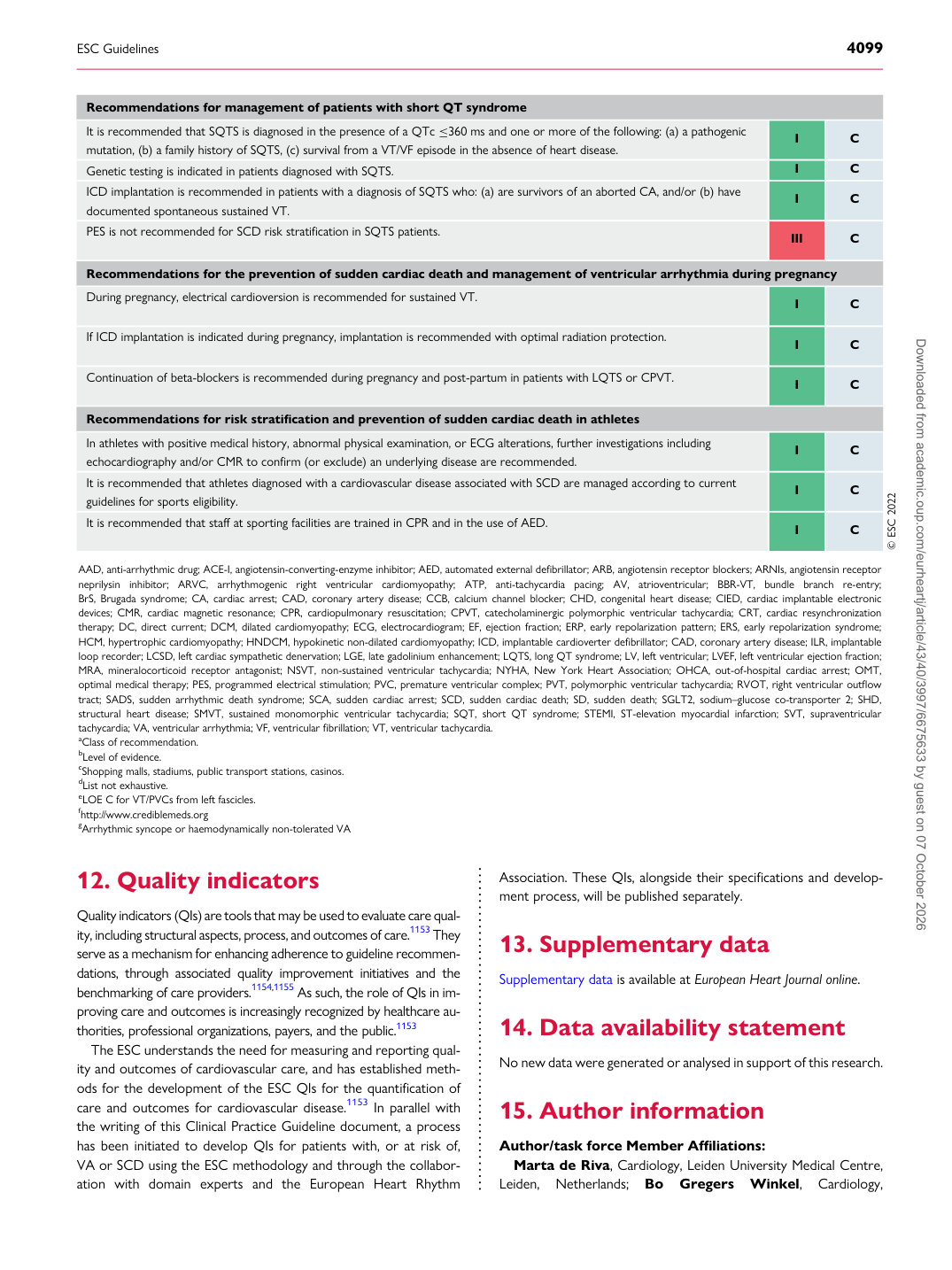
Recommendations for management of patients with short QT syndrome It is recommended that SQTS is diagnosed in the presence of a QTc ≤360 ms and one or more of the following: (a) a pathogenic mutation, (b) a family history of SQTS, (c) survival from a VT/VF episode in the absence of heart disease. I C Genetic testing is indicated in patients diagnosed with SQTS. I C ICD implantation is recommended in patients with a diagnosis of SQTS who: (a) are survivors of an aborted CA, and/or (b) have documented spontaneous sustained VT. I C PES is not recommended for SCD risk stratification in SQTS patients. III C

Recommendations for the prevention of sudden cardiac death and management of ventricular arrhythmia during pregnancy During pregnancy, electrical cardioversion is recommended for sustained VT. I C

If ICD implantation is indicated during pregnancy, implantation is recommended with optimal radiation protection. I C

Continuation of beta-blockers is recommended during pregnancy and post-partum in patients with LQTS or CPVT. I C

Recommendations for risk stratification and prevention of sudden cardiac death in athletes In athletes with positive medical history, abnormal physical examination, or ECG alterations, further investigations including echocardiography and/or CMR to confirm (or exclude) an underlying disease are recommended. I C It is recommended that athletes diagnosed with a cardiovascular disease associated with SCD are managed according to current guidelines for sports eligibility. I C It is recommended that staff at sporting facilities are trained in CPR and in the use of AED. I C © ESC 2022

AAD, anti-arrhythmic drug; ACE-I, angiotensin-converting-enzyme inhibitor; AED, automated external defibrillator; ARB, angiotensin receptor blockers; ARNIs, angiotensin receptor neprilysin inhibitor; ARVC, arrhythmogenic right ventricular cardiomyopathy; ATP, anti-tachycardia pacing; AV, atrioventricular; BBR-VT, bundle branch re-entry; BrS, Brugada syndrome; CA, cardiac arrest; CAD, coronary artery disease; CCB, calcium channel blocker; CHD, congenital heart disease; CIED, cardiac implantable electronic devices; CMR, cardiac magnetic resonance; CPR, cardiopulmonary resuscitation; CPVT, catecholaminergic polymorphic ventricular tachycardia; CRT, cardiac resynchronization therapy; DC, direct current; DCM, dilated cardiomyopathy; ECG, electrocardiogram; EF, ejection fraction; ERP, early repolarization pattern; ERS, early repolarization syndrome; HCM, hypertrophic cardiomyopathy; HNDCM, hypokinetic non-dilated cardiomyopathy; ICD, implantable cardioverter defibrillator; CAD, coronary artery disease; ILR, implantable loop recorder; LCSD, left cardiac sympathetic denervation; LGE, late gadolinium enhancement; LQTS, long QT syndrome; LV, left ventricular; LVEF, left ventricular ejection fraction; MRA, mineralocorticoid receptor antagonist; NSVT, non-sustained ventricular tachycardia; NYHA, New York Heart Association; OHCA, out-of-hospital cardiac arrest; OMT, optimal medical therapy; PES, programmed electrical stimulation; PVC, premature ventricular complex; PVT, polymorphic ventricular tachycardia; RVOT, right ventricular outflow tract; SADS, sudden arrhythmic death syndrome; SCA, sudden cardiac arrest; SCD, sudden cardiac death; SD, sudden death; SGLT2, sodium–glucose co-transporter 2; SHD, structural heart disease; SMVT, sustained monomorphic ventricular tachycardia; SQT, short QT syndrome; STEMI, ST-elevation myocardial infarction; SVT, supraventricular tachycardia; VA, ventricular arrhythmia; VF, ventricular fibrillation; VT, ventricular tachycardia. aClass of recommendation. bLevel of evidence. cShopping malls, stadiums, public transport stations, casinos. dList not exhaustive. eLOE C for VT/PVCs from left fascicles. fhttp://www.crediblemeds.org gArrhythmic syncope or haemodynamically non-tolerated VA Downloaded from academic.oup.com/eurheartj/article/43/40/3997/6675633 by guest on 07 October 2026