p.10 抽出テキスト
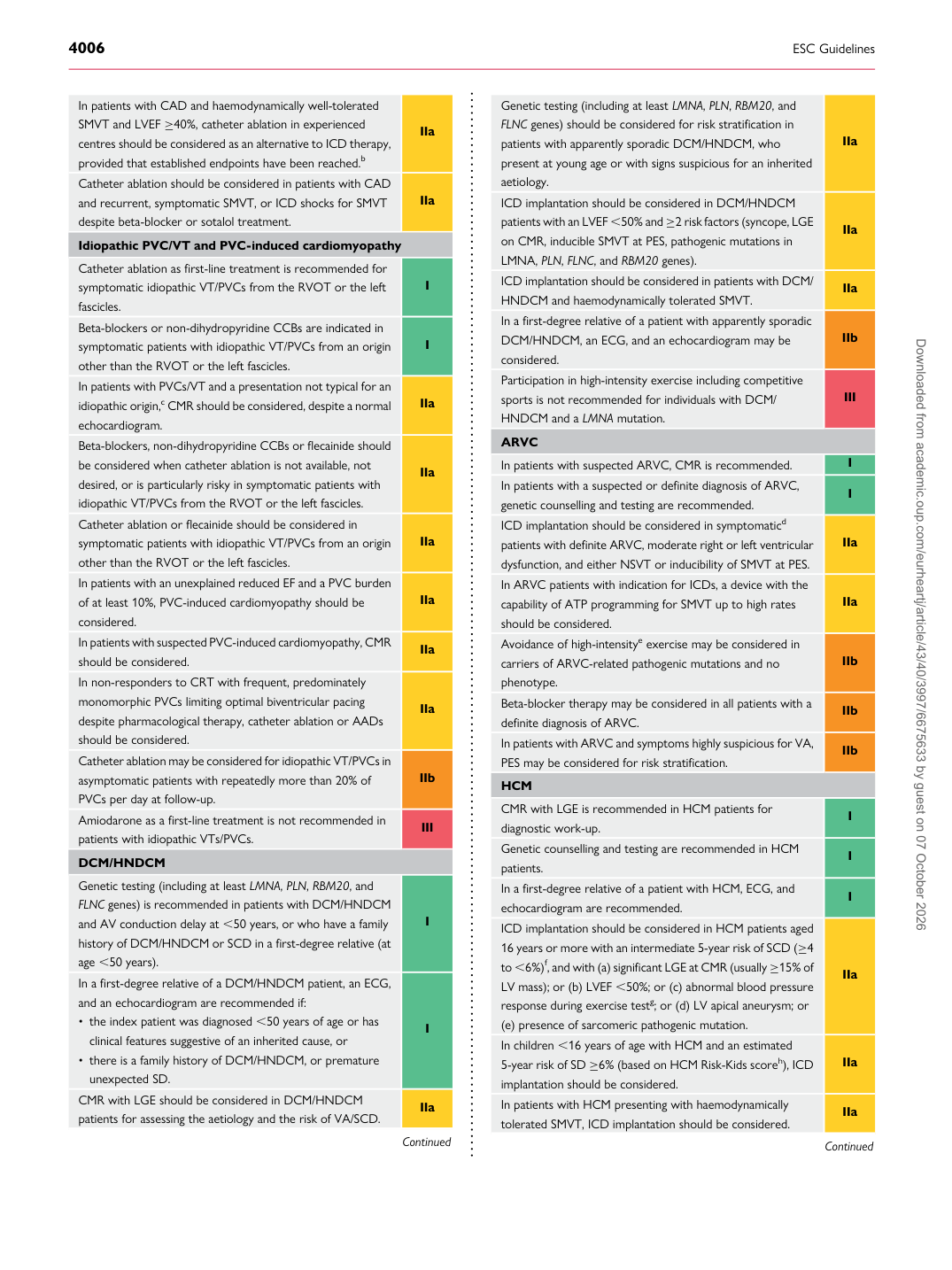
In patients with CAD and haemodynamically well-tolerated SMVT and LVEF ≥40%, catheter ablation in experienced centres should be considered as an alternative to ICD therapy, provided that established endpoints have been reached.b IIa Catheter ablation should be considered in patients with CAD and recurrent, symptomatic SMVT, or ICD shocks for SMVT despite beta-blocker or sotalol treatment. IIa Idiopathic PVC/VT and PVC-induced cardiomyopathy Catheter ablation as first-line treatment is recommended for symptomatic idiopathic VT/PVCs from the RVOT or the left fascicles. I Beta-blockers or non-dihydropyridine CCBs are indicated in symptomatic patients with idiopathic VT/PVCs from an origin other than the RVOT or the left fascicles. I In patients with PVCs/VT and a presentation not typical for an idiopathic origin,c CMR should be considered, despite a normal echocardiogram. IIa Beta-blockers, non-dihydropyridine CCBs or flecainide should be considered when catheter ablation is not available, not desired, or is particularly risky in symptomatic patients with idiopathic VT/PVCs from the RVOT or the left fascicles. IIa Catheter ablation or flecainide should be considered in symptomatic patients with idiopathic VT/PVCs from an origin other than the RVOT or the left fascicles. IIa In patients with an unexplained reduced EF and a PVC burden of at least 10%, PVC-induced cardiomyopathy should be considered. IIa In patients with suspected PVC-induced cardiomyopathy, CMR should be considered. IIa In non-responders to CRT with frequent, predominately monomorphic PVCs limiting optimal biventricular pacing despite pharmacological therapy, catheter ablation or AADs should be considered. IIa Catheter ablation may be considered for idiopathic VT/PVCs in asymptomatic patients with repeatedly more than 20% of PVCs per day at follow-up. IIb Amiodarone as a first-line treatment is not recommended in patients with idiopathic VTs/PVCs. III DCM/HNDCM Genetic testing (including at least LMNA, PLN, RBM20, and FLNC genes) is recommended in patients with DCM/HNDCM and AV conduction delay at ,50 years, or who have a family history of DCM/HNDCM or SCD in a first-degree relative (at age ,50 years). I In a first-degree relative of a DCM/HNDCM patient, an ECG, and an echocardiogram are recommended if: • the index patient was diagnosed ,50 years of age or has

clinical features suggestive of an inherited cause, or • there is a family history of DCM/HNDCM, or premature unexpected SD. I CMR with LGE should be considered in DCM/HNDCM patients for assessing the aetiology and the risk of VA/SCD. IIa

Continued Genetic testing (including at least LMNA, PLN, RBM20, and

FLNC genes) should be considered for risk stratification in patients with apparently sporadic DCM/HNDCM, who present at young age or with signs suspicious for an inherited aetiology. IIa ICD implantation should be considered in DCM/HNDCM patients with an LVEF ,50% and ≥2 risk factors (syncope, LGE on CMR, inducible SMVT at PES, pathogenic mutations in LMNA, PLN, FLNC, and RBM20 genes). IIa ICD implantation should be considered in patients with DCM/ HNDCM and haemodynamically tolerated SMVT. IIa In a first-degree relative of a patient with apparently sporadic DCM/HNDCM, an ECG, and an echocardiogram may be considered. IIb Participation in high-intensity exercise including competitive sports is not recommended for individuals with DCM/ HNDCM and a LMNA mutation. III ARVC In patients with suspected ARVC, CMR is recommended. I In patients with a suspected or definite diagnosis of ARVC, genetic counselling and testing are recommended. I ICD implantation should be considered in symptomaticd patients with definite ARVC, moderate right or left ventricular dysfunction, and either NSVT or inducibility of SMVT at PES. IIa In ARVC patients with indication for ICDs, a device with the capability of ATP programming for SMVT up to high rates should be considered. IIa Avoidance of high-intensitye exercise may be considered in carriers of ARVC-related pathogenic mutations and no phenotype. IIb Beta-blocker therapy may be considered in all patients with a definite diagnosis of ARVC. IIb In patients with ARVC and symptoms highly suspicious for VA, PES may be considered for risk stratification. IIb HCM CMR with LGE is recommended in HCM patients for diagnostic work-up. I Genetic counselling and testing are recommended in HCM patients. I In a first-degree relative of a patient with HCM, ECG, and echocardiogram are recommended. I ICD implantation should be considered in HCM patients aged 16 years or more with an intermediate 5-year risk of SCD (≥4 to ,6%)f, and with (a) significant LGE at CMR (usually ≥15% of LV mass); or (b) LVEF ,50%; or (c) abnormal blood pressure response during exercise testg; or (d) LV apical aneurysm; or (e) presence of sarcomeric pathogenic mutation. IIa In children ,16 years of age with HCM and an estimated 5-year risk of SD ≥6% (based on HCM Risk-Kids scoreh), ICD implantation should be considered. IIa In patients with HCM presenting with haemodynamically tolerated SMVT, ICD implantation should be considered. IIa

Continued Downloaded from academic.oup.com/eurheartj/article/43/40/3997/6675633 by guest on 07 October 2026