p.93 抽出テキスト
16 Quality indicators

Quality indicators (QIs) are tools that may be used to evaluate care quality, including structural, process, and outcomes of care.847 They may also serve as a mechanism for enhancing adherence to guideline recommendations through associated quality-improvement initiatives and benchmarking of care providers.848,849 As such, the role of QIs in improving care and outcomes for cardiovascular disease is increasingly being recognized by health care authorities, professional organizations, payers, and the public.847 The ESC understands the need for measuring and reporting quality and outcomes of cardiovascular care, and has established methods for developing the ESC QIs for the quantification of care and outcomes for cardiovascular diseases.847 To date, the ESC has developed QI suites for a number of cardiovascular diseases850–852

and embedded these in respective ESC Clinical Practice guidelines.27,477,853,854 Furthermore, the ESC aims to integrate its QIs with clinical registries such as the EurObservational Research Programme and the European Unified Registries On Heart Care Evaluation and Randomized Trials (EuroHeart) project855 to provide real-world data about the patterns and outcomes of care for cardiovascular disease across Europe. In parallel with the writing of this Clinical Practice Guideline, a process has been initiated to develop QIs for patients with PH using the

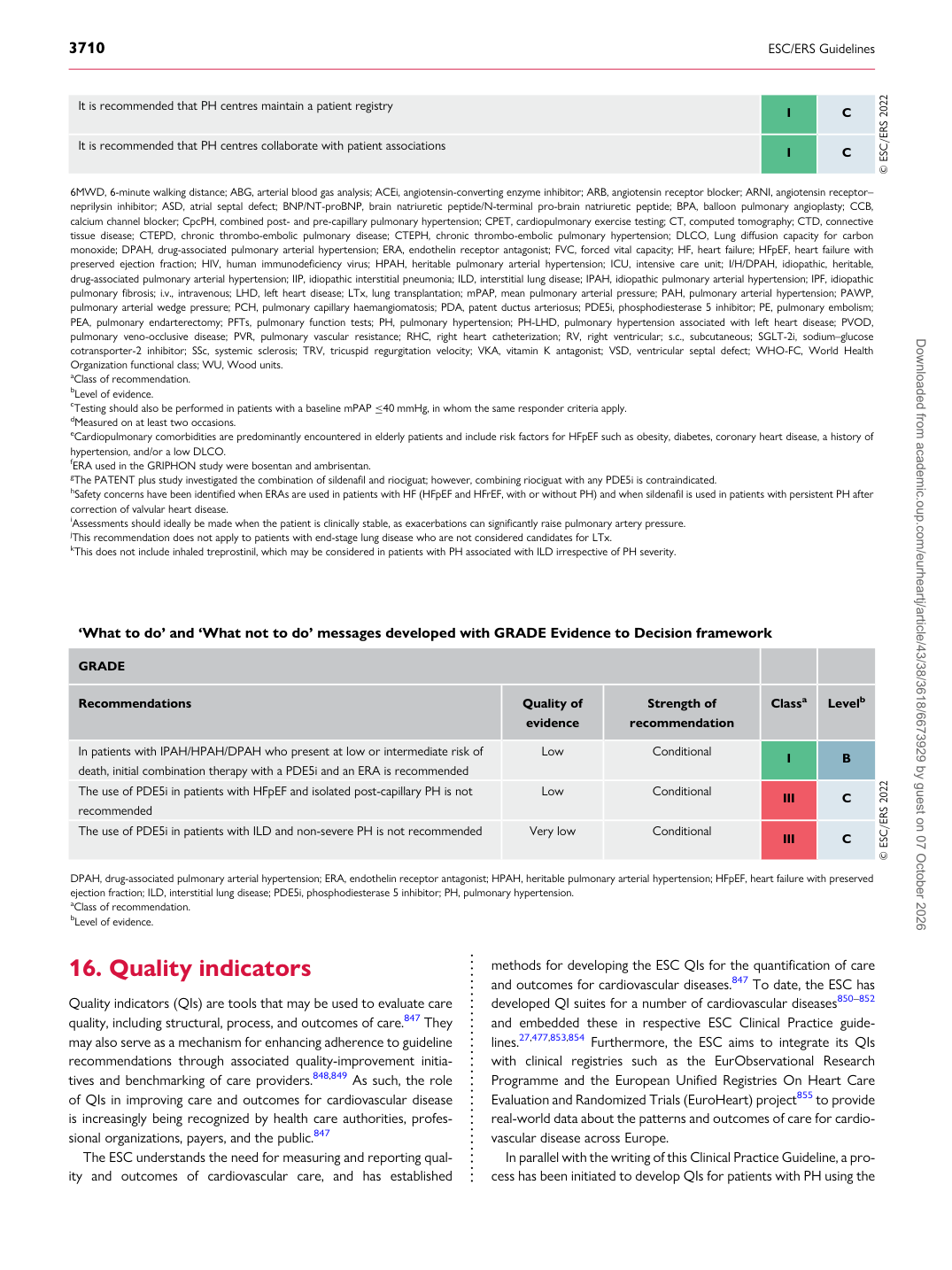
It is recommended that PH centres maintain a patient registry I C

It is recommended that PH centres collaborate with patient associations I C © ESC/ERS 2022 6MWD, 6-minute walking distance; ABG, arterial blood gas analysis; ACEi, angiotensin-converting enzyme inhibitor; ARB, angiotensin receptor blocker; ARNI, angiotensin receptor– neprilysin inhibitor; ASD, atrial septal defect; BNP/NT-proBNP, brain natriuretic peptide/N-terminal pro-brain natriuretic peptide; BPA, balloon pulmonary angioplasty; CCB, calcium channel blocker; CpcPH, combined post- and pre-capillary pulmonary hypertension; CPET, cardiopulmonary exercise testing; CT, computed tomography; CTD, connective tissue disease; CTEPD, chronic thrombo-embolic pulmonary disease; CTEPH, chronic thrombo-embolic pulmonary hypertension; DLCO, Lung diffusion capacity for carbon monoxide; DPAH, drug-associated pulmonary arterial hypertension; ERA, endothelin receptor antagonist; FVC, forced vital capacity; HF, heart failure; HFpEF, heart failure with preserved ejection fraction; HIV, human immunodeficiency virus; HPAH, heritable pulmonary arterial hypertension; ICU, intensive care unit; I/H/DPAH, idiopathic, heritable, drug-associated pulmonary arterial hypertension; IIP, idiopathic interstitial pneumonia; ILD, interstitial lung disease; IPAH, idiopathic pulmonary arterial hypertension; IPF, idiopathic pulmonary fibrosis; i.v., intravenous; LHD, left heart disease; LTx, lung transplantation; mPAP, mean pulmonary arterial pressure; PAH, pulmonary arterial hypertension; PAWP, pulmonary arterial wedge pressure; PCH, pulmonary capillary haemangiomatosis; PDA, patent ductus arteriosus; PDE5i, phosphodiesterase 5 inhibitor; PE, pulmonary embolism; PEA, pulmonary endarterectomy; PFTs, pulmonary function tests; PH, pulmonary hypertension; PH-LHD, pulmonary hypertension associated with left heart disease; PVOD, pulmonary veno-occlusive disease; PVR, pulmonary vascular resistance; RHC, right heart catheterization; RV, right ventricular; s.c., subcutaneous; SGLT-2i, sodium–glucose cotransporter-2 inhibitor; SSc, systemic sclerosis; TRV, tricuspid regurgitation velocity; VKA, vitamin K antagonist; VSD, ventricular septal defect; WHO-FC, World Health Organization functional class; WU, Wood units. aClass of recommendation. bLevel of evidence. cTesting should also be performed in patients with a baseline mPAP ≤40 mmHg, in whom the same responder criteria apply. dMeasured on at least two occasions. eCardiopulmonary comorbidities are predominantly encountered in elderly patients and include risk factors for HFpEF such as obesity, diabetes, coronary heart disease, a history of hypertension, and/or a low DLCO. fERA used in the GRIPHON study were bosentan and ambrisentan. gThe PATENT plus study investigated the combination of sildenafil and riociguat; however, combining riociguat with any PDE5i is contraindicated. hSafety concerns have been identified when ERAs are used in patients with HF (HFpEF and HFrEF, with or without PH) and when sildenafil is used in patients with persistent PH after correction of valvular heart disease. iAssessments should ideally be made when the patient is clinically stable, as exacerbations can significantly raise pulmonary artery pressure. jThis recommendation does not apply to patients with end-stage lung disease who are not considered candidates for LTx. kThis does not include inhaled treprostinil, which may be considered in patients with PH associated with ILD irrespective of PH severity.

‘What to do’ and ‘What not to do’ messages developed with GRADE Evidence to Decision framework

GRADE

Recommendations Quality of

evidence Strength of

recommendation Classa Levelb

In patients with IPAH/HPAH/DPAH who present at low or intermediate risk of death, initial combination therapy with a PDE5i and an ERA is recommended Low Conditional I B The use of PDE5i in patients with HFpEF and isolated post-capillary PH is not recommended Low Conditional III C The use of PDE5i in patients with ILD and non-severe PH is not recommended Very low Conditional III C © ESC/ERS 2022 DPAH, drug-associated pulmonary arterial hypertension; ERA, endothelin receptor antagonist; HPAH, heritable pulmonary arterial hypertension; HFpEF, heart failure with preserved ejection fraction; ILD, interstitial lung disease; PDE5i, phosphodiesterase 5 inhibitor; PH, pulmonary hypertension. aClass of recommendation. bLevel of evidence. Downloaded from academic.oup.com/eurheartj/article/43/38/3618/6673929 by guest on 07 October 2026