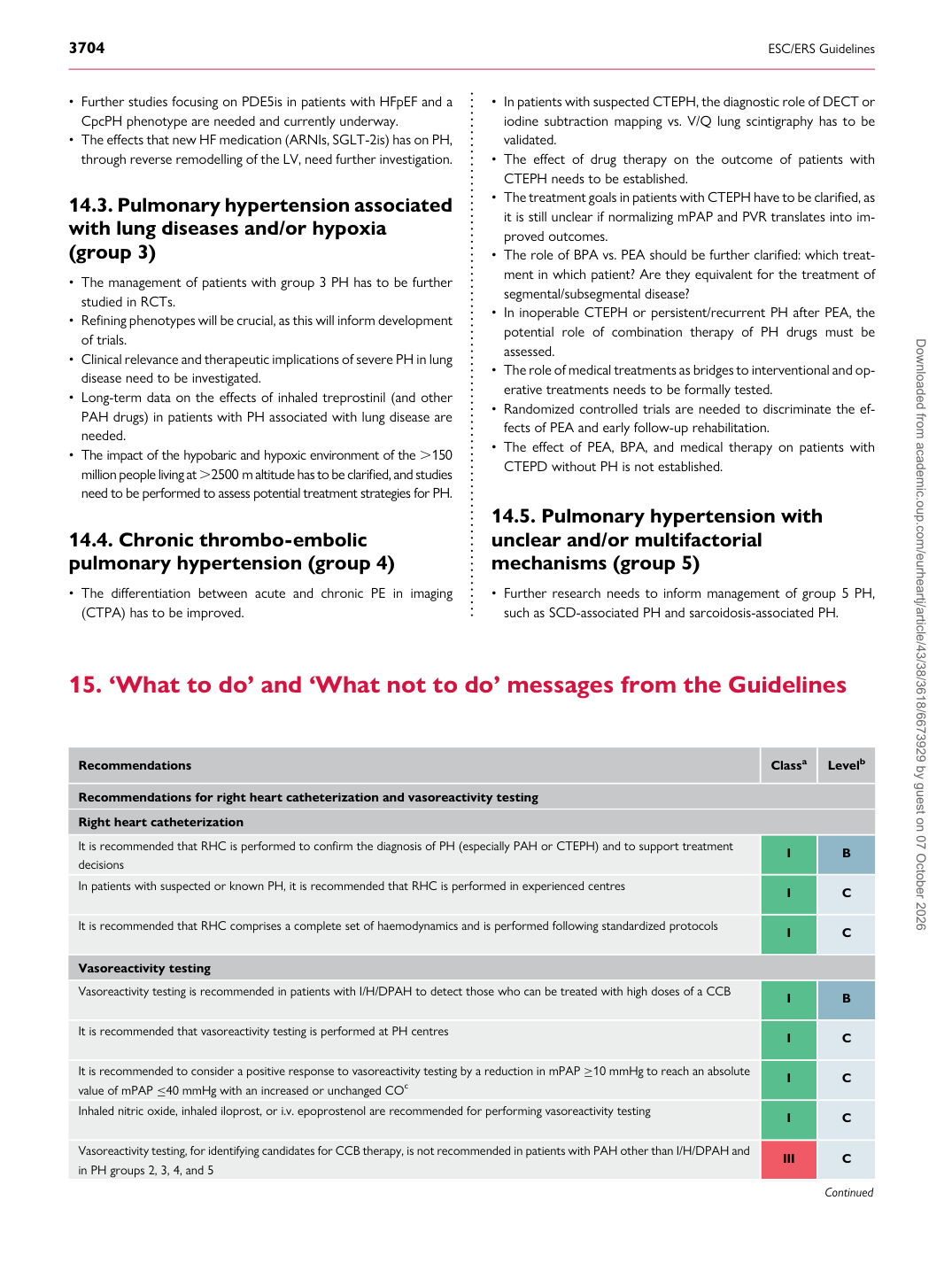
p.87 抽出テキスト
• Further studies focusing on PDE5is in patients with HFpEF and a CpcPH phenotype are needed and currently underway. • The effects that new HF medication (ARNIs, SGLT-2is) has on PH, through reverse remodelling of the LV, need further investigation.

14.3 Pulmonary hypertension associated

with lung diseases and/or hypoxia (group 3)

• The management of patients with group 3 PH has to be further studied in RCTs. • Refining phenotypes will be crucial, as this will inform development of trials. • Clinical relevance and therapeutic implications of severe PH in lung disease need to be investigated. • Long-term data on the effects of inhaled treprostinil (and other PAH drugs) in patients with PH associated with lung disease are needed. • The impact of the hypobaric and hypoxic environment of the .150 million people living at .2500 m altitude has tobe clarified, and studies need to be performed to assess potential treatment strategies for PH.

14.4 Chronic thrombo-embolic

pulmonary hypertension (group 4)

• The differentiation between acute and chronic PE in imaging (CTPA) has to be improved. • In patients with suspected CTEPH, the diagnostic role of DECT or iodine subtraction mapping vs. V/Q lung scintigraphy has to be validated. • The effect of drug therapy on the outcome of patients with CTEPH needs to be established. • The treatment goals in patients with CTEPH have to be clarified, as it is still unclear if normalizing mPAP and PVR translates into improved outcomes. • The role of BPA vs. PEA should be further clarified: which treatment in which patient? Are they equivalent for the treatment of segmental/subsegmental disease? • In inoperable CTEPH or persistent/recurrent PH after PEA, the potential role of combination therapy of PH drugs must be assessed. • The role of medical treatments as bridges to interventional and operative treatments needs to be formally tested. • Randomized controlled trials are needed to discriminate the effects of PEA and early follow-up rehabilitation. • The effect of PEA, BPA, and medical therapy on patients with CTEPD without PH is not established.

14.5 Pulmonary hypertension with

unclear and/or multifactorial mechanisms (group 5)

• Further research needs to inform management of group 5 PH, such as SCD-associated PH and sarcoidosis-associated PH.

15 ‘What to do’ and ‘What not to do’ messages from the Guidelines

Recommendations Classa Levelb

Recommendations for right heart catheterization and vasoreactivity testing Right heart catheterization It is recommended that RHC is performed to confirm the diagnosis of PH (especially PAH or CTEPH) and to support treatment decisions I B In patients with suspected or known PH, it is recommended that RHC is performed in experienced centres I C

It is recommended that RHC comprises a complete set of haemodynamics and is performed following standardized protocols I C

Vasoreactivity testing Vasoreactivity testing is recommended in patients with I/H/DPAH to detect those who can be treated with high doses of a CCB I B

It is recommended that vasoreactivity testing is performed at PH centres I C

It is recommended to consider a positive response to vasoreactivity testing by a reduction in mPAP ≥10 mmHg to reach an absolute value of mPAP ≤40 mmHg with an increased or unchanged COc I C Inhaled nitric oxide, inhaled iloprost, or i.v. epoprostenol are recommended for performing vasoreactivity testing I C

Vasoreactivity testing, for identifying candidates for CCB therapy, is not recommended in patients with PAH other than I/H/DPAH and in PH groups 2, 3, 4, and 5 III C

Continued Downloaded from academic.oup.com/eurheartj/article/43/38/3618/6673929 by guest on 07 October 2026