p.85 抽出テキスト
12.1 Facilities and skills required for a

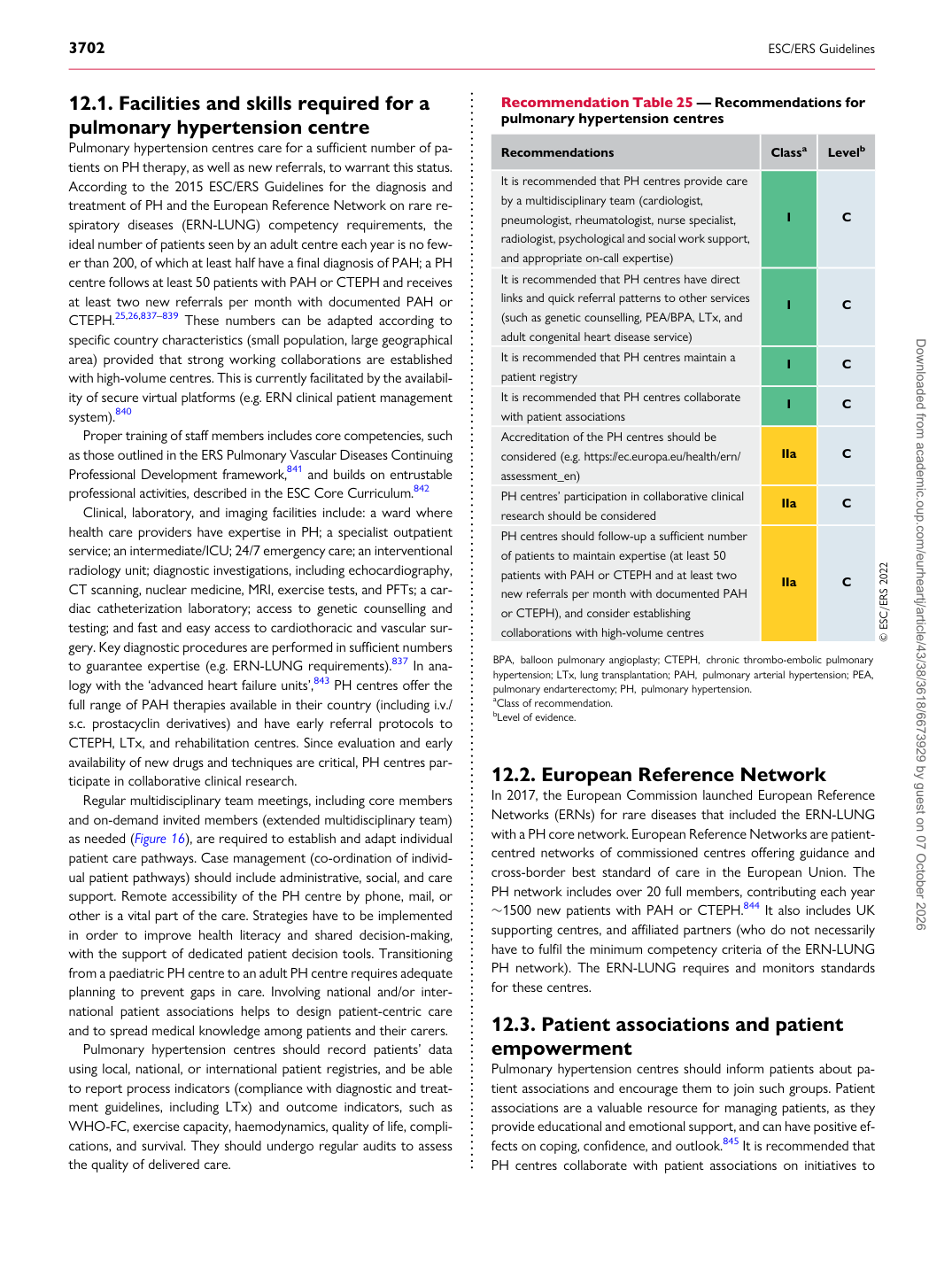
pulmonary hypertension centre Pulmonary hypertension centres care for a sufficient number of patients on PH therapy, as well as new referrals, to warrant this status. According to the 2015 ESC/ERS Guidelines for the diagnosis and treatment of PH and the European Reference Network on rare respiratory diseases (ERN-LUNG) competency requirements, the ideal number of patients seen by an adult centre each year is no fewer than 200, of which at least half have a final diagnosis of PAH; a PH centre follows at least 50 patients with PAH or CTEPH and receives at least two new referrals per month with documented PAH or CTEPH.25,26,837–839 These numbers can be adapted according to specific country characteristics (small population, large geographical area) provided that strong working collaborations are established with high-volume centres. This is currently facilitated by the availability of secure virtual platforms (e.g. ERN clinical patient management system).840 Proper training of staff members includes core competencies, such as those outlined in the ERS Pulmonary Vascular Diseases Continuing Professional Development framework,841 and builds on entrustable professional activities, described in the ESC Core Curriculum.842 Clinical, laboratory, and imaging facilities include: a ward where health care providers have expertise in PH; a specialist outpatient service; an intermediate/ICU; 24/7 emergency care; an interventional radiology unit; diagnostic investigations, including echocardiography, CT scanning, nuclear medicine, MRI, exercise tests, and PFTs; a cardiac catheterization laboratory; access to genetic counselling and testing; and fast and easy access to cardiothoracic and vascular surgery. Key diagnostic procedures are performed in sufficient numbers to guarantee expertise (e.g. ERN-LUNG requirements).837 In analogy with the ‘advanced heart failure units’,843 PH centres offer the full range of PAH therapies available in their country (including i.v./ s.c. prostacyclin derivatives) and have early referral protocols to CTEPH, LTx, and rehabilitation centres. Since evaluation and early availability of new drugs and techniques are critical, PH centres participate in collaborative clinical research. Regular multidisciplinary team meetings, including core members and on-demand invited members (extended multidisciplinary team) as needed (Figure 16), are required to establish and adapt individual patient care pathways. Case management (co-ordination of individual patient pathways) should include administrative, social, and care support. Remote accessibility of the PH centre by phone, mail, or other is a vital part of the care. Strategies have to be implemented in order to improve health literacy and shared decision-making, with the support of dedicated patient decision tools. Transitioning from a paediatric PH centre to an adult PH centre requires adequate planning to prevent gaps in care. Involving national and/or international patient associations helps to design patient-centric care and to spread medical knowledge among patients and their carers. Pulmonary hypertension centres should record patients’ data using local, national, or international patient registries, and be able to report process indicators (compliance with diagnostic and treatment guidelines, including LTx) and outcome indicators, such as WHO-FC, exercise capacity, haemodynamics, quality of life, complications, and survival. They should undergo regular audits to assess the quality of delivered care. 12.2 European Reference Network

In 2017, the European Commission launched European Reference Networks (ERNs) for rare diseases that included the ERN-LUNG with a PH core network. European Reference Networks are patientcentred networks of commissioned centres offering guidance and cross-border best standard of care in the European Union. The PH network includes over 20 full members, contributing each year ≏1500 new patients with PAH or CTEPH.844 It also includes UK supporting centres, and affiliated partners (who do not necessarily have to fulfil the minimum competency criteria of the ERN-LUNG PH network). The ERN-LUNG requires and monitors standards for these centres.

12.3 Patient associations and patient

empowerment Pulmonary hypertension centres should inform patients about patient associations and encourage them to join such groups. Patient associations are a valuable resource for managing patients, as they provide educational and emotional support, and can have positive effects on coping, confidence, and outlook.845 It is recommended that PH centres collaborate with patient associations on initiatives to

Recommendation Table 25 — Recommendations for pulmonary hypertension centres

Recommendations Classa Levelb

It is recommended that PH centres provide care by a multidisciplinary team (cardiologist, pneumologist, rheumatologist, nurse specialist, radiologist, psychological and social work support, and appropriate on-call expertise) I C It is recommended that PH centres have direct links and quick referral patterns to other services (such as genetic counselling, PEA/BPA, LTx, and adult congenital heart disease service) I C It is recommended that PH centres maintain a patient registry I C It is recommended that PH centres collaborate with patient associations I C Accreditation of the PH centres should be considered (e.g. https://ec.europa.eu/health/ern/ assessment_en) IIa C PH centres’ participation in collaborative clinical research should be considered IIa C PH centres should follow-up a sufficient number of patients to maintain expertise (at least 50 patients with PAH or CTEPH and at least two new referrals per month with documented PAH or CTEPH), and consider establishing collaborations with high-volume centres IIa C © ESC/ERS 2022 BPA, balloon pulmonary angioplasty; CTEPH, chronic thrombo-embolic pulmonary hypertension; LTx, lung transplantation; PAH, pulmonary arterial hypertension; PEA, pulmonary endarterectomy; PH, pulmonary hypertension. aClass of recommendation. bLevel of evidence. Downloaded from academic.oup.com/eurheartj/article/43/38/3618/6673929 by guest on 07 October 2026