p.82 抽出テキスト
11 Pulmonary hypertension with

unclear and/or multifactorial mechanisms (group 5)

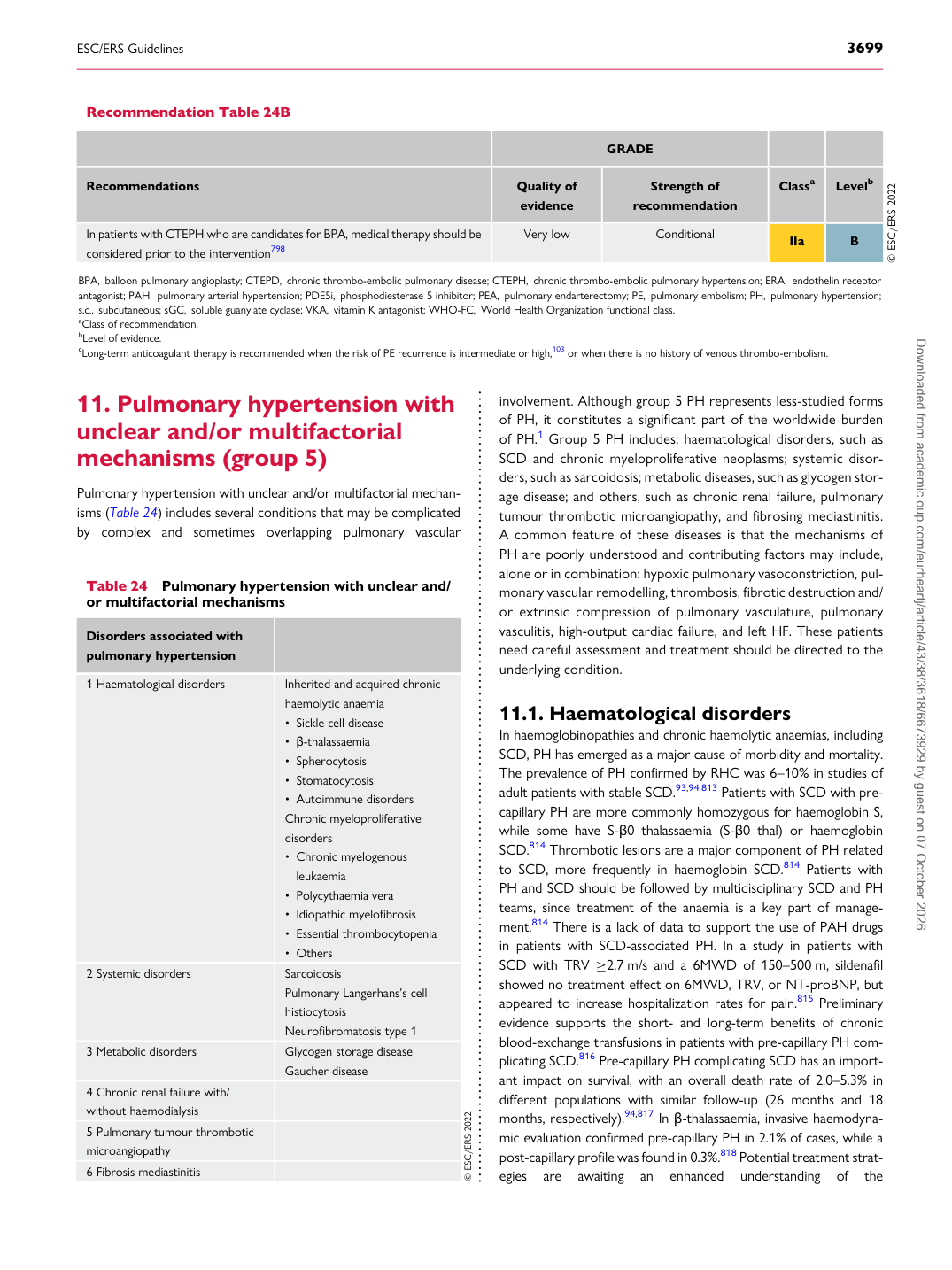
Pulmonary hypertension with unclear and/or multifactorial mechanisms (Table 24) includes several conditions that may be complicated by complex and sometimes overlapping pulmonary vascular involvement. Although group 5 PH represents less-studied forms of PH, it constitutes a significant part of the worldwide burden of PH.1 Group 5 PH includes: haematological disorders, such as SCD and chronic myeloproliferative neoplasms; systemic disorders, such as sarcoidosis; metabolic diseases, such as glycogen storage disease; and others, such as chronic renal failure, pulmonary tumour thrombotic microangiopathy, and fibrosing mediastinitis. A common feature of these diseases is that the mechanisms of PH are poorly understood and contributing factors may include, alone or in combination: hypoxic pulmonary vasoconstriction, pulmonary vascular remodelling, thrombosis, fibrotic destruction and/ or extrinsic compression of pulmonary vasculature, pulmonary vasculitis, high-output cardiac failure, and left HF. These patients need careful assessment and treatment should be directed to the underlying condition.

11.1 Haematological disorders

In haemoglobinopathies and chronic haemolytic anaemias, including SCD, PH has emerged as a major cause of morbidity and mortality. The prevalence of PH confirmed by RHC was 6–10% in studies of adult patients with stable SCD.93,94,813 Patients with SCD with precapillary PH are more commonly homozygous for haemoglobin S, while some have S-β0 thalassaemia (S-β0 thal) or haemoglobin SCD.814 Thrombotic lesions are a major component of PH related to SCD, more frequently in haemoglobin SCD.814 Patients with PH and SCD should be followed by multidisciplinary SCD and PH teams, since treatment of the anaemia is a key part of management.814 There is a lack of data to support the use of PAH drugs in patients with SCD-associated PH. In a study in patients with SCD with TRV ≥2.7 m/s and a 6MWD of 150–500 m, sildenafil showed no treatment effect on 6MWD, TRV, or NT-proBNP, but appeared to increase hospitalization rates for pain.815 Preliminary evidence supports the short- and long-term benefits of chronic blood-exchange transfusions in patients with pre-capillary PH complicating SCD.816 Pre-capillary PH complicating SCD has an important impact on survival, with an overall death rate of 2.0–5.3% in different populations with similar follow-up (26 months and 18 months, respectively).94,817 In β-thalassaemia, invasive haemodynamic evaluation confirmed pre-capillary PH in 2.1% of cases, while a post-capillary profile was found in 0.3%.818 Potential treatment strategies are awaiting an enhanced understanding of the

Recommendation Table 24B

GRADE

Recommendations Quality of

evidence Strength of

recommendation Classa Levelb

In patients with CTEPH who are candidates for BPA, medical therapy should be considered prior to the intervention798 Very low Conditional IIa B © ESC/ERS 2022 BPA, balloon pulmonary angioplasty; CTEPD, chronic thrombo-embolic pulmonary disease; CTEPH, chronic thrombo-embolic pulmonary hypertension; ERA, endothelin receptor antagonist; PAH, pulmonary arterial hypertension; PDE5i, phosphodiesterase 5 inhibitor; PEA, pulmonary endarterectomy; PE, pulmonary embolism; PH, pulmonary hypertension; s.c., subcutaneous; sGC, soluble guanylate cyclase; VKA, vitamin K antagonist; WHO-FC, World Health Organization functional class. aClass of recommendation. bLevel of evidence. cLong-term anticoagulant therapy is recommended when the risk of PE recurrence is intermediate or high,103 or when there is no history of venous thrombo-embolism.

Table 24 Pulmonary hypertension with unclear and/ or multifactorial mechanisms

Disorders associated with pulmonary hypertension

1 Haematological disorders Inherited and acquired chronic haemolytic anaemia

• Sickle cell disease • β-thalassaemia • Spherocytosis • Stomatocytosis • Autoimmune disorders Chronic myeloproliferative disorders • Chronic myelogenous leukaemia • Polycythaemia vera • Idiopathic myelofibrosis • Essential thrombocytopenia • Others

2 Systemic disorders Sarcoidosis

Pulmonary Langerhans’s cell histiocytosis Neurofibromatosis type 1

3 Metabolic disorders Glycogen storage disease

Gaucher disease

4 Chronic renal failure with/ without haemodialysis 5 Pulmonary tumour thrombotic microangiopathy 6 Fibrosis mediastinitis © ESC/ERS 2022 Downloaded from academic.oup.com/eurheartj/article/43/38/3618/6673929 by guest on 07 October 2026