p.81 抽出テキスト
that pre-treatment improves pulmonary haemodynamics and safety of the procedure. This is confirmed by the clinical experience of Task Force members. However, due to the low certainty of the evidence, the recommendation is conditional.

10.2.5 Follow-up

Regardless of the result of PEA/BPA, patients should be regularly followed-up, including invasive assessment with RHC 3–6 months after intervention, allowing for consideration of a multimodal treatment approach. After successful treatment, yearly non-invasive followup, including echocardiography and an evaluation of exercise capacity, is indicated because recurrent PH has been described (Figure 14).806 Risk assessment with either the ESC/ERS or REVEAL risk score developed for PAH has been validated in medically treated patients with CTEPH,300,808,809 but it is unknown if its use has any therapeutic implication or affects outcome. Therearenodataorconsensusonwhatisthetherapeutictargetafter PEA/BPAormedicaltherapyinCTEPH.Mostexpertsacceptachievinga good functional class (WHO-FC I–II) and/or normalization or near normalization of haemodynamics at rest, obtained at RHC 3–6 months post-procedure (PEA or last BPA), and improvement in quality of life.

10.3 Chronic thrombo-embolic

pulmonary hypertension team and experience criteria To optimize patients’ outcomes, CTEPH centres should fulfil criteria for a PH centre (Section 12) and have a CTEPH multidisciplinary team consisting of a PEA surgeon, BPA interventionist, PH specialist, and thoracic radiologist, trained in high-volume PEA and/or BPA centres. The team should meet regularly to review new referrals and posttreatment follow-up cases. Ideally, CTEPH centres should have PEA activities (.50/year)810 and BPAs (.30 patients/year or .100 procedures/year),781 as these figures have been associated with better outcome. The CTEPH centres should also manage medically treated patients. Based on regional requirements, these numbers may be adjusted for the country’s population, ideally concentrating care and expertise in high-volume centres.

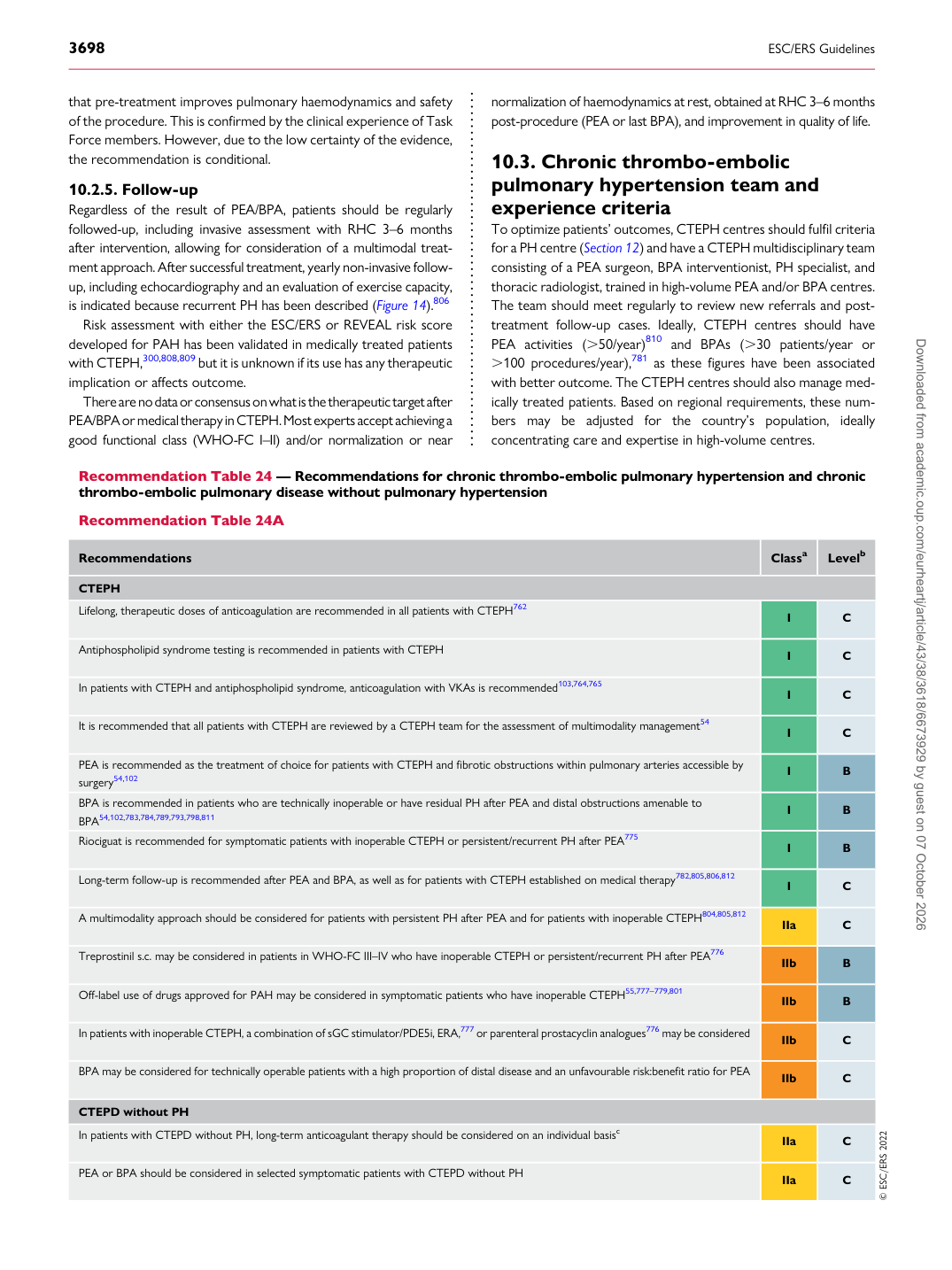
Recommendation Table 24 — Recommendations for chronic thrombo-embolic pulmonary hypertension and chronic thrombo-embolic pulmonary disease without pulmonary hypertension Recommendation Table 24A

Recommendations Classa Levelb

CTEPH Lifelong, therapeutic doses of anticoagulation are recommended in all patients with CTEPH762 I C

Antiphospholipid syndrome testing is recommended in patients with CTEPH I C

In patients with CTEPH and antiphospholipid syndrome, anticoagulation with VKAs is recommended103,764,765 I C

It is recommended that all patients with CTEPH are reviewed by a CTEPH team for the assessment of multimodality management54 I C

PEA is recommended as the treatment of choice for patients with CTEPH and fibrotic obstructions within pulmonary arteries accessible by surgery54,102 I B BPA is recommended in patients who are technically inoperable or have residual PH after PEA and distal obstructions amenable to BPA54,102,783,784,789,793,798,811 I B Riociguat is recommended for symptomatic patients with inoperable CTEPH or persistent/recurrent PH after PEA775 I B

Long-term follow-up is recommended after PEA and BPA, as well as for patients with CTEPH established on medical therapy782,805,806,812 I C

A multimodality approach should be considered for patients with persistent PH after PEA and for patients with inoperable CTEPH804,805,812 IIa C

Treprostinil s.c. may be considered in patients in WHO-FC III–IV who have inoperable CTEPH or persistent/recurrent PH after PEA776 IIb B

Off-label use of drugs approved for PAH may be considered in symptomatic patients who have inoperable CTEPH55,777–779,801 IIb B

In patients with inoperable CTEPH, a combination of sGC stimulator/PDE5i, ERA,777 or parenteral prostacyclin analogues776 may be considered IIb C

BPA may be considered for technically operable patients with a high proportion of distal disease and an unfavourable risk:benefit ratio for PEA IIb C

CTEPD without PH In patients with CTEPD without PH, long-term anticoagulant therapy should be considered on an individual basisc IIa C

PEA or BPA should be considered in selected symptomatic patients with CTEPD without PH IIa C © ESC/ERS 2022 Downloaded from academic.oup.com/eurheartj/article/43/38/3618/6673929 by guest on 07 October 2026