p.79 抽出テキスト
at 16 and 24 weeks, respectively.777 A phase 3 RCT is ongoing to evaluate the safety and efficacy of macitentan 75 mg in inoperable or persistent/recurrent CTEPH (NCT04271475). Other medical therapies—PDE5is (e.g. sildenafil) and ERAs (e.g. bosentan)—have been used off-label, as their efficacy in inoperable CTEPH has not been proven by RCTs or registry data.769,778,779 However, oral combination therapy, including PDE5is and ERAs, is common practice in patients with CTEPH with severe haemodynamic compromise.780

10.2.3 Interventional treatment

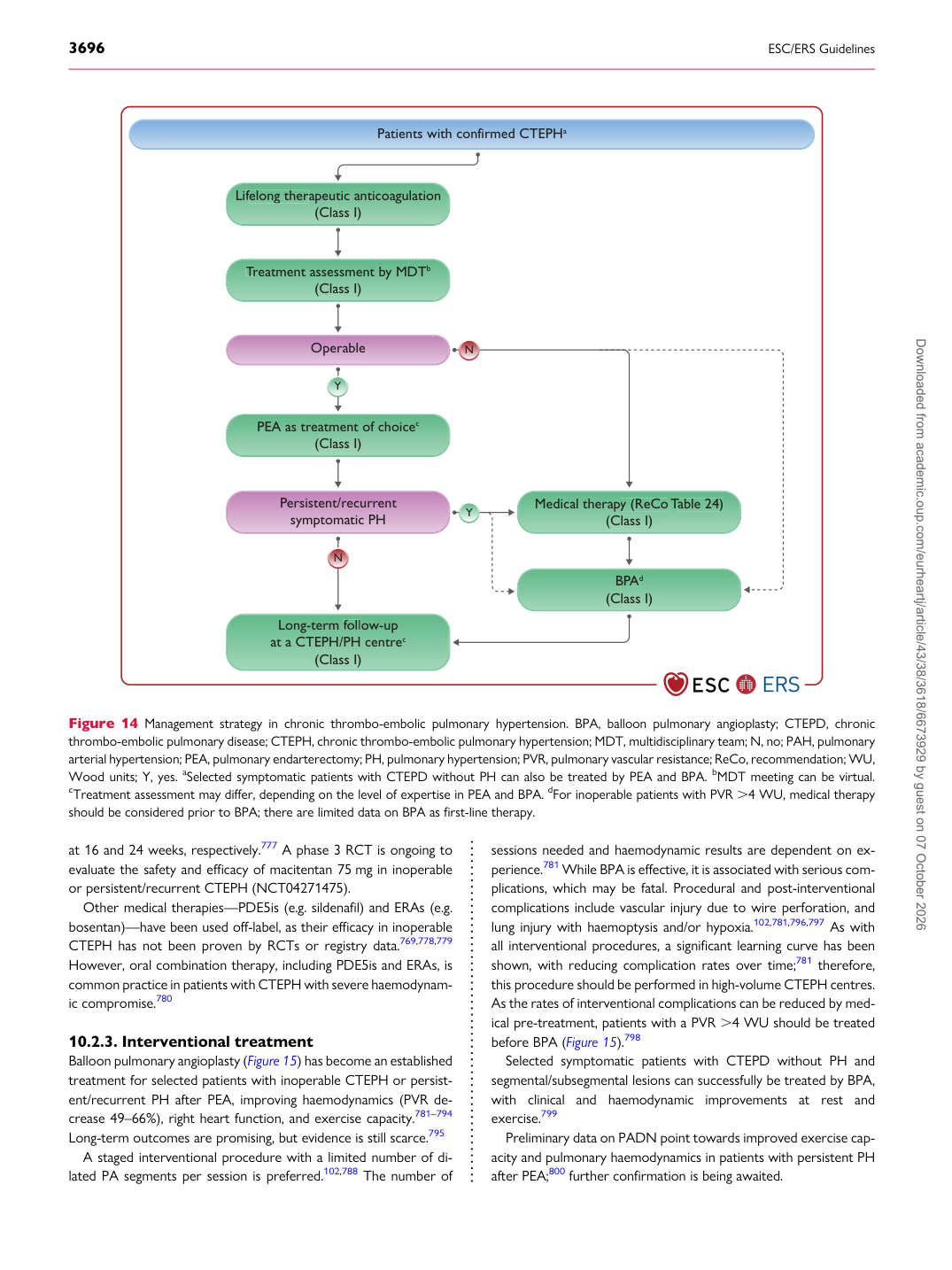
Balloon pulmonary angioplasty (Figure 15) has become an established treatment for selected patients with inoperable CTEPH or persistent/recurrent PH after PEA, improving haemodynamics (PVR decrease 49–66%), right heart function, and exercise capacity.781–794 Long-term outcomes are promising, but evidence is still scarce.795 A staged interventional procedure with a limited number of dilated PA segments per session is preferred.102,788 The number of sessions needed and haemodynamic results are dependent on experience.781 While BPA is effective, it is associated with serious complications, which may be fatal. Procedural and post-interventional complications include vascular injury due to wire perforation, and lung injury with haemoptysis and/or hypoxia.102,781,796,797 As with all interventional procedures, a significant learning curve has been shown, with reducing complication rates over time;781 therefore, this procedure should be performed in high-volume CTEPH centres. As the rates of interventional complications can be reduced by medical pre-treatment, patients with a PVR .4 WU should be treated before BPA (Figure 15).798

Selected symptomatic patients with CTEPD without PH and segmental/subsegmental lesions can successfully be treated by BPA, with clinical and haemodynamic improvements at rest and exercise.799 Preliminary data on PADN point towards improved exercise capacity and pulmonary haemodynamics in patients with persistent PH after PEA;800 further confirmation is being awaited.

Patients with confirmed CTEPH a

Li f elong ther

f f a peutic anticoagulation

(Class I)

T r

T

T eatment assessment b y MDT b

(Class I)

PEA as t r eatment of choice c

(Class I)

Long-term f oll

f f o w-up

at a CTEPH/PH cent r e c

(Class I) Medical ther a p y (ReCo

p T able 24)

T T

(Class I)

B P A

P P d (Class I)

Operable

P ersistent/ r ecu r r ent

symptomatic PH N

N

Y

Y

Figure 14 Management strategy in chronic thrombo-embolic pulmonary hypertension. BPA, balloon pulmonary angioplasty; CTEPD, chronic thrombo-embolic pulmonary disease; CTEPH, chronic thrombo-embolic pulmonary hypertension; MDT, multidisciplinary team; N, no; PAH, pulmonary arterial hypertension; PEA, pulmonary endarterectomy; PH, pulmonary hypertension; PVR, pulmonary vascular resistance; ReCo, recommendation; WU, Wood units; Y, yes. aSelected symptomatic patients with CTEPD without PH can also be treated by PEA and BPA. bMDT meeting can be virtual. cTreatment assessment may differ, depending on the level of expertise in PEA and BPA. dFor inoperable patients with PVR .4 WU, medical therapy should be considered prior to BPA; there are limited data on BPA as first-line therapy. Downloaded from academic.oup.com/eurheartj/article/43/38/3618/6673929 by guest on 07 October 2026