p.73 抽出テキスト
9 Pulmonary hypertension

associated with lung diseases and/ or hypoxia (group 3)

Pulmonary hypertension is frequently observed in patients with COPD and/or emphysema, ILD, combined pulmonary fibrosis and emphysema (CPFE), and hypoventilation syndromes.52,165,707,708 Pulmonary hypertension is uncommon in obstructive sleep apnoea unless other conditions coexist, such as COPD or daytime hypoventilation.709 At high altitude (.2500 m) hypoxia-induced PH is thought to affect .5% of the population, the development of PH being related to geography and genetic factors.710 A PH screening study performed on a large cohort of .100 patients with lymphangioleiomyomatosis confirmed that PH is usually mild in that setting: from six patients (5.7%) presenting with pre-capillary PH, none had mPAP .30 mmHg and PH was associated with PFT alteration, suggesting that the rise in mPAP is associated with parenchymal involvement.711

Thus, PH in lymphangioleiomyomatosis is now classified in group 3 PH.1 In patients with lung disease, PH is categorized as non-severe or severe, depending on haemodynamic findings (Figure 12). In the 2015 ESC/ERS Guidelines for the diagnosis and treatment of PH, severe PH was defined by mPAP .35 mmHg or mPAP ≥25 mmHg with CI ,2.5 L/min/m2.25,26 However, two recent studies have demonstrated that a PVR .5 WU is a better threshold for predicting worse prognosis in patients with PH associated with both COPD and ILD.712,713 Based on these data, the current guidelines used PVR to distinguish between non-severe PH (PVR

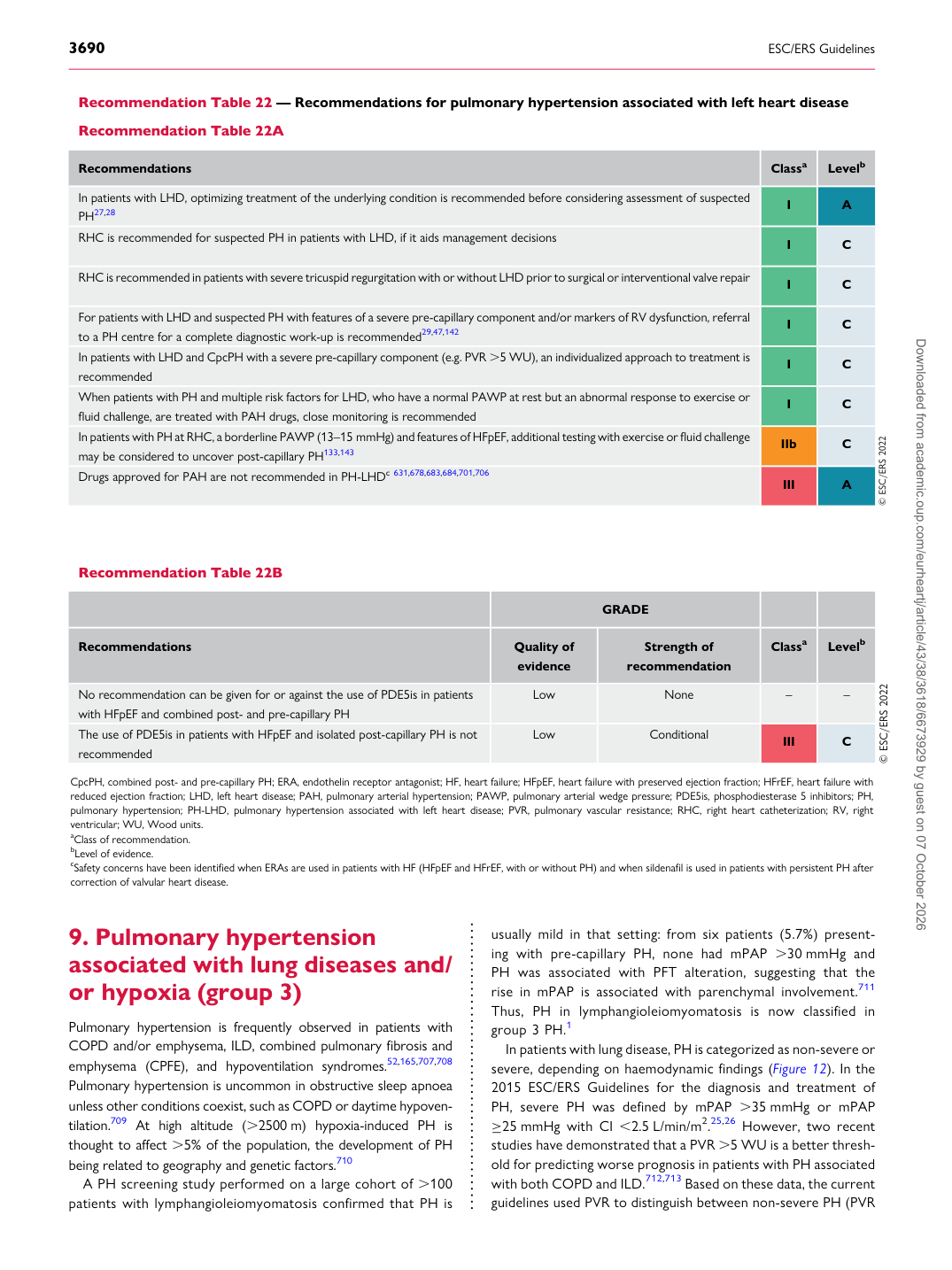
Recommendation Table 22 — Recommendations for pulmonary hypertension associated with left heart disease Recommendation Table 22A

Recommendations Classa Levelb

In patients with LHD, optimizing treatment of the underlying condition is recommended before considering assessment of suspected PH27,28 I A RHC is recommended for suspected PH in patients with LHD, if it aids management decisions I C

RHC is recommended in patients with severe tricuspid regurgitation with or without LHD prior to surgical or interventional valve repair I C

For patients with LHD and suspected PH with features of a severe pre-capillary component and/or markers of RV dysfunction, referral to a PH centre for a complete diagnostic work-up is recommended29,47,142 I C In patients with LHD and CpcPH with a severe pre-capillary component (e.g. PVR .5 WU), an individualized approach to treatment is recommended I C When patients with PH and multiple risk factors for LHD, who have a normal PAWP at rest but an abnormal response to exercise or fluid challenge, are treated with PAH drugs, close monitoring is recommended I C In patients with PH at RHC, a borderline PAWP (13–15 mmHg) and features of HFpEF, additional testing with exercise or fluid challenge may be considered to uncover post-capillary PH133,143 IIb C Drugs approved for PAH are not recommended in PH-LHDc 631,678,683,684,701,706 III A © ESC/ERS 2022

Recommendation Table 22B

GRADE

Recommendations Quality of

evidence Strength of

recommendation Classa Levelb

No recommendation can be given for or against the use of PDE5is in patients with HFpEF and combined post- and pre-capillary PH Low None – – The use of PDE5is in patients with HFpEF and isolated post-capillary PH is not recommended Low Conditional III C © ESC/ERS 2022 CpcPH, combined post- and pre-capillary PH; ERA, endothelin receptor antagonist; HF, heart failure; HFpEF, heart failure with preserved ejection fraction; HFrEF, heart failure with reduced ejection fraction; LHD, left heart disease; PAH, pulmonary arterial hypertension; PAWP, pulmonary arterial wedge pressure; PDE5is, phosphodiesterase 5 inhibitors; PH, pulmonary hypertension; PH-LHD, pulmonary hypertension associated with left heart disease; PVR, pulmonary vascular resistance; RHC, right heart catheterization; RV, right ventricular; WU, Wood units. aClass of recommendation. bLevel of evidence. cSafety concerns have been identified when ERAs are used in patients with HF (HFpEF and HFrEF, with or without PH) and when sildenafil is used in patients with persistent PH after correction of valvular heart disease. Downloaded from academic.oup.com/eurheartj/article/43/38/3618/6673929 by guest on 07 October 2026