p.64 抽出テキスト
ectasia and proliferation, with doubling and tripling of the alveolar septal capillary layers that may be focally distributed within the alveolar interstitium.425,590 The proportion of patients with IPAH that fulfil the criteria for PVOD/PCH is ≏10%, resulting in a lowest estimate of PVOD/PCH incidence and prevalence of ,1 case/million.425 In contrast to IPAH, there is a male predominance in PVOD/PCH and its prognosis is worse.425,589,591 Familial PVOD/PCH typically occurs in the young siblings of one generation, with unaffected and sometimes consanguineous parents, indicating that the disease segregates as a recessive trait.158,425,591 Biallelic mutations in the EIF2AK4 gene cause heritable PVOD/PCH.158 In addition, PVOD/PCH can complicate the course of associated conditions, such as SSc,425 or be associated with exposure to environmental triggers, such as alkylating agents (cyclophosphamide, mitomycin C)34 and solvents (trichloroethylene).38

7.7.1 Diagnosis

Most patients complain of non-specific dyspnoea on exertion and fatigue.590 Physical examination may reveal digital clubbing and bibasal crackles on lung auscultation.590 Pulmonary arterial hypertension and PVOD/PCH share the same haemodynamic profile as precapillary PH.590,591 The PAWP is not elevated because the pulmonary vascular changes occur in small venulae and capillaries, while the LA filling pressure remains normal.590,591 A diagnosis of PVOD/PCH is based on the results of tests suggesting venous post-capillary involvement, chronic interstitial pulmonary oedema, and capillary proliferation.1,590,591 These tests include PFTs (decreased DLCO, frequently ,50% theoretical values), ABG (hypoxaemia), and non-contrast chest CT (subpleural thickened septal lines, centrilobular ground-glass opacities, and mediastinal lymphadenopathy).1,425,589,591,592 Importantly, these patients are at risk of drug-induced pulmonary oedema with PAH therapy, a finding suggestive of PVOD/PCH.425,591 Detecting biallelic EIF2AK4 mutations is sufficient to confirm a diagnosis of heritable PVOD/ PCH.158,591,592 Lung biopsy is hazardous in PH and is not recommended for diagnosing PVOD/PCH.1,425

7.7.2 Therapy

There is no established medical therapy for PVOD/PCH.425 Compared with IPAH, PVOD/PCH has a poor prognosis and limited response to PAH therapy, with a risk of pulmonary oedema due to pulmonary venous obstruction.425,591 However, there are reports of incomplete and transient clinical improvement in individual patients with PVOD/PCH treated with PAH therapy, which should be used with great caution in this setting.425,591 Diuretics, oxygen therapy, and slow titration of PAH therapy can be used on an individual basis.425 Therefore, therapy for PVOD/PCH should be undertaken at centres with extensive experience in managing PH, and patients should be fully informed about the risks.425 Anecdotal reports suggest a potential benefit of immunomodulatory treatments, but this approach requires further study.593 The only curative therapy for PVOD/PCH is LTx, and eligible patients should be referred to a transplant centre for evaluation upon diagnosis.425,591 Pathological examination of the explanted lungs will confirm the diagnosis.590 7.8 Paediatric pulmonary hypertension

Pulmonary hypertension may present at all ages, including in infants and children. Pulmonary hypertension in childhood shares many common features with PH in adulthood; however, there are also important differences, which concern epidemiology, aetiology, genetic background, age-dependent diagnostic and treatment approaches, and disease monitoring. An important and conceptually distinctive feature of paediatric PH is injury to developing foetal, neonatal, or paediatric lung circulation.

7.8.1 Epidemiology and classification

The reported annual incident rate for paediatric PH is 64/million children.594 The distribution of the various aetiologies of PH in childhood differs from PH in adulthood.594–596 Pulmonary arterial hypertension is the most frequent type of PH in children, with the vast majority (82%) of cases being infants with transient PAH (i.e. PPHN or repairable cardiac shunt defects). Of the remaining children with PAH, most have either IPAH, HPAH, or irreversible CHD-associated PAH. The reported incidences of IPAH/HPAH and (non-transient) CHD-associated PAH are 0.7 and 2.2/million children, respectively, with a prevalence of 4.4 and 15.6/million children, respectively.594 Other conditions associated with PAH (Table 6) do occur in children but are rare. Another significant proportion (34–49%) of children with nontransient PH are neonates and infants with PH associated with respiratory disease, especially developmental lung diseases, including bronchopulmonary dysplasia (BPD), congenital diaphragmatic hernia (CDH), and congenital pulmonary vascular abnormalities.594–598 These children form a prominent and distinctive group in paediatric PH and are currently classified as PH group 3 associated with

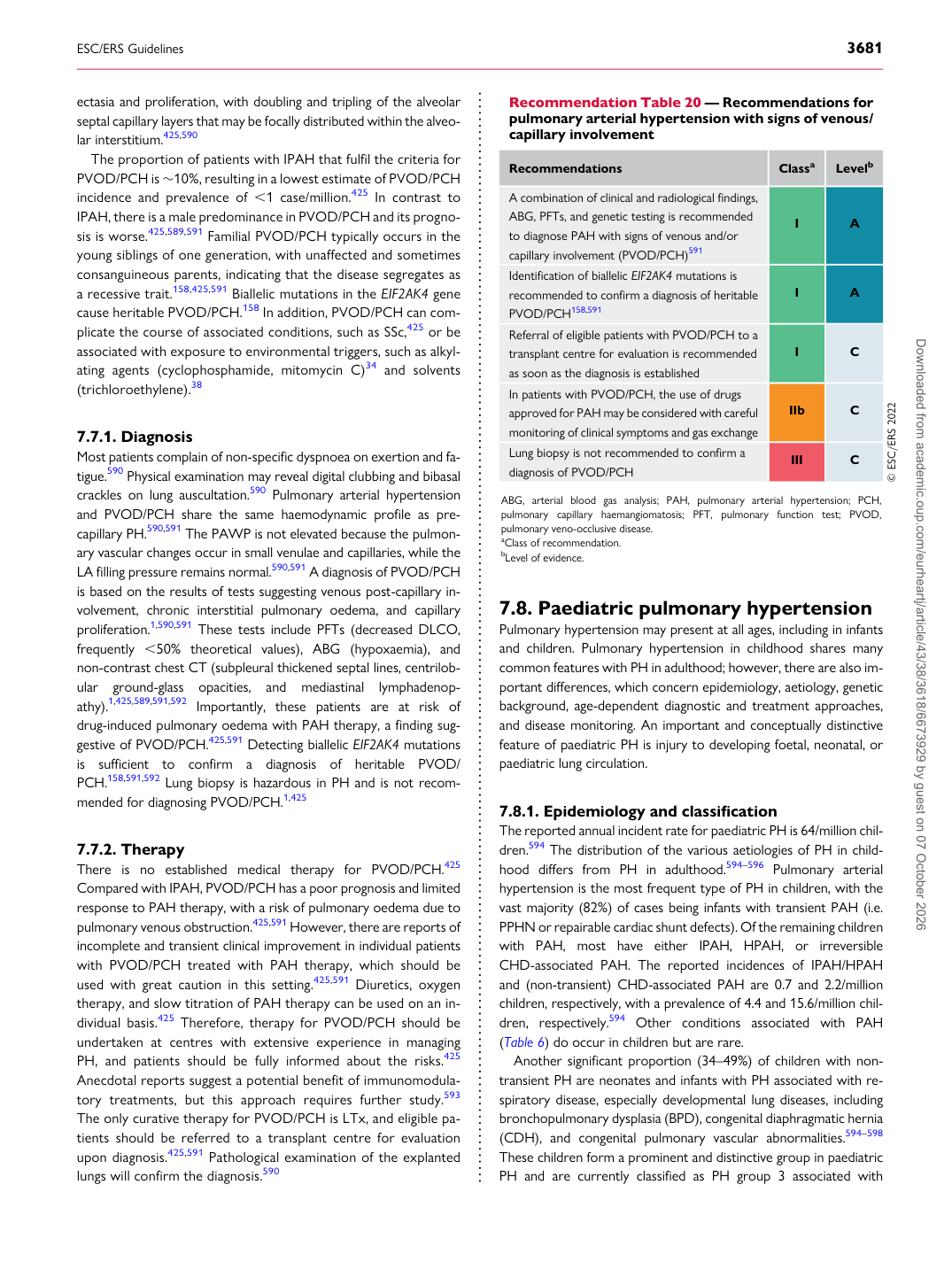
Recommendation Table 20 — Recommendations for pulmonary arterial hypertension with signs of venous/ capillary involvement

Recommendations Classa Levelb

A combination of clinical and radiological findings, ABG, PFTs, and genetic testing is recommended to diagnose PAH with signs of venous and/or capillary involvement (PVOD/PCH)591 I A Identification of biallelic EIF2AK4 mutations is recommended to confirm a diagnosis of heritable PVOD/PCH158,591 I A Referral of eligible patients with PVOD/PCH to a transplant centre for evaluation is recommended as soon as the diagnosis is established I C In patients with PVOD/PCH, the use of drugs approved for PAH may be considered with careful monitoring of clinical symptoms and gas exchange IIb C Lung biopsy is not recommended to confirm a diagnosis of PVOD/PCH III C © ESC/ERS 2022 ABG, arterial blood gas analysis; PAH, pulmonary arterial hypertension; PCH, pulmonary capillary haemangiomatosis; PFT, pulmonary function test; PVOD, pulmonary veno-occlusive disease. aClass of recommendation. bLevel of evidence. Downloaded from academic.oup.com/eurheartj/article/43/38/3618/6673929 by guest on 07 October 2026