p.63 抽出テキスト
7.6 Pulmonary arterial hypertension

associated with schistosomiasis Schistosomiasis is one of the most common chronic infectious diseases worldwide, affecting around 200 million people.586,587 Schistosomiasis-associated PAH is present in 5% of patients with the hepatosplenic form of the disease.586 It is thus a leading cause of PAH, especially in some regions of South America, Africa, and Asia. Compared with patients with IPAH, patients with schistosomiasis-associated PAH present with higher CO and lower PVR, and have a better survival.587 Registry data suggest that survival in schistosomiasis-associated PAH has improved in recent years with the use of PAH drugs.588

7.7 Pulmonary arterial hypertension

with signs of venous/capillary involvement The common risk factors, identical genetic substrate, and indistinguishable clinical presentations of PCH and PVOD necessitate their consideration as a single disease belonging to the group 1 PH spectrum of diseases (PAH with signs of venous/capillary involvement).1,425,589 In PVOD/PCH, post-capillary lesions affecting septal veins and pre-septal venules consist of loose, fibrous remodelling of the intima that may totally occlude the lumen.1,425,589,590 These changes are frequently associated with PCH consisting of capillary

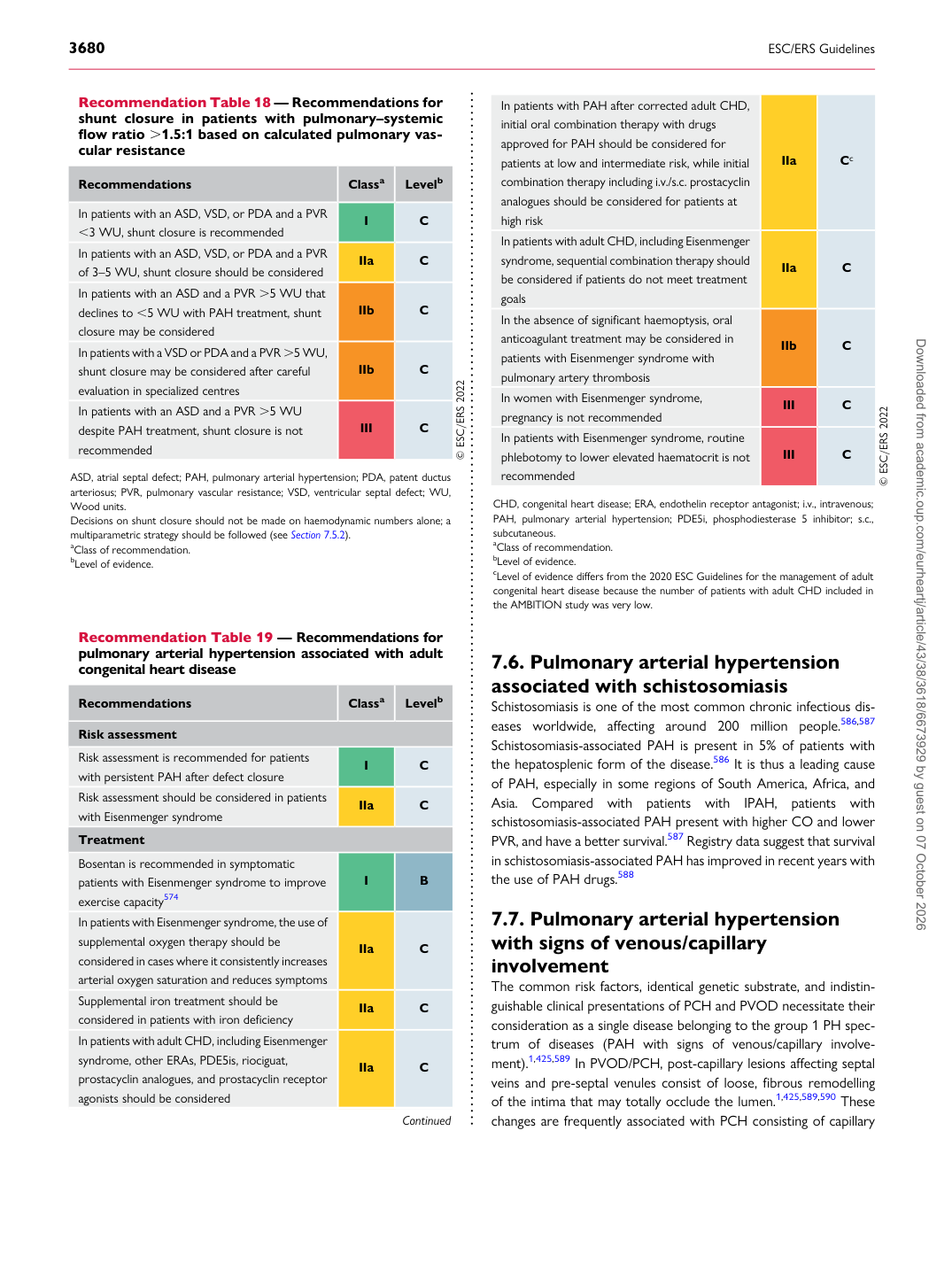
Recommendation Table 18 — Recommendations for shunt closure in patients with pulmonary–systemic flow ratio .1.5:1 based on calculated pulmonary vascular resistance

Recommendations Classa Levelb

In patients with an ASD, VSD, or PDA and a PVR ,3 WU, shunt closure is recommended I C In patients with an ASD, VSD, or PDA and a PVR of 3–5 WU, shunt closure should be considered IIa C In patients with an ASD and a PVR .5 WU that declines to ,5 WU with PAH treatment, shunt closure may be considered IIb C In patients with a VSD or PDA and a PVR .5 WU, shunt closure may be considered after careful evaluation in specialized centres IIb C In patients with an ASD and a PVR .5 WU despite PAH treatment, shunt closure is not recommended III C © ESC/ERS 2022 ASD, atrial septal defect; PAH, pulmonary arterial hypertension; PDA, patent ductus arteriosus; PVR, pulmonary vascular resistance; VSD, ventricular septal defect; WU, Wood units. Decisions on shunt closure should not be made on haemodynamic numbers alone; a multiparametric strategy should be followed (see Section 7.5.2). aClass of recommendation. bLevel of evidence.

Recommendation Table 19 — Recommendations for pulmonary arterial hypertension associated with adult congenital heart disease

Recommendations Classa Levelb

Risk assessment Risk assessment is recommended for patients with persistent PAH after defect closure I C Risk assessment should be considered in patients with Eisenmenger syndrome IIa C Treatment Bosentan is recommended in symptomatic patients with Eisenmenger syndrome to improve exercise capacity574 I B In patients with Eisenmenger syndrome, the use of supplemental oxygen therapy should be considered in cases where it consistently increases arterial oxygen saturation and reduces symptoms IIa C Supplemental iron treatment should be considered in patients with iron deficiency IIa C In patients with adult CHD, including Eisenmenger syndrome, other ERAs, PDE5is, riociguat, prostacyclin analogues, and prostacyclin receptor agonists should be considered IIa C

Continued In patients with PAH after corrected adult CHD,

initial oral combination therapy with drugs approved for PAH should be considered for patients at low and intermediate risk, while initial combination therapy including i.v./s.c. prostacyclin analogues should be considered for patients at high risk IIa Cc In patients with adult CHD, including Eisenmenger syndrome, sequential combination therapy should be considered if patients do not meet treatment goals IIa C In the absence of significant haemoptysis, oral anticoagulant treatment may be considered in patients with Eisenmenger syndrome with pulmonary artery thrombosis IIb C In women with Eisenmenger syndrome, pregnancy is not recommended III C In patients with Eisenmenger syndrome, routine phlebotomy to lower elevated haematocrit is not recommended III C © ESC/ERS 2022 CHD, congenital heart disease; ERA, endothelin receptor antagonist; i.v., intravenous; PAH, pulmonary arterial hypertension; PDE5i, phosphodiesterase 5 inhibitor; s.c., subcutaneous. aClass of recommendation. bLevel of evidence. cLevel of evidence differs from the 2020 ESC Guidelines for the management of adult congenital heart disease because the number of patients with adult CHD included in the AMBITION study was very low. Downloaded from academic.oup.com/eurheartj/article/43/38/3618/6673929 by guest on 07 October 2026