p.61 抽出テキスト
7.5 Pulmonary arterial hypertension

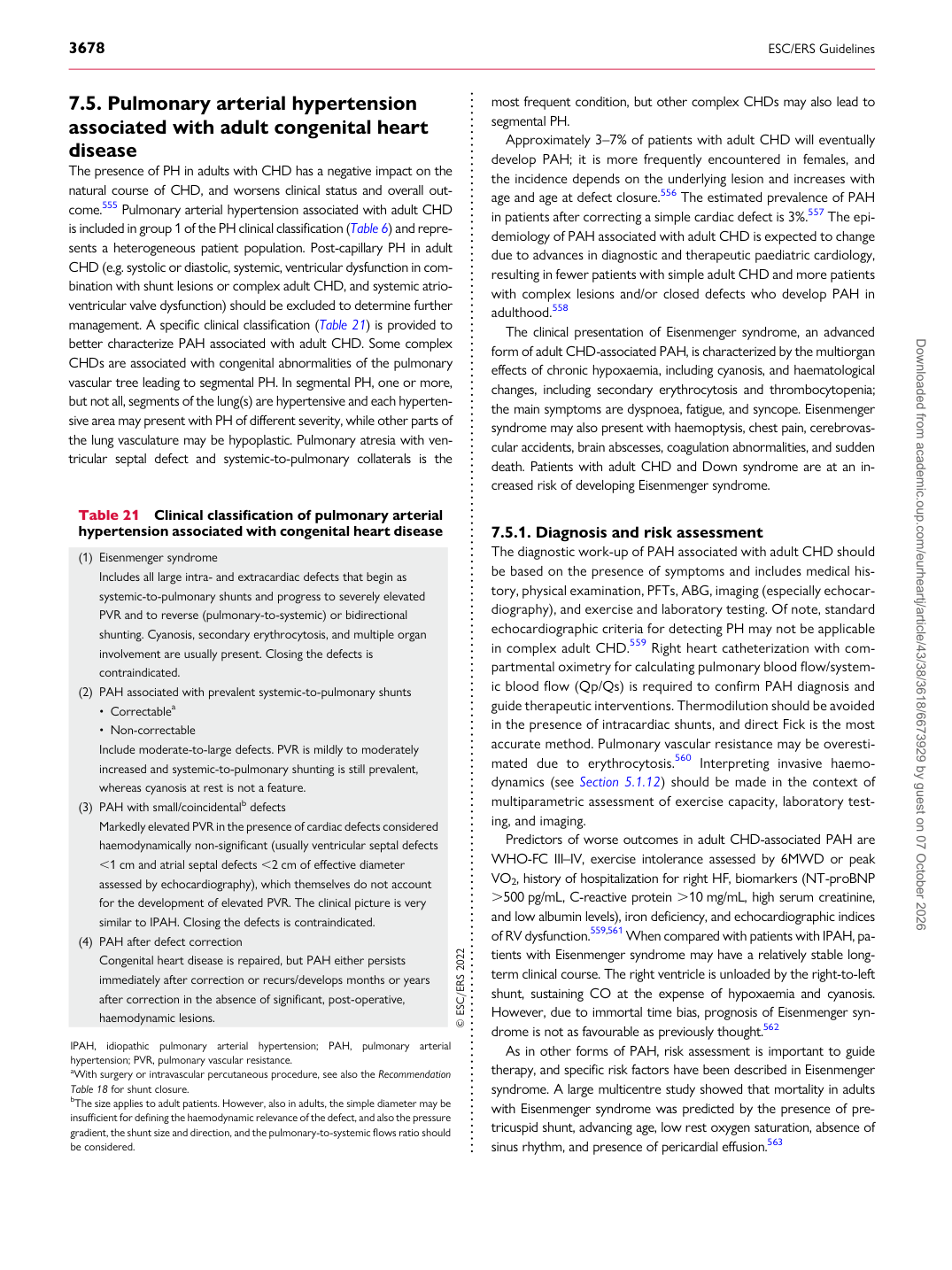
associated with adult congenital heart disease The presence of PH in adults with CHD has a negative impact on the natural course of CHD, and worsens clinical status and overall outcome.555 Pulmonary arterial hypertension associated with adult CHD is included in group 1 of the PH clinical classification (Table 6) and represents a heterogeneous patient population. Post-capillary PH in adult CHD (e.g. systolic or diastolic, systemic, ventricular dysfunction in combination with shunt lesions or complex adult CHD, and systemic atrioventricular valve dysfunction) should be excluded to determine further management. A specific clinical classification (Table 21) is provided to better characterize PAH associated with adult CHD. Some complex CHDs are associated with congenital abnormalities of the pulmonary vascular tree leading to segmental PH. In segmental PH, one or more, but not all, segments of the lung(s) are hypertensive and each hypertensive area may present with PH of different severity, while other parts of the lung vasculature may be hypoplastic. Pulmonary atresia with ventricular septal defect and systemic-to-pulmonary collaterals is the most frequent condition, but other complex CHDs may also lead to segmental PH.

Approximately 3–7% of patients with adult CHD will eventually develop PAH; it is more frequently encountered in females, and the incidence depends on the underlying lesion and increases with age and age at defect closure.556 The estimated prevalence of PAH in patients after correcting a simple cardiac defect is 3%.557 The epidemiology of PAH associated with adult CHD is expected to change due to advances in diagnostic and therapeutic paediatric cardiology, resulting in fewer patients with simple adult CHD and more patients with complex lesions and/or closed defects who develop PAH in adulthood.558 The clinical presentation of Eisenmenger syndrome, an advanced form of adult CHD-associated PAH, is characterized by the multiorgan effects of chronic hypoxaemia, including cyanosis, and haematological changes, including secondary erythrocytosis and thrombocytopenia; the main symptoms are dyspnoea, fatigue, and syncope. Eisenmenger syndrome may also present with haemoptysis, chest pain, cerebrovascular accidents, brain abscesses, coagulation abnormalities, and sudden death. Patients with adult CHD and Down syndrome are at an increased risk of developing Eisenmenger syndrome.

7.5.1 Diagnosis and risk assessment

The diagnostic work-up of PAH associated with adult CHD should be based on the presence of symptoms and includes medical history, physical examination, PFTs, ABG, imaging (especially echocardiography), and exercise and laboratory testing. Of note, standard echocardiographic criteria for detecting PH may not be applicable in complex adult CHD.559 Right heart catheterization with compartmental oximetry for calculating pulmonary blood flow/systemic blood flow (Qp/Qs) is required to confirm PAH diagnosis and guide therapeutic interventions. Thermodilution should be avoided in the presence of intracardiac shunts, and direct Fick is the most accurate method. Pulmonary vascular resistance may be overestimated due to erythrocytosis.560 Interpreting invasive haemodynamics (see Section 5.1.12) should be made in the context of multiparametric assessment of exercise capacity, laboratory testing, and imaging. Predictors of worse outcomes in adult CHD-associated PAH are WHO-FC III–IV, exercise intolerance assessed by 6MWD or peak VO2, history of hospitalization for right HF, biomarkers (NT-proBNP .500 pg/mL, C-reactive protein .10 mg/mL, high serum creatinine, and low albumin levels), iron deficiency, and echocardiographic indices of RV dysfunction.559,561 When compared with patients with IPAH, patients with Eisenmenger syndrome may have a relatively stable longterm clinical course. The right ventricle is unloaded by the right-to-left shunt, sustaining CO at the expense of hypoxaemia and cyanosis. However, due to immortal time bias, prognosis of Eisenmenger syndrome is not as favourable as previously thought.562 As in other forms of PAH, risk assessment is important to guide therapy, and specific risk factors have been described in Eisenmenger syndrome. A large multicentre study showed that mortality in adults with Eisenmenger syndrome was predicted by the presence of pretricuspid shunt, advancing age, low rest oxygen saturation, absence of sinus rhythm, and presence of pericardial effusion.563

Table 21 Clinical classification of pulmonary arterial hypertension associated with congenital heart disease (1) Eisenmenger syndrome

Includes all large intra- and extracardiac defects that begin as systemic-to-pulmonary shunts and progress to severely elevated PVR and to reverse (pulmonary-to-systemic) or bidirectional shunting. Cyanosis, secondary erythrocytosis, and multiple organ involvement are usually present. Closing the defects is contraindicated. (2) PAH associated with prevalent systemic-to-pulmonary shunts

• Correctablea • Non-correctable Include moderate-to-large defects. PVR is mildly to moderately increased and systemic-to-pulmonary shunting is still prevalent, whereas cyanosis at rest is not a feature. (3) PAH with small/coincidentalb defects

Markedly elevated PVR in the presence of cardiac defects considered haemodynamically non-significant (usually ventricular septal defects ,1 cm and atrial septal defects ,2 cm of effective diameter assessed by echocardiography), which themselves do not account for the development of elevated PVR. The clinical picture is very similar to IPAH. Closing the defects is contraindicated. (4) PAH after defect correction

Congenital heart disease is repaired, but PAH either persists immediately after correction or recurs/develops months or years after correction in the absence of significant, post-operative, haemodynamic lesions. © ESC/ERS 2022 IPAH, idiopathic pulmonary arterial hypertension; PAH, pulmonary arterial hypertension; PVR, pulmonary vascular resistance. aWith surgery or intravascular percutaneous procedure, see also the Recommendation Table 18 for shunt closure. bThe size applies to adult patients. However, also in adults, the simple diameter may be insufficient for defining the haemodynamic relevance of the defect, and also the pressure gradient, the shunt size and direction, and the pulmonary-to-systemic flows ratio should be considered. Downloaded from academic.oup.com/eurheartj/article/43/38/3618/6673929 by guest on 07 October 2026