p.60 抽出テキスト
7.4 Pulmonary arterial hypertension

associated with portal hypertension Pulmonary arterial hypertension associated with portal hypertension, commonly referred to as PoPH, develops in 2–6% of patients with portal hypertension, with or without liver disease. In PAH registries, PoPH represents 5–15% of the patients.543–545 Rarely, some patients with PoPH have portosystemic shunts in the absence of portal hypertension (congenital extrahepatic cavoportal shunts).546 However, PoPH is distinct from hepatopulmonary syndrome (HPS), which is characterized by intrapulmonary vascular dilatations and hypoxaemia. Of note, HPS and PoPH can occur sequentially or concurrently in patients with portal hypertension.547

7.4.1 Diagnosis

The diagnosis of PoPH is based on the presence of otherwise unexplained pre-capillary PH in patients with portal hypertension or a portosystemic shunt. The diagnostic approach is the same as in other patients with suspected or newly detected PH. Transthoracic echocardiography is usually the first non-invasive assessment in patients with suspected PH, and echocardiography is also recommended as a screening tool in patients evaluated for liver transplantation. As patients with liver disease often have an elevated CO, TRV tends to overestimate PAP in these patients. Hence, RHC with comprehensive haemodynamic assessment is essential to confirm the diagnosis of PH and to distinguish PAH (with elevated PVR) from unclassified PH (with a normal PVR).

7.4.2 Therapy

Patients with unclassified PH (i.e. mPAP .20 mmHg, elevated CO, and PVR ≤2.0 WU) should be regularly followed-up but should not be treated with drugs approved for PAH. In patients with an established diagnosis of PoPH, treatment should follow the same general principles as in other patients with PAH, taking into account the severity of underlying liver disease, the indication for liver transplantation, and the potential effects of PAH medication on gas exchange, which may deteriorate with vasodilators in patients with PoPH.548,549 All drugs approved for PAH can principally be used to treat patients with PoPH, bearing in mind that these patients are usually excluded from registration studies. Nevertheless, various case series support the use of approved PAH medication in patients with PoPH. The largest series published so far reported on 574 patients with PoPH treated with various PAH drugs, mostly PDE5is or ERAs, alone and in combination.545 Most patients (56.8%) were in Child–Pugh class A at the time of PAH diagnosis. At the first follow-up, which took place 4.5 months after starting treatment, improvements were seen in haemodynamics, WHO-FC, 6MWD, and BNP/NT-proBNP; survival at 5 years was 51%. In patients presenting with mild liver disease, the main causes of death were PAH progression and malignancy, whereas complications of liver disease were the most common causes of death in patients with advanced liver disease. The 5 year survival of patients who underwent liver transplantation (n = 63) was 81%. The only RCT dedicated to the treatment of PoPH was PORTICO, a 12 week study that randomized 85 patients to macitentan (n = 43) or placebo (n = 42).168 PORTICO met its primary endpoint, demonstrating a significant reduction in PVR from baseline (ratio of geometric mean 0.65; 95% CI, 0.59–0.72; P , 0.0001). There were, however, no differences between the two treatment groups in secondary outcome measures, including WHO-FC, 6MWD, and NT-proBNP.

7.4.2.1 Liver transplantation

Porto-pulmonary hypertension is not per se an indication for liver transplantation. Pulmonary arterial hypertension poses a major threat to patients who undergo liver transplantation when indicated for the severity of liver disease. In a historical series from the Mayo Clinic, severe PAH with mPAP ≥50 mmHg was associated with a 100% perioperative mortality rate. In patients with mPAP 35–50 mmHg and PVR .3.0 WU, mortality was still 50%.550 In liver transplantation candidates with PAH, targeted medical therapy successfully improves haemodynamics and establishes eligibility for transplantation.545,551– 554 However, haemodynamic criteria for successful liver transplantation have not been firmly established. The International Liver Transplant Society proposed haemodynamic targets of mPAP ,35 mmHg and PVR ,5 WU, or mPAP ≥35 mmHg and PVR ,3 WU in patients receiving PAH therapy, while acknowledging that these criteria need to be further validated.175 An mPAP ≥45 mmHg is regarded as an absolute contraindication to liver transplantation.175 In patients with PoPH who successfully underwent liver transplantation, de-escalation or discontinuation of PAH medication is often feasible, but this has to be performed on an individual basis.551,554

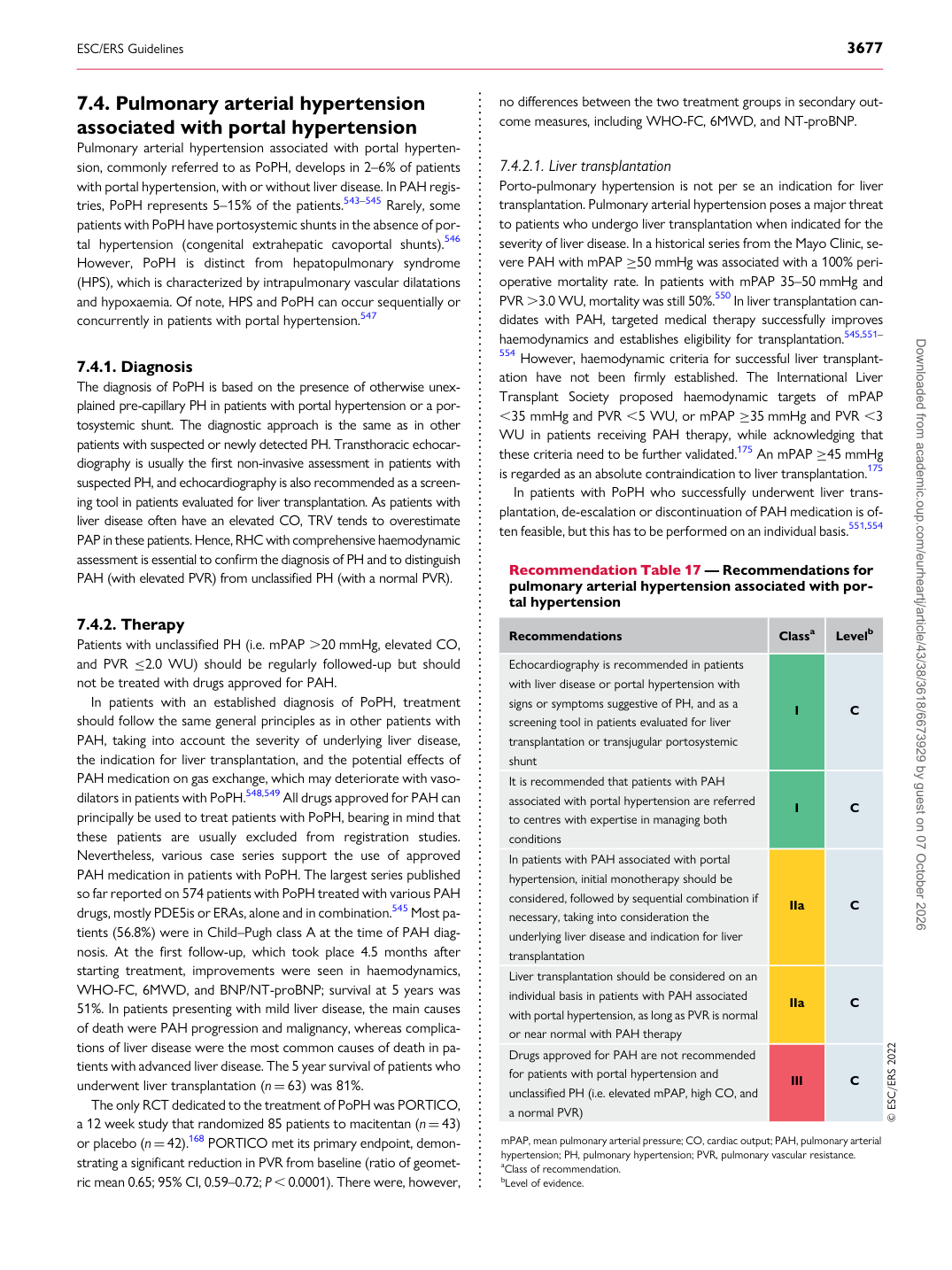
Recommendation Table 17 — Recommendations for pulmonary arterial hypertension associated with portal hypertension

Recommendations Classa Levelb

Echocardiography is recommended in patients with liver disease or portal hypertension with signs or symptoms suggestive of PH, and as a screening tool in patients evaluated for liver transplantation or transjugular portosystemic shunt I C It is recommended that patients with PAH associated with portal hypertension are referred to centres with expertise in managing both conditions I C In patients with PAH associated with portal hypertension, initial monotherapy should be considered, followed by sequential combination if necessary, taking into consideration the underlying liver disease and indication for liver transplantation IIa C Liver transplantation should be considered on an individual basis in patients with PAH associated with portal hypertension, as long as PVR is normal or near normal with PAH therapy IIa C Drugs approved for PAH are not recommended for patients with portal hypertension and unclassified PH (i.e. elevated mPAP, high CO, and a normal PVR) III C © ESC/ERS 2022 mPAP, mean pulmonary arterial pressure; CO, cardiac output; PAH, pulmonary arterial hypertension; PH, pulmonary hypertension; PVR, pulmonary vascular resistance. aClass of recommendation. bLevel of evidence. Downloaded from academic.oup.com/eurheartj/article/43/38/3618/6673929 by guest on 07 October 2026