p.59 抽出テキスト
7.3 Pulmonary arterial hypertension

associated with human immunodeficiency virus infection The use of highly active antiretroviral therapy (HAART), and advances in managing opportunistic infections have contributed to increased life expectancy in patients with HIV.525,526 Consequently, the spectrum of complications has shifted towards other long-term conditions, including PAH. Clinical and histopathological findings in PAH associated with HIV infection (PAH-HIV) share many similarities with IPAH.1,527 With the availability of HAART given in combination with PAH therapies, the prognosis of PAH-HIV has markedly improved in recent years.526,528 In addition, the incidence of PAH-HIV has declined in parallel with the increasing availability of HAART.528 Taken together, these effects on survival and incidence have resulted in a stable PAH prevalence in patients with HIV over recent decades. A French population study indicated that the prevalence of PAH in individuals with HIV infection was 0.46%, which is very similar to the prevalence before the HAART era.177 The pathogenesis of PAH-HIV remains unclear. There is no evidence of a direct role of HIV in the pathogenesis of PAH and, although present in inflammatory cells in the lungs, the virus itself has never been found in pulmonary vascular lesions of patients with PAH-HIV.529 This suggests that an indirect action of viral infection on inflammation and growth factors may act as a trigger in a predisposed patient.

7.3.1 Diagnosis

Pulmonary arterial hypertension associated with HIV shares a clinical presentation with IPAH. Before the availability of HAART most patients were in WHO-FC III or IV at diagnosis. Nowadays, patients are diagnosed with much less severe symptoms and haemodynamics. Patients may present with other risk factors for PAH such as liver disease (chronic viral hepatitis B or C) or exposure to drugs or toxins. Patients with PAH-HIV are more likely to be male and i.v. drug abusers.403,526 There is no correlation between the severity of PAH and the stage of HIV infection or the degree of immunodeficiency.403,530 Because of its low prevalence, asymptomatic patients with HIV should not be screened for PAH. However, echocardiography should be performed in patients with unexplained dyspnoea to detect HIV-related cardiovascular complications such as myocarditis, cardiomyopathy, or PAH. Right heart catheterization is mandatory to confirm the diagnosis of PAH-HIV and to rule out LHD.527 Pulmonary arterial hypertension is an independent risk factor for death in patients with HIV. In the 1990s, before the availability of HAART, patients with PAH-HIV had poor outcomes, with a 3 year survival of ,50%.403 The overall survival has now improved and patients with PAH-HIV have a better prognosis than most patients with other forms of PAH.526 7.3.2 Therapy

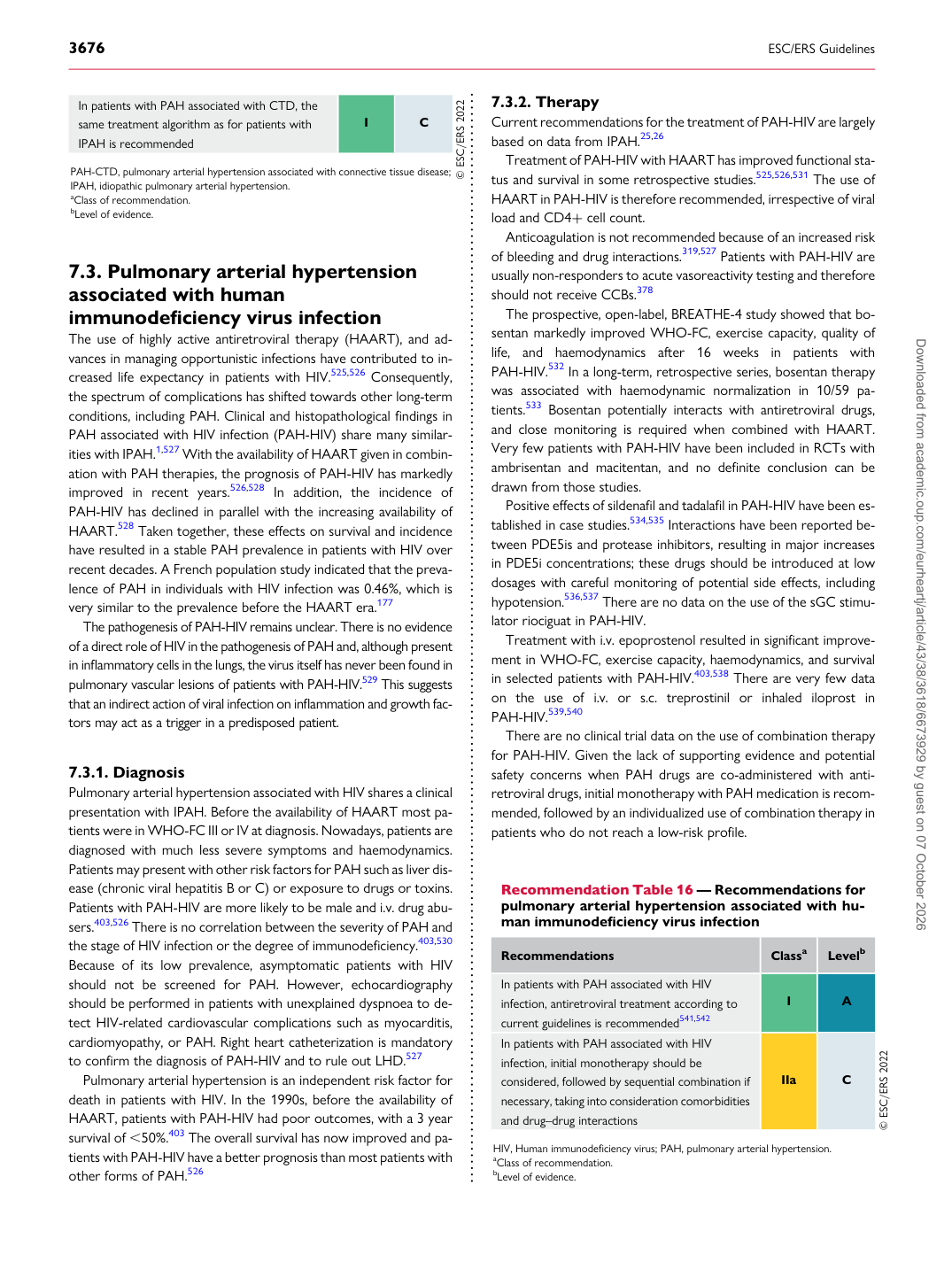
Current recommendations for the treatment of PAH-HIV are largely based on data from IPAH.25,26 Treatment of PAH-HIV with HAART has improved functional status and survival in some retrospective studies.525,526,531 The use of HAART in PAH-HIV is therefore recommended, irrespective of viral load and CD4+ cell count. Anticoagulation is not recommended because of an increased risk of bleeding and drug interactions.319,527 Patients with PAH-HIV are usually non-responders to acute vasoreactivity testing and therefore should not receive CCBs.378 The prospective, open-label, BREATHE-4 study showed that bosentan markedly improved WHO-FC, exercise capacity, quality of life, and haemodynamics after 16 weeks in patients with PAH-HIV.532 In a long-term, retrospective series, bosentan therapy was associated with haemodynamic normalization in 10/59 patients.533 Bosentan potentially interacts with antiretroviral drugs, and close monitoring is required when combined with HAART. Very few patients with PAH-HIV have been included in RCTs with ambrisentan and macitentan, and no definite conclusion can be drawn from those studies. Positive effects of sildenafil and tadalafil in PAH-HIV have been established in case studies.534,535 Interactions have been reported between PDE5is and protease inhibitors, resulting in major increases in PDE5i concentrations; these drugs should be introduced at low dosages with careful monitoring of potential side effects, including hypotension.536,537 There are no data on the use of the sGC stimulator riociguat in PAH-HIV. Treatment with i.v. epoprostenol resulted in significant improvement in WHO-FC, exercise capacity, haemodynamics, and survival in selected patients with PAH-HIV.403,538 There are very few data on the use of i.v. or s.c. treprostinil or inhaled iloprost in PAH-HIV.539,540 There are no clinical trial data on the use of combination therapy for PAH-HIV. Given the lack of supporting evidence and potential safety concerns when PAH drugs are co-administered with antiretroviral drugs, initial monotherapy with PAH medication is recommended, followed by an individualized use of combination therapy in patients who do not reach a low-risk profile.

In patients with PAH associated with CTD, the same treatment algorithm as for patients with IPAH is recommended I C © ESC/ERS 2022

PAH-CTD, pulmonary arterial hypertension associated with connective tissue disease; IPAH, idiopathic pulmonary arterial hypertension. aClass of recommendation. bLevel of evidence.

Recommendation Table 16 — Recommendations for pulmonary arterial hypertension associated with human immunodeficiency virus infection

Recommendations Classa Levelb

In patients with PAH associated with HIV infection, antiretroviral treatment according to current guidelines is recommended541,542 I A In patients with PAH associated with HIV infection, initial monotherapy should be considered, followed by sequential combination if necessary, taking into consideration comorbidities and drug–drug interactions IIa C © ESC/ERS 2022 HIV, Human immunodeficiency virus; PAH, pulmonary arterial hypertension. aClass of recommendation. bLevel of evidence. Downloaded from academic.oup.com/eurheartj/article/43/38/3618/6673929 by guest on 07 October 2026