p.58 抽出テキスト
7.2 Pulmonary arterial hypertension

associated with connective tissue disease Pulmonary arterial hypertension is a well-known pulmonary vascular complication of SSc,173,502–504 systemic lupus erythematosus (SLE),505–507 mixed CTD,506 and, rarely, dermatomyositis508 and Sjögren’s syndrome.509 Conversely, the relationship between rheumatoid arthritis and PAH is not established.510 After IPAH, PAH-CTD is the second most prevalent type of PAH in western countries.511 Systemic sclerosis, particularly in its limited variant, represents the main cause of PAH-CTD in Europe and the USA (SLE being more common in Asia).173,502,506 The prevalence of pre-capillary PH in large cohorts of patients with SSc is 5–19%.173,502 In these patients, PH may occur in association with ILD504,512 or as a result of PAH,173,502–504,506 sometimes with features of venous/capillary involvement.504,513 Moreover, group 2 PH-LHD is also common due to myocardial SSc involvement.504,514 Of note, patients with SLE may also present with PAH, LHD, ILD, and CTEPH (mostly in the setting of antiphospholipid syndrome). It is therefore essential to carefully determine which mechanism is operative in a given patient, since this will dictate treatment in the context of a multifaceted disease. Cluster analysis performed in patients with SSc has shown that pre-capillary PH can be characterized into distinct clusters that differ in prognosis.503 One cluster, characterized by the presence of extensive ILD, and another by severely impaired haemodynamics carried a dismal prognosis, while the two others showed either the absence of ILD or the presence of limited ILD, with mild-to-moderate risk PAH and a relatively favourable overall prognosis.503

7.2.1 Epidemiology and diagnosis

There is a strong female predominance in PAH-CTD (female/male ratio 4:1), and mean age at diagnosis is commonly .50 years, especially in SSc.173,502–511,513,515,516 In the setting of a CTD, patients may present with concomitant disorders such as ILD, and have shorter survival compared with patients with IPAH.503 The unadjusted risk of death for PAH-SSc compared with IPAH is 2.9, and the predictors of outcome are broadly similar to those for IPAH.516,517 Symptoms and clinical presentation are also similar to IPAH, and some patients thought to have IPAH can be identified as having an associated CTD by careful clinical examination and immunological screening tests. Chest CT is recommended for evaluating the presence of associated ILD or PVOD/PCH.504,513,515 An isolated reduction of DLCO is common in PAH-CTD.173,502–504 Resting echocardiography combined with other tests is recommended as a screening test in asymptomatic patients with SSc, followed by annual assessments. Screening/early detection is discussed in Section 5.3.1. In other CTDs, PH screening in the absence of suggestive symptoms is not recommended, while echocardiography should be performed in the presence of symptoms. As in other forms of PAH, RHC is recommended in all cases of suspected PAH-CTD to confirm diagnosis, determine severity, and rule out LHD.504

7.2.2 Therapy

Drugs for PAH should be prescribed in PAH-CTD according to the same treatment algorithm as in IPAH (Figure 9). Patients with PAH-CTD have been included in most of the major RCTs for regulatory approval of PAH therapy.518 Some aspects of PAH-CTD treatment differ according to the associated CTD.506 Immunosuppressive therapy combining glucocorticosteroids and cyclophosphamide may result in clinical improvement in patients with SLE- or mixed CTD-associated PAH,506 while it is not recommended in PAH-SSc.519 Patients with SSc and other CTDs may have ILD and/or HFpEF, which needs to be considered when initiating PAH therapy.504,515 In SSc, the long-term risk/benefit ratio of oral anticoagulation is unfavourable because of an increased risk of bleeding, while VKAs are recommended in PAH-CTD with a thrombophilic predisposition (e.g. antiphospholipid syndrome).319 Subgroup analyses of patients with PAH-SSc enrolled in RCTs performed with monotherapy or combination therapy of ERAs, PDE5is, sGC stimulators, prostacyclin receptor agonists, epoprostenol, and prostacyclin analogues have shown positive effects vs. placebo.301,401,519,520 In some of these trials, the magnitude of the response in the PAH-CTD subgroup was lower than in the IPAH subgroup.519,520 Continuous i.v. epoprostenol therapy improved exercise capacity, symptoms, and haemodynamics in a 3-month RCT in PAH-SSc.401 However, a retrospective analysis showed a better effect of i.v. epoprostenol on survival in IPAH compared with PAH-SSc.521 The choice of PAH therapy in the context of SSc and its systemic manifestations may consider other vascular damage such as digital ulcers.522 Connective tissue disease should not be considered as an a priori contraindication for LTx.523 This has been extensively studied in SSc, where a multidisciplinary approach optimizing SSc management before, during, and after surgery is recommended.523 Indications and contraindications for transplantation have to be adapted to the specificities of CTD, with a special focus on digestive (gastrooesophageal reflux disease and intestinal disease), cardiac, renal, and cutaneous involvement.523

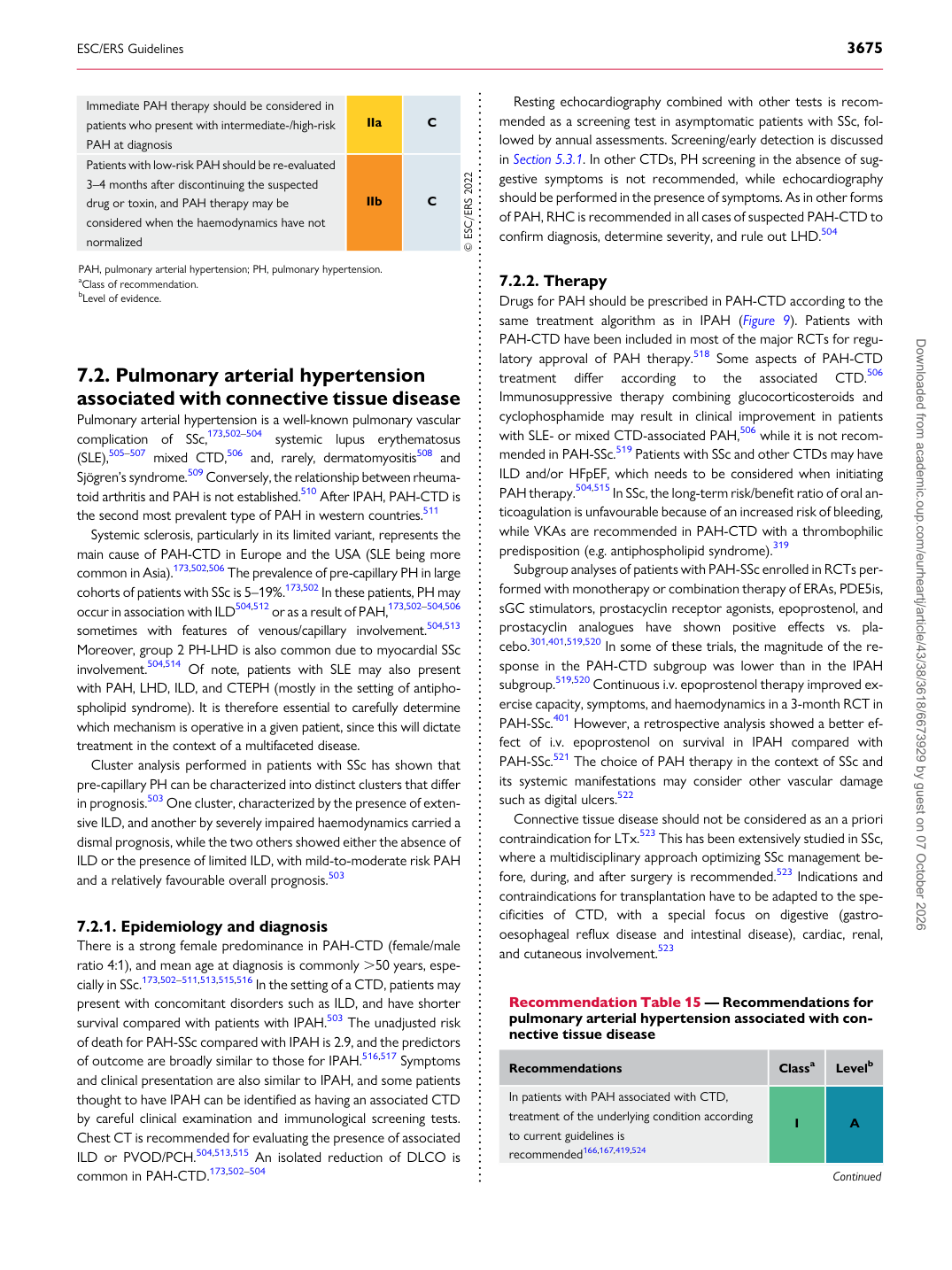
Immediate PAH therapy should be considered in patients who present with intermediate-/high-risk PAH at diagnosis IIa C Patients with low-risk PAH should be re-evaluated 3–4 months after discontinuing the suspected drug or toxin, and PAH therapy may be considered when the haemodynamics have not normalized IIb C © ESC/ERS 2022 PAH, pulmonary arterial hypertension; PH, pulmonary hypertension. aClass of recommendation. bLevel of evidence.

Recommendation Table 15 — Recommendations for pulmonary arterial hypertension associated with connective tissue disease

Recommendations Classa Levelb

In patients with PAH associated with CTD, treatment of the underlying condition according to current guidelines is recommended166,167,419,524 I A

Continued Downloaded from academic.oup.com/eurheartj/article/43/38/3618/6673929 by guest on 07 October 2026