p.57 抽出テキスト
For patients with left main coronary artery compression syndrome, percutaneous coronary stenting is an effective and safe treatment.62 For patients with asymptomatic left main coronary artery compression or non-severe compromise of its anatomy, evaluation with intravascular ultrasound or coronary pressure wire may help to avoid unnecessary interventions.494

6.3.11 End-of-life care and ethical issues

The clinical course of PAH may be characterized by progressive deterioration and occasional episodes of acute decompensation. Life expectancy is difficult to predict, as patients may either die slowly because of progressive right HF or experience sudden death. Patient-orientated care is essential in managing PAH. Information about disease severity and possible prognosis should be provided at initial diagnosis but empathic and hopeful communication, as well as yielding hope, is essential, in line with Section 6.3.1.8. At the right time, open and sensitive communication will enable advanced planning and discussion of a patient’s fears, concerns, and wishes, and will ultimately contribute to making the final, well-informed, and joint decision about treatment with the medical team. Patients approaching end of life require frequent assessment of their full needs by a multidisciplinary team. In advanced stages, recognizing that cardiopulmonary resuscitation in severe PAH has a poor outcome may enable a do not resuscitate order; this may facilitate patients being in their preferred place of care at end of life. Attention should be given to controlling distressing symptoms and prescribing appropriate drugs while withdrawing medication that is no longer needed, which may include PAH medication. Well-informed psychological, social, and spiritual support is also vital. Specialist palliative care should be consulted for patients whose needs are beyond the expertise of the PH team.346

6.3.12 New drugs in advanced clinical development

(phase 3 studies) Pulmonary arterial hypertension remains an incurable condition with a high mortality rate, despite use of PAH drugs mainly targeting imbalance of vasoactive factors. Novel agents, which are currently in phase 3 development, are ralinepag and sotatercept. Ralinepag is an orally available prostacyclin receptor agonist, which, in a phase 2 RCT that included 61 patients with PAH, improved PVR compared with placebo after 22 weeks of therapy.495 Sotatercept—a fusion protein comprising the extracellular domain of the human activin receptor type IIA linked to the Fc domain of human immunoglobulin G1—acts as a ligand trap for members of the transforming growth factor (TGF)-β superfamily, thus restoring balance between growthpromoting and growth-inhibiting pathways.496 In a phase 2 RCT that included 106 patients with PAH treated over 24 weeks, s.c. sotatercept reduced PVR in patients receiving background PAH therapy;496 improvements were also observed in 6MWD and NT-proBNP.496

7 Specific pulmonary arterial

hypertension subsets

7.1 Pulmonary arterial hypertension

associated with drugs and toxins Several drugs and toxins are associated with developing PAH or PVOD/PCH. Historically, certain appetite suppressants and toxic rapeseed oil were the most prominent examples, whereas methamphetamines, interferons, and some tyrosine kinase inhibitors are more common causes nowadays (Table 7). Pulmonary arterial hypertension is a rare complication in patients exposed to these drugs, and many of these drugs have also been linked to other pulmonary complications such as parenchymal lung disease or pleural effusions. These pulmonary complications may occur concurrently.

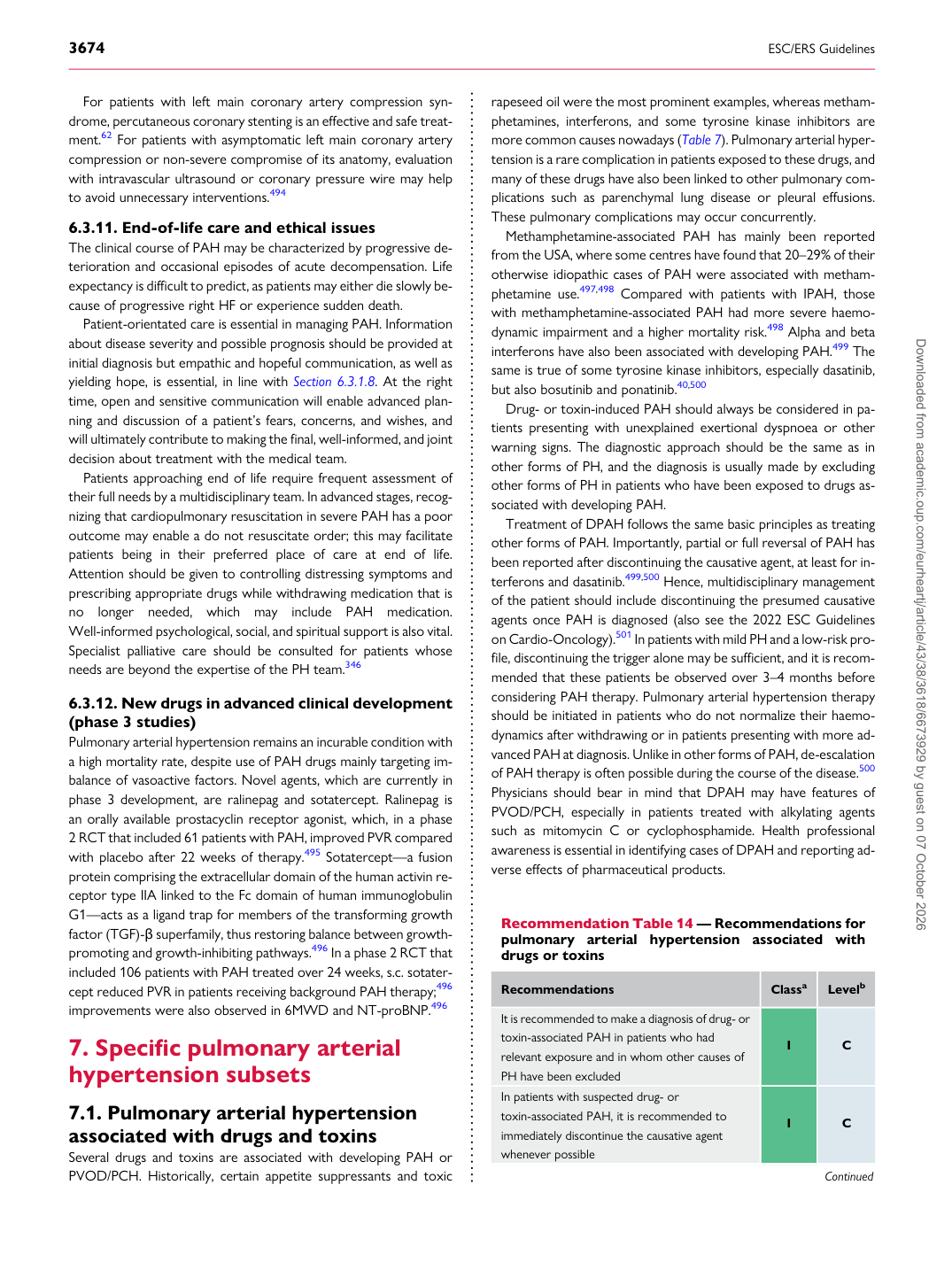
Methamphetamine-associated PAH has mainly been reported from the USA, where some centres have found that 20–29% of their otherwise idiopathic cases of PAH were associated with methamphetamine use.497,498 Compared with patients with IPAH, those with methamphetamine-associated PAH had more severe haemodynamic impairment and a higher mortality risk.498 Alpha and beta interferons have also been associated with developing PAH.499 The same is true of some tyrosine kinase inhibitors, especially dasatinib, but also bosutinib and ponatinib.40,500 Drug- or toxin-induced PAH should always be considered in patients presenting with unexplained exertional dyspnoea or other warning signs. The diagnostic approach should be the same as in other forms of PH, and the diagnosis is usually made by excluding other forms of PH in patients who have been exposed to drugs associated with developing PAH. Treatment of DPAH follows the same basic principles as treating other forms of PAH. Importantly, partial or full reversal of PAH has been reported after discontinuing the causative agent, at least for interferons and dasatinib.499,500 Hence, multidisciplinary management of the patient should include discontinuing the presumed causative agents once PAH is diagnosed (also see the 2022 ESC Guidelines on Cardio-Oncology).501 In patients with mild PH and a low-risk profile, discontinuing the trigger alone may be sufficient, and it is recommended that these patients be observed over 3–4 months before considering PAH therapy. Pulmonary arterial hypertension therapy should be initiated in patients who do not normalize their haemodynamics after withdrawing or in patients presenting with more advanced PAH at diagnosis. Unlike in other forms of PAH, de-escalation of PAH therapy is often possible during the course of the disease.500 Physicians should bear in mind that DPAH may have features of PVOD/PCH, especially in patients treated with alkylating agents such as mitomycin C or cyclophosphamide. Health professional awareness is essential in identifying cases of DPAH and reporting adverse effects of pharmaceutical products.

Recommendation Table 14 — Recommendations for pulmonary arterial hypertension associated with drugs or toxins

Recommendations Classa Levelb

It is recommended to make a diagnosis of drug- or toxin-associated PAH in patients who had relevant exposure and in whom other causes of PH have been excluded I C In patients with suspected drug- or toxin-associated PAH, it is recommended to immediately discontinue the causative agent whenever possible I C

Continued Downloaded from academic.oup.com/eurheartj/article/43/38/3618/6673929 by guest on 07 October 2026